

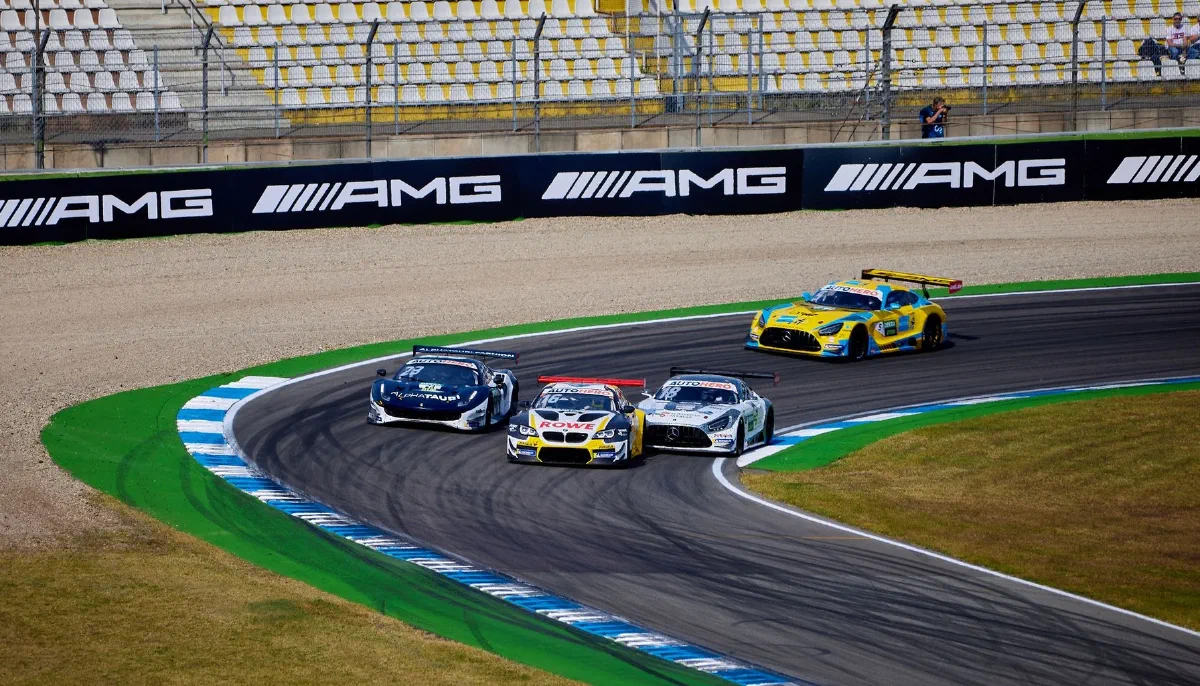
The IMSA SportsCar Championship is one of the most important endurance championships in the world. Its hallmark is the multi-class race: prototypes and GT cars share the same track at the same time. As a result, cars not only fight each other within their own class but must constantly deal with traffic from faster or slower cars.
That places high demands on drivers, engineers and strategists. Lapping, tire management, fuel strategy and the timing of pit stops are often just as decisive as pure car performance.
The championship consists of four main classes:
- GTP
- LMP2
- GTD Pro
- GTD
Although all cars run at the same time, they differ fundamentally in construction, technology and driver line-up.
GTP – the premier class
GTP (Grand Touring Prototype) forms the top category of IMSA. The cars are pure race prototypes and represent the most modern vehicle technology in the championship.
Since 2023 the class has been based on the international LMDh regulations (Le Mans Daytona h). These allow manufacturers to compete with the same car both in IMSA and at the 24 Hours of Le Mans and the FIA World Endurance Championship (WEC).
Car concept
GTP cars feature:
- a closed carbon monocoque
- highly developed aerodynamics
- rear-wheel drive
- a common hybrid system
- a manufacturer-specific combustion engine
While the hybrid system is standardized, the manufacturers develop the engine, bodywork, cooling and car setup themselves. That keeps a technical competition alive without letting costs rise without limit.
Hybrid drivetrain
All GTP cars use:
- a standardized electric motor
- a standardized battery
- a standardized gearbox casing
The electric motor supports the combustion engine under acceleration and recovers energy under braking. Total output is limited by the regulations and the Balance of Performance to about 680 hp (500 kW).
Manufacturers
Currently the competing manufacturers include:
Each manufacturer pursues its own engine concept — from the naturally aspirated V8 to the turbocharged V6.
LMP2 – the prototypes for customer teams
LMP2 forms the second-highest prototype class.
Unlike GTP, the focus here is not manufacturer competition but a cost-efficient, largely standardized set of regulations.
Today practically the entire field runs the Oreca 07.
Common technology
All cars have:
- an identical carbon chassis
- a Gibson 4.2-liter naturally aspirated V8
- around 600 hp
- a sequential gearbox
- no hybrid system
Because engine and chassis are nearly identical, what mainly decides win or loss is:
- car setup
- tire management
- strategy
- driver performance
- data analysis
For that reason LMP2 is regarded as an excellent development platform for young drivers and race engineers.
GTD Pro – professional GT3 racing
GTD Pro is based on the globally established GT3 regulations.
Unlike the prototypes, GT3 cars are derived from production sports cars. The basic concept of the road car is retained but rigorously adapted for racing.
Typical modifications
Compared to the production car, GT3 race cars receive, among other things:
- a full roll cage
- racing suspension
- a motorsport braking system
- a sequential racing gearbox
- extensive aerodynamics
- motorsport electronics
- a rapid refueling system
- center-lock wheels
Although many body elements resemble the production model, technically these are highly developed race cars.
Drivers
GTD Pro is the class of the professional teams.
Typically the line-ups consist exclusively of:
- factory drivers
- professional racing drivers
- top international drivers
This produces the highest sporting level within the GT classes.
GTD – GT3 for Pro-Am teams
Technically, GTD cars differ hardly at all from GTD Pro.
Here too the same GT3 cars are used.
The difference lies solely in the driver make-up.
Pro-Am concept
Every car must field at least one amateur driver.
Drivers are classified by the FIA:
- Platinum
- Gold
- Silver
- Bronze
While GTD Pro consists mostly of Platinum and Gold drivers, in GTD amateur drivers compete alongside professionals.
This lets customer teams fight for class wins without having to race against pure factory squads.
Balance of Performance
Because the cars are based on completely different concepts, IMSA regulates their performance through what is called the Balance of Performance (BoP).
Depending on the car, the following can be adjusted:
- minimum weight
- engine power
- turbo boost pressure
- air restrictors
- ride height
- energy use of the hybrid system
The aim is not to make all cars identically fast, but to let different technical concepts compete within a comparable performance window.
This allows front-, mid- and rear-engined cars, as well as different displacements or forced-induction concepts, to race each other.
The multi-class race
The real hallmark of IMSA is not a single car class, but the simultaneous racing of all classes.
While GTP prototypes can reach speeds of over 320 km/h, GT3 cars are significantly slower, especially in fast corners.
This creates constant lapping.
For both sides the rule is:
- The faster driver bears the responsibility for a safe overtake.
- The slower car should stay predictable and hold its line as consistently as possible.
- Time lost in traffic can be decisive over a race distance of several hours.
Especially on street courses or tight circuits such as Lime Rock Park, Long Beach or Mosport, managing traffic is one of the most important factors for success.
Comparison of the IMSA classes
| Class | Car type | Power* | Hybrid | Driver line-up |
|---|---|---|---|---|
| GTP | Race prototype | approx. 680 hp | Yes | Professionals |
| LMP2 | Race prototype | approx. 600 hp | No | Professionals and young drivers |
| GTD Pro | GT3 | approx. 500–600 hp | No | Professionals |
| GTD | GT3 | approx. 500–600 hp | No | Pro-Am |
*Actual power varies depending on the Balance of Performance.