

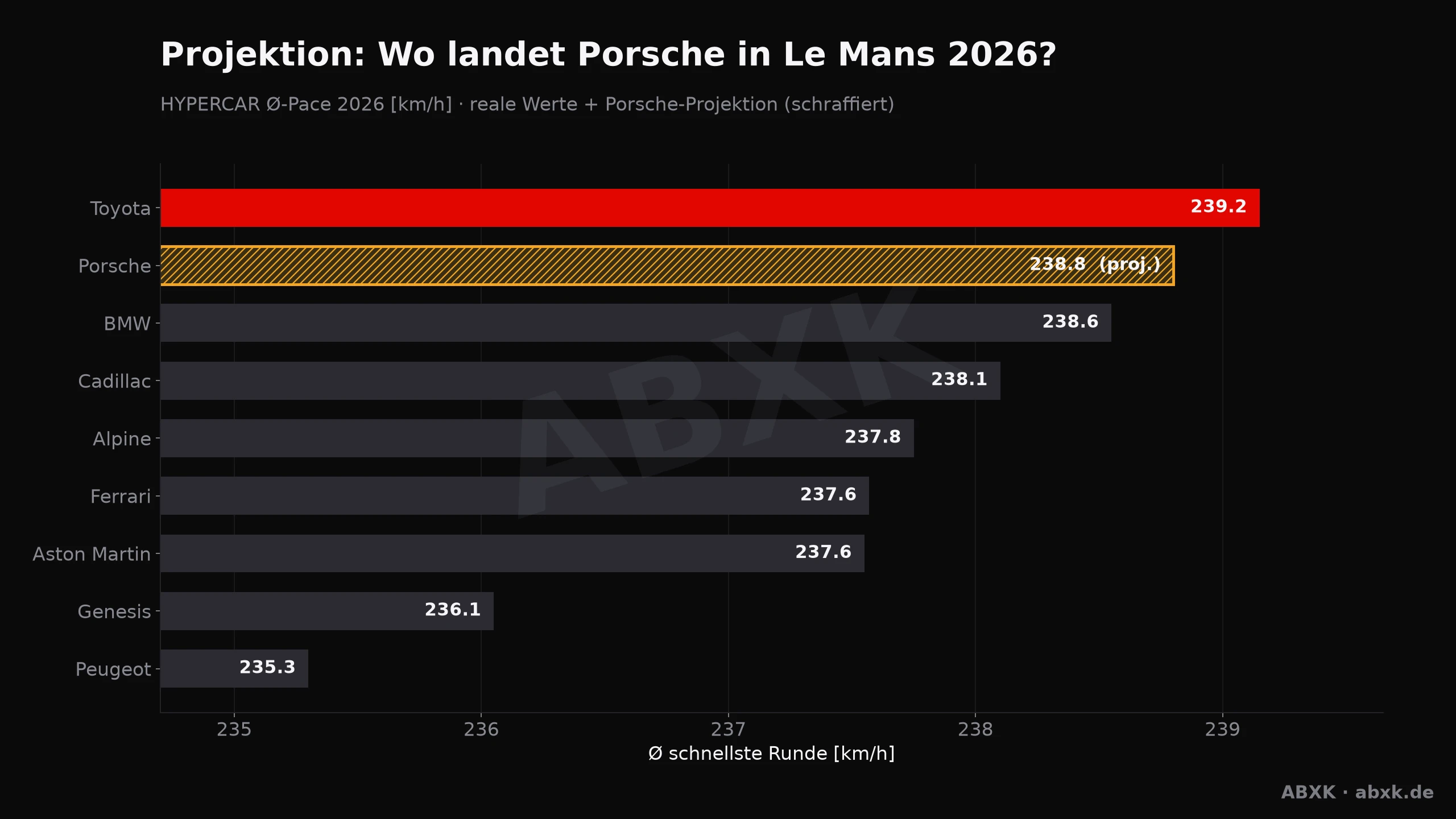
Let’s be clear up front, so there’s no misunderstanding: Toyota won the 2026 24 Hours of Le Mans with the best pace and the cleanest race execution. Toyota’s new 2026 hypercar (listed in the data as the TR010) was the fastest car in the field at 239.2 km/h average best-lap pace, and at the same time the operationally cleanest at the front of the fight — finishing 10.9 seconds ahead of the BMW #20.
Even so, one name was missing from the HYPERCAR class in 2026: Porsche. The 963 ran the entire season exclusively in IMSA. From a technical standpoint, the intriguing question is therefore a counterfactual one: what does the data say — could a further-developed 963 have fought for the win at Le Mans? This is explicitly a data-driven scenario, not a verdict on the real result.
The Data Picture: Two Development Trajectories
Absolute pace can’t be compared between Daytona (~214 km/h) and Le Mans (~237 km/h) — different circuit, different aerodynamics. Only relative strength is meaningful: how far behind the fastest car in its class did Porsche fall each time? That’s exactly what makes IMSA and WEC comparable — and purely with reference to Porsche.
One methodological caveat that can’t be swept under the rug: the “pace” used here is the average of the fastest race laps of a manufacturer’s classified cars — a crude proxy figure. A race engineer would work more cleanly with stint medians, fuel-corrected pace, tire degradation over double stints, traffic sensitivity, pit loss, and FCY/safety-car exposure. A strong best-lap pace can overvalue a car that was fast under ideal conditions but less stable in traffic or with a full tank. The following projection is therefore a pace indicator, not a stint model — and should be read accordingly, with caution.
| Year | IMSA / Daytona — Gap to Best | WEC / Le Mans — Gap to Best | Relatively stronger where? |
|---|---|---|---|
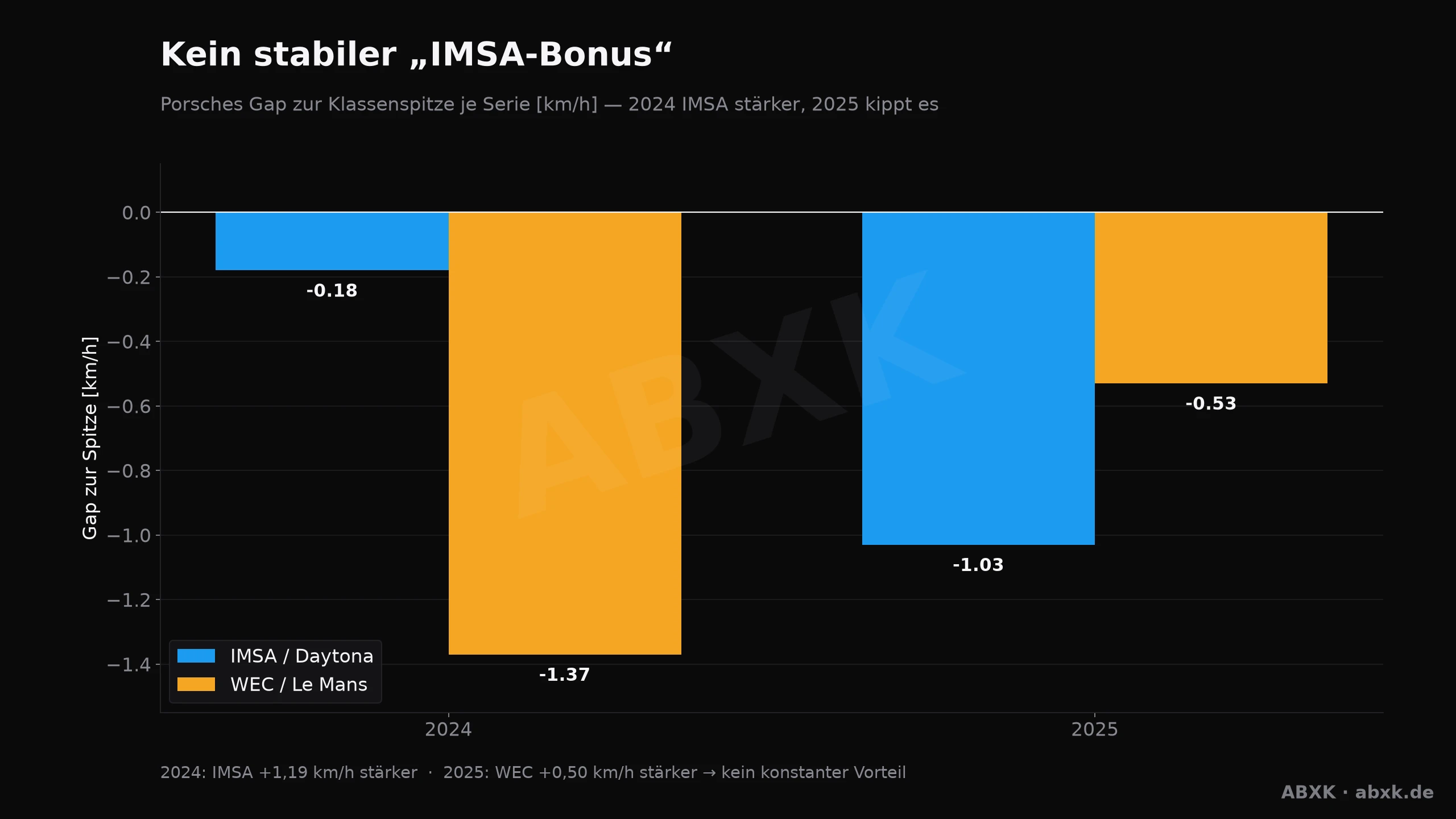
| 2024 | −0.18 km/h (P2, win) | −1.37 km/h (P4, P4) | IMSA (+1.19) |
| 2025 | −1.03 km/h (P3, win) | −0.53 km/h (P3, P2) | WEC (+0.50) |
| 2026 | ±0.00 km/h (P1, win) | did not enter | — |
Is Porsche “Much Stronger” in IMSA? No — It Flips
This is the crux of the question. If Porsche were systematically stronger at Daytona than at Le Mans, then its outstanding Daytona 2026 showing (top pace for the first time, gap ±0) would have to be discounted heavily when carried over to Le Mans. But the data doesn’t support that:
- 2024 saw Porsche relatively clearly stronger in IMSA (−0.18 versus −1.37 — a full 1.19 km/h difference). If you’d derived a rule here, it would read “IMSA bonus.”
- 2025 reverses it: at the Sarthe, Porsche was relatively stronger (−0.53) than at Daytona (−1.03). The Daytona advantage vanished, and the WEC program pulled ahead.
So there is no stable IMSA bonus. The average series offset across the two years sits at around −0.35 km/h to Le Mans’s disadvantage — but be careful: two data points are not a reliable calibration. The jump from 2024 → 2025 could stem from genuine development, just as easily as from BoP, the level of the competition, the setup window, weather, or how the race unfolded. The data refutes a blanket IMSA bonus, but isn’t enough to derive a precise series transfer. The −0.35 value is therefore a heuristic plausibility check, not a model-solid factor. Still, there is a discernible trend: Porsche’s WEC gap improved from −1.37 to −0.53 (+0.84/year), while the IMSA gap fluctuated — it was the Le Mans line that pointed upward, not the Daytona line.
Deriving the Case for Le Mans 2026
From Porsche’s own data trail alone — not from the competition — two converging paths emerge:
| Method | Calculation | Projected gap to LM leader | Pace |
|---|---|---|---|
| Series transfer (Daytona 2026 + offset) | ±0.00 − 0.35 | ≈ −0.35 km/h | ~238.8 km/h |
| WEC internal trend (−1.37 → −0.53 → …) | Extrapolation with flattening | ≈ −0.0 to −0.3 km/h | ~238.9–239.2 km/h |
A word on the second method: a purely linear extrapolation (+0.84/year) would even put Porsche slightly ahead of the old benchmark — which is unrealistic, because catch-up rates flatten out and the benchmark itself was raised in 2026. Set conservatively, it too lands near zero deficit.
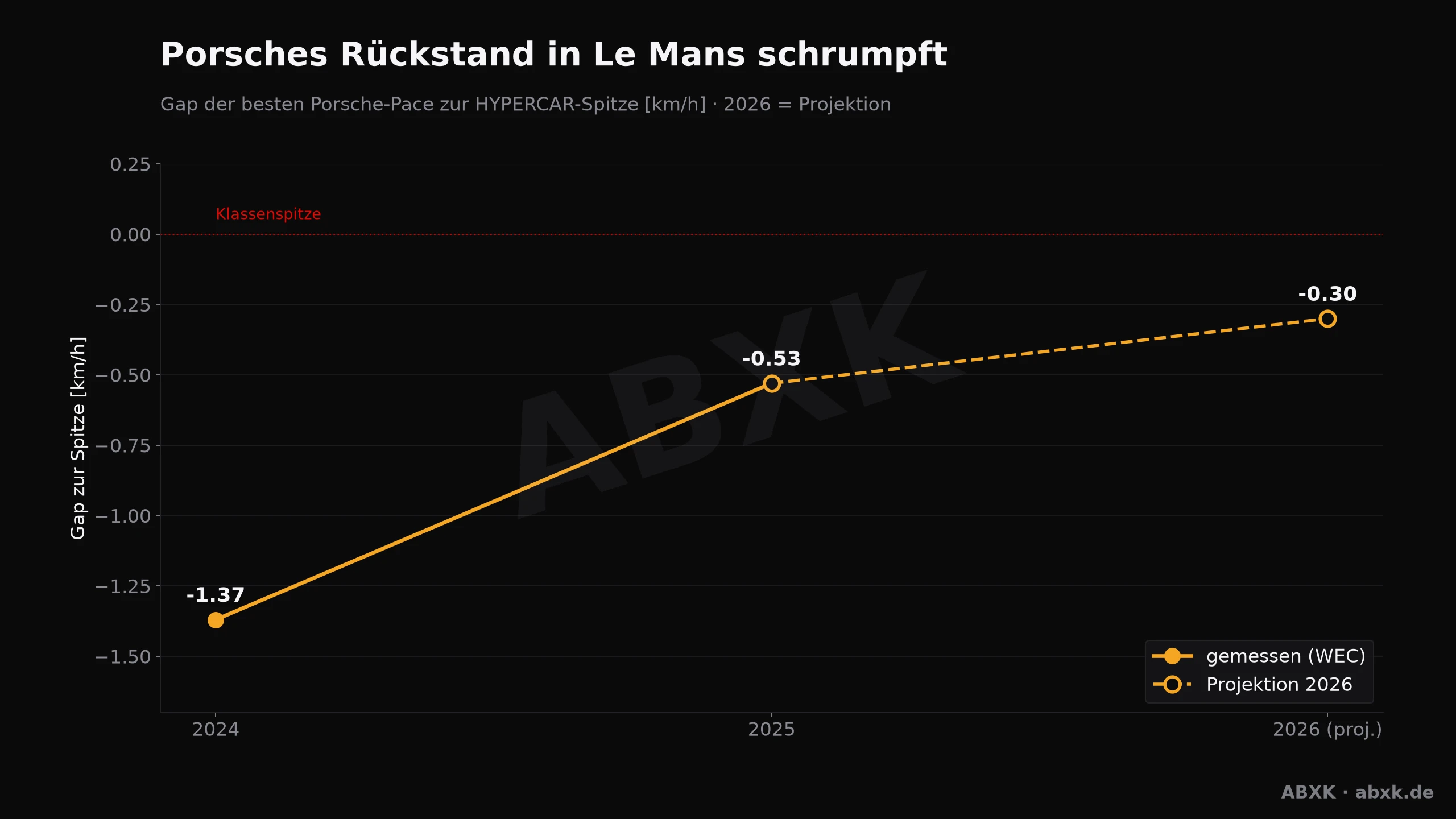
Both paths land at around 238.8 to 239.0 km/h — that is, roughly 0.2 to 0.4 km/h behind the real LM 2026 benchmark (Toyota, 239.2). Translated into the field: P2–P3, above BMW/Cadillac level, but behind the fastest Toyota. Crucially: even if you fully credit Porsche’s strong Daytona 2026 figure, the cross-series calibration does not lift it above Toyota — precisely because Porsche is not reliably “IMSA-strong.” A serious win contender, yes; a nailed-on winner, no.
The Other Side: Four Data Signals That Argue for a Porsche Win
Pace is only the entry ticket. If you go looking specifically for evidence that supports a Porsche win, the data delivers four pieces — some stronger than the pace argument alone would suggest.
1. The head-to-head recently favored Porsche. At the last shared Le Mans in 2025, the finish read Porsche #6 in P2 (387 laps) — the best Toyota (#7) only in P5, one lap down. Where both entered and it counted, Porsche was in front last time out. That’s not a model, that’s a result.
2. Operational depth over a single car. In 2025, Porsche put four cars in the top 13 (P2, P6, P8, P13), all classified, within an extremely tight pace band of 236.4 to 237.1 km/h. The fastest individual Porsche (#5, 237.1 km/h) was actually quicker than the best Toyota. Four competitive cars mean not just mechanical reliability but setup breadth, driver depth, a fallback strategy, and error robustness — a team set up this way substantially raises its statistical win probability over 24 hours. Le Mans rewards exactly this kind of redundancy.
3. Daytona delivers a strong indicator: win conversion under 24h pressure. Porsche won the Rolex 24 three times in a row, each time in a photo finish (margins 1.3–2.1 s) and with several cars in the top 6. That demonstrates precisely the capability a 24-hour win demands: stint consistency, error-free pit work, nerve in the closing sprint. Porsche has proven it more often of late than any other manufacturer. Caveat: Daytona conversion transfers to Le Mans only to a limited degree — different caution dynamics, different tire and brake loads, a higher share of night running, and different strategic resets from yellow-flag phases. It proves team quality, not automatically Le Mans-winning capability.
4. Toyota’s conversion weakness — at least in 2024. The clearest example comes from 2024: Toyota had the fastest pace (rank 1) and still finished only P2, beaten by Ferrari. Here speed and result didn’t line up — exactly the gap a conversion-strong Porsche could have exploited. In fairness, though, this signal rests on a single data point: in 2025 Toyota simply wasn’t fast enough (only the fourth-quickest manufacturer → logically P5), and in 2026 top pace and the win coincided anyway. The “fast but no win” pattern is real, but thin.
Taken together, this shifts the assessment: Porsche wasn’t merely “podium plus an outsider’s chance.” Three strong indicators (the head-to-head, reliability depth, Daytona win conversion) — flanked by a weaker fourth — move it close to level terms, toward an open outcome rather than a clear-cut Toyota affair.
The Counterargument: Toyota Didn’t Stand Still — a New Car for 2026
As clean as the Porsche picture looks, it has one decisive weak spot: it compares Porsche’s development line against a Toyota that no longer existed in 2026. The data shows a clear break in the car:
| Year | Toyota Model | Pace | Jump | Best Result |
|---|---|---|---|---|
| 2024 | GR010 Hybrid | 234.7 km/h | — | P2 |
| 2025 | GR010 Hybrid | 236.5 km/h | +1.8 km/h | P5 |
| 2026 | TR010 Hybrid | 239.2 km/h | +2.7 km/h | P1 |
Three points partly undercut the Porsche indicators:
1. The 2026 jump is a generational change, not fine-tuning. With the new TR010, Toyota gained +2.7 km/h — the largest year-on-year jump in the dataset, clearly above the previous year’s +1.8. That’s the signature of a new car, not a further-developed platform.
2. The “conversion weakness” was thin to begin with — and belongs to the old car. The only clean example (2024: fastest pace, only P2) concerns the GR010; in 2025 Toyota wasn’t slow in execution, it simply wasn’t fast enough (rank 4 → P5). The new TR010 converted its pace straight into a win at its very first outing in 2026. Pro-Porsche signal No. 4 thus rests on a single data point from a car that no longer exists.
3. The won head-to-head of 2025 loses its weight. Porsche #6 beat Toyota #7 in 2025 — but that was the GR010. The TR010 was a full 2.7 km/h faster in 2026 and won. Beating the old Toyota says little about whether you’d have beaten the new one.
And one methodological point carries serious weight: our Porsche projection extrapolates the development of the existing 963. Toyota, by contrast, brought fresh hardware. New cars tend to deliver bigger steps than the further development of an established concept — so the projection likely underestimates Toyota’s separation in 2026.
The Biggest Unknown: BoP
One factor weighs more than any pace projection and therefore doesn’t belong in a footnote but at the core: the Balance of Performance. In Hypercar/LMDh, the question “would Porsche have beaten Toyota?” can hardly be answered seriously without BoP.
A 963 returning in 2026 would not have stood at Le Mans in its IMSA specification. It would have received its own WEC/Le Mans classification — minimum mass, maximum power, power-gain curve, stint energy, plus possible platform adjustments. It’s precisely these parameters that quickly shift several tenths per lap and entire stint lengths at Le Mans. A favorable classification could erase our −0.3 km/h projection; an unfavorable one could double it.
In other words: BoP here is not a marginal uncertainty but the central limit of the model. Every pace derivation — ours included — is subject to a classification that can’t be forecast, because it’s designed to neutralize precisely what we’re trying to measure.
The Honest Conclusion
Weighing both sides, the picture is more nuanced than the pure pace projection first suggests. In Toyota’s favor is the actual result: fastest car, an error-free 24 hours, a 10.9 s margin — and a clean-sheet design (TR010) with the largest year-on-year jump in the dataset, which converted its pace straight into a win at its first outing. In Porsche’s favor are three strong indicators — the won head-to-head in 2025, the reliability depth with four consistent cars, and the win conversion proven three times over at Daytona — flanked by a weaker fourth (Toyota’s pace-conversion gap from 2024).
Even so — and this is decisive — the data can prove no Porsche win. The quantitative projection itself sees Porsche only at P2–P3; the new Toyota went untested; the series transfer is heuristic; and the BoP classification of a returnee is simply not forecastable. On top of that comes a sobering order of magnitude: a pace difference of a few tenths of a km/h is almost too small, over 24 hours, to quantify a win probability from at all — at race level, traffic, safety-car timing, tire degradation, and pit strategy dominate margins like these. That’s exactly why “P2–P3 with a shot at the win” is the more defensible statement than “Porsche would have won.” “Coin flip” would be too optimistic. More realistic is a probability ladder:
| Scenario | Assessment |
|---|---|
| Porsche fights for the podium | high |
| Porsche realistically fights for the win | medium to elevated |
| Porsche would be the favorite against Toyota | probably not |
| Porsche would surely have won | no |
| Toyota remains the slight favorite | yes |
So not “Toyota clearly superior,” but not 50:50 either. Rather: Toyota the slight favorite, Porsche the most dangerous hypothetical challenger.
The sober final verdict: No — the data does not show that Porsche would have won Le Mans 2026. It plausibly shows that a further-developed 963 would not have been a bit-part player but the strongest additional win candidate — a win candidate with an open starting position, not the favorite. Against the new, actually victorious TR010, that’s enough for “serious chance,” not for “likely winner.”
And finally, to be perfectly clear: this is a data-driven AI analysis — a thought experiment with numbers, not an oracle and not an after-the-fact relativizing of the result. What truly counts was decided on track. In the end, Toyota won. Congratulations! 🏆
Data basis: Le Mans 2024–2025 and Daytona 2024–2026, Porsche 963 pace per race, reproducibly derived. Projection = cross-series calibration (relative gap to the class leader) plus extrapolation of the WEC in-house development — explicitly labeled as a data-driven scenario.