

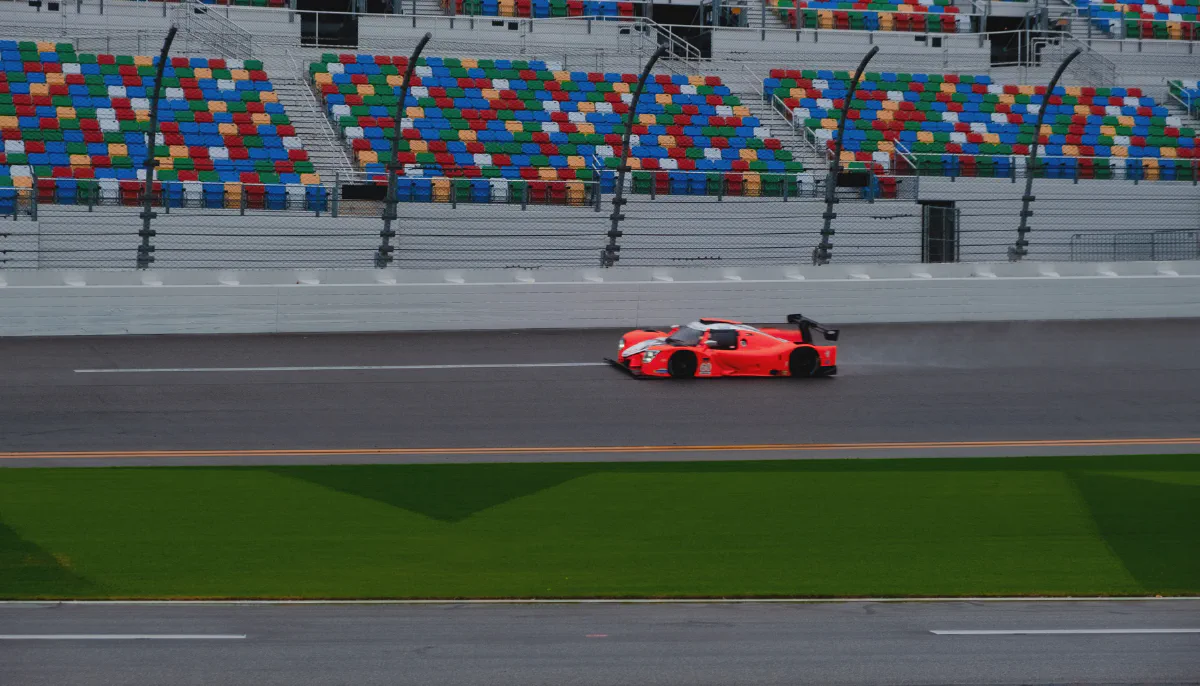
A Full Course Yellow (FCY) is one of the defining elements of an IMSA endurance race. Almost no other intervention by race control changes the course of a race so dramatically. While the neutralization primarily serves safety, it also shapes strategies, pit stops and often even the outcome of a race.
In endurance classics such as the Rolex 24 at Daytona or Petit Le Mans, Full Course Yellow periods regularly determine which teams end up fighting for the win.
What is a Full Course Yellow?
During a Full Course Yellow the entire race is neutralized. Yellow applies across the whole circuit, overtaking is prohibited and the safety car gathers up the field.
Unlike local yellows that affect only one section of the track, an FCY reduces the pace of every car. This allows marshals, recovery vehicles and rescue crews to work safely.
Triggers include, among others:
- accidents
- stranded cars
- debris on the track
- oil or coolant spills
- repairs to barriers or track boundaries
- medical interventions
Race control decides, based on the level of danger, whether a local yellow is sufficient or a full neutralization is necessary.
How a Full Course Yellow works
Once race control calls an FCY, a clearly defined procedure begins.
First, yellow flags are waved around the entire circuit. Every driver must reduce speed and may no longer overtake.
The safety car then takes to the track and picks up the leading car. The whole field closes up until all cars are running nose to tail.
Meanwhile, race control assesses the situation at the accident scene. Recovery vehicles can remove damaged race cars, marshals clear debris and repair crews fix damaged barriers where necessary.
Depending on the race situation, race control then opens the pit lane. Teams can now refuel, change tires or carry out a driver change.
Only once the track is completely safe again is the race restarted behind the safety car and finally released with the green flag.
Why does IMSA use Full Course Yellow?
The most important reason is safety.
Modern GTP prototypes reach speeds of over 300 km/h on many circuits. Even GT cars travel well above 250 km/h on long straights. Working at an accident scene would often be too dangerous under racing conditions, even with local yellows.
A neutralization therefore creates a controlled working zone in which:
- cars can be recovered,
- track damage is repaired,
- fluids are cleared away,
- medical care can be provided.
This is essential above all on long natural-terrain circuits with limited run-off areas.
The strategic significance
For strategists, the real work often begins during a Full Course Yellow.
Because the entire field is running much slower, a car loses considerably less time during a pit stop than under green. A stop that would cost several positions at racing speed can be made under yellow with almost no loss of track position.
Teams therefore have to decide within a few seconds:
- Do we stay out or come into the pits?
- Will fuel and tires last until the next planned stop?
- Are we expecting further caution periods?
- How will our direct rivals react?
Throughout, engineers constantly monitor the telemetry as well as the strategies of every competitor.
Advantages of a Full Course Yellow
Maximum safety
The biggest advantage is the protection of everyone involved.
Marshals, rescue services and recovery vehicles can work under far safer conditions. At the same time, the risk of further accidents drops considerably.
Smaller pit stop losses
A pit stop costs significantly less time under yellow.
This lets teams make tactical decisions that would not be possible under racing conditions.
More excitement
Because the field is bunched up behind the safety car, large time gaps sometimes disappear entirely.
A driver who was 40 seconds behind can find himself right on the leader’s tail again after a neutralization. For spectators, this often produces intense closing stages.
New strategic options
An FCY opens up a range of options:
- an alternative pit stop window
- changing tire strategy
- saving fuel
- carrying out minor repairs
- timing a driver change perfectly
Experienced strategists in particular can gain substantial advantages from this.
Disadvantages of a Full Course Yellow
Hard-earned leads are wiped out
The biggest criticism concerns sporting fairness.
A team can build a comfortable lead over several hours. As soon as the field is gathered up behind the safety car, that lead has practically vanished.
This partly devalues exceptional race pace.
The luck factor increases
The timing of a caution period often decides win or defeat.
For example, one team may have refueled just before a neutralization, while a rival can make a far more favorable pit stop under yellow a few seconds later.
This element of chance cannot be fully controlled even with perfect strategy.
Long-term strategies are upended
Many teams plan their race strategy before the start based on:
- fuel consumption
- tire wear
- stint lengths
- weather development
An unexpected Full Course Yellow can completely overturn that plan within a few minutes.
Disruption to the racing rhythm
During longer neutralizations there is no genuine competition.
Spectators who prefer continuous racing action in particular often find longer caution periods frustrating.
Special considerations in multiclass racing
IMSA runs its races with several vehicle classes on track at the same time.
Prototypes and GT cars differ considerably in speed, braking performance and cornering speed. During a Full Course Yellow this creates additional challenges.
After the neutralization, cars of different classes are frequently packed close together again. At the restart, drivers have to work their way back through dense multiclass traffic within just a few corners.
For the engineers, this means they have to monitor not only their own competition but also the position of cars in other classes.
Why Full Course Yellow defines IMSA
Almost no other racing series is influenced strategically by caution periods as much as IMSA.
Teams already calculate various scenarios before the start of the race:
- a race with no caution periods
- an early neutralization
- several short FCYs
- long recovery phases
- a yellow shortly before the finish
That is why flexibility is one of the most important qualities of successful endurance teams. The fastest cars do not win automatically — often it is the best combination of speed, strategy and handling a Full Course Yellow correctly that decides the result.