AI

AI Text Detector

Our AI text detection tool helps you find out whether content was written by a human or generated by AI. It uses advanced language analysis, machine learning, and semantic modeling to give accurate results. The best part? It's completely free to use—no sign-up needed!

Analyze Your Text

Paste your text below and click "Analyze Text" to check if it was generated by AI.

Key Points:
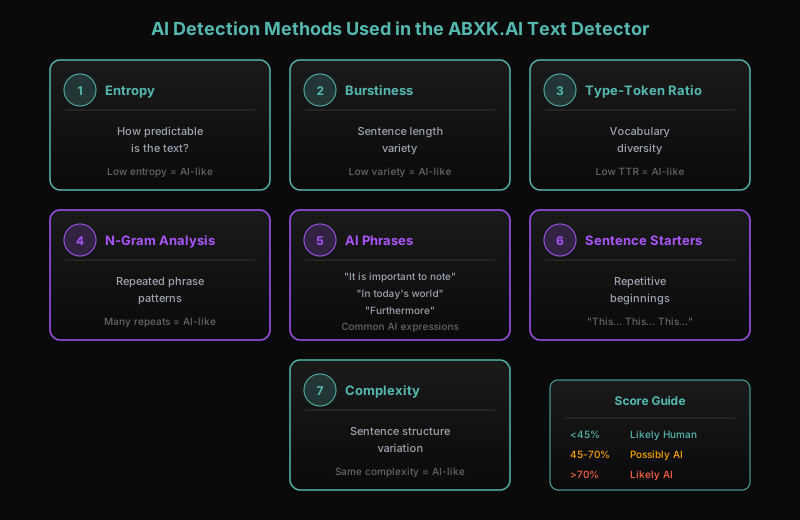
  • Perplexity & Burstiness:AI-written text often has low perplexity and a steady rhythm, making it more predictable than human writing, which tends to vary in structure and tone.
  • Stylometric Analysis:Patterns like sentence length, word choice, and punctuation use help reveal whether a piece was written by a person or generated by AI.
  • Structure & Coherence:AI-generated content can sound smooth but may lack the natural flow or logical order found in human writing.
  • Embedding & Curvature Techniques:Tools like BERT and DetectGPT use deep language models to check for consistency in meaning and identify patterns that point to AI generation.

This tool explores different ways to spot text written by AI. These methods include using statistics, studying language patterns, and applying advanced machine learning tools. It also addresses some current challenges, including false positives—when writing by a real person gets wrongly marked as AI—and the fact that some AI models are getting better at hiding their tracks.

How It Works

Perplexity and Burstiness

Perplexityis a measure used in language models to show how predictable a piece of text is. Simply put, it tells us how "surprised" a model is by the words. If the perplexity is low, the model finds the text easy to predict. If it's high, the text is harder for the model to guess.

Burstinessrefers to how much perplexity changes from one sentence to the next. Human writing tends to mix things up — sometimes it's complex, sometimes simple. That creates a pattern with lots of ups and downs. In contrast, AI text usually sounds smoother and more even.

Stylometric Analysis

Stylometryis the study of writing style. It helps identify who wrote a text by analyzing their unique way of writing. In AI detection, stylometric analysis looks for patterns that may show if a text was written by a human or an AI.

Language and Sentence Structure

Researchers look at grammar and sentence structure to spot AI-written text. One thing they've noticed is that AI often writes in a formulaic way, reusing certain sentence structures more than human writers do.

Advanced Detection Methods

Modern detection methods use transformer embeddings from models like BERT. These models turn text into high-dimensional vectors that capture meaning and structure, helping distinguish between human and AI-generated content.

Challenges and Limitations

  • False Positives:Some human-written content is wrongly flagged as AI, especially formal or structured writing.
  • Bias Against Non-Native Writers:AI detectors can unfairly target writing by non-native speakers who may use simpler sentence structures.
  • Evading Detection:Simple changes like swapping words or adding small grammar errors can fool many detection systems.
  • Short Text Issues:Detecting AI in short texts is much harder and often less accurate.

Important Note:AI detection results should be used as a clue—not as final proof. A mix of tools, human judgment, and context is the best approach.