
 What Does This Platform Do?
 How the System Works
 v0.3 Analysis Pipeline
 AI Trading Platform Blog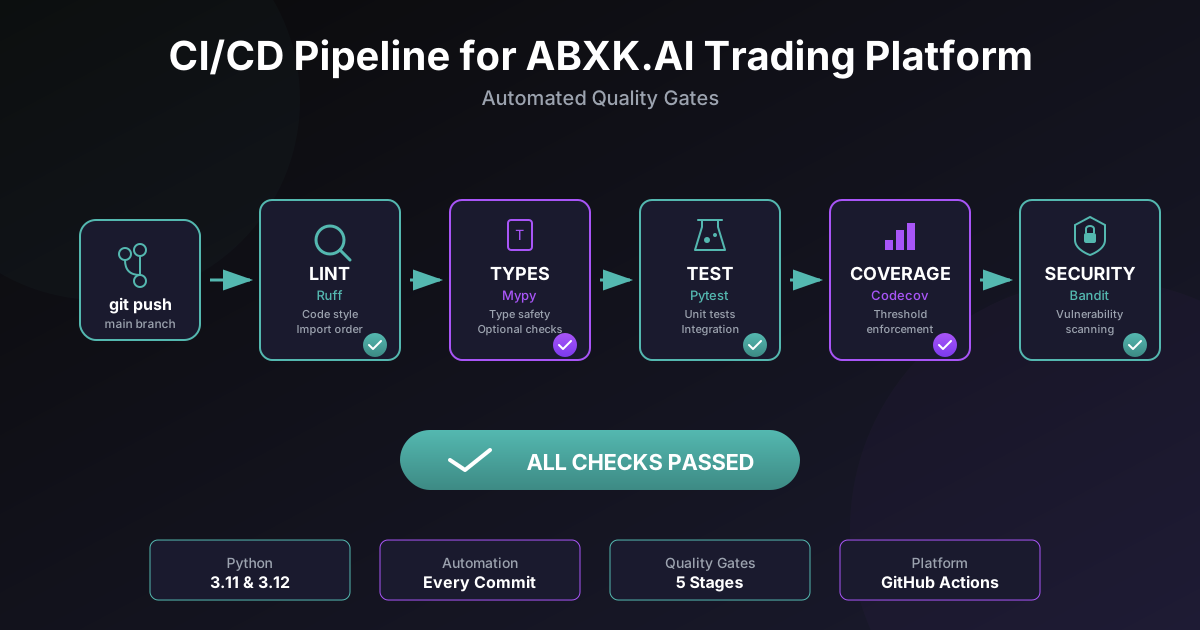
AI Trading Platform: Adding CI/CD to Our Development Workflow
We implemented a CI/CD pipeline for the AI Trading Platform. This post documents the approach, the types of bugs it catches, and why automated testing matters …

The AI Trading Platform generates actionable trade signals and validates them using causal paper trading. The focus is on exit optimization and CVR/MFE-based evaluation rather than prediction accuracy alone.
ABXK.AI is a research platform that analyzes price data and technical context to generate trade signals. Neural models provide directional bias, but exit strategy determines realized profitability. After research showed that exit timing has more impact than entry prediction, the focus shifted to two-stage exits and CVR optimization.
The platform uses a disciplined approach with four key components:
Neural networks (LSTM and Transformer) are trained offline on historical data using CVR/MFE soft labels instead of simple win/loss categories. This means the models learn from all directionally correct trades, not just perfect exits.
When analyzing a symbol, the system calculates technical indicators and feeds them to both neural networks. The outputs are combined with learned indicator weights to produce a final signal with confidence score.
Different market conditions need different exit strategies. The system classifies signals by regime characteristics:
Signal-family routing is currently under validation during the paper trading phase.
Research showed trailing stops were cutting winners short by 0.81R per winning trade. The solution splits each position into two parts:
The current architecture processes signals through this flow:
The platform calculates these indicators every time it analyzes a market:
| Indicator | What It Measures |
|---|---|
| RSI (14) | Momentum - overbought above 70, oversold below 30 |
| MACD | Trend momentum - signal line crossovers |
| SMA 20/50/200 | Short, medium, and long-term trends |
| EMA 12/26 | Exponential moving averages (react faster) |
| Bollinger Bands | Volatility - price relative to bands |
| Ichimoku Cloud | Trend, momentum, support/resistance combined |
| ADX | Trend strength - above 25 means strong trend |
| Stochastic | Momentum oscillator - %K and %D lines |
| ATR | Volatility - used for stop loss sizing |
| Volume Ratio | Current volume vs 20-day average |
Each indicator gets a learned weight based on how well it predicted winning trades in the past.
The platform can analyze these markets and symbols:
| Category | Symbols |
|---|---|
| US Stocks | AAPL, MSFT, GOOGL, AMZN, NVDA, TSLA, META |
| European | SAP, ASML, MC.PA, SHEL, NESN.SW |
| Asian | 9984.T (SoftBank), 005930.KS (Samsung), 9988.HK (Alibaba) |
| Forex | EUR/USD, GBP/USD, USD/JPY |
| Crypto | BTC/USD, ETH/USD, SOL/USD |
| Commodities | GC=F (Gold), CL=F (Oil), SI=F (Silver) |
| ETFs | SPY, QQQ, GLD, IWM |
Total: 208+ symbols across global markets.
Backtesting knows the entire price history and creates false confidence. Paper trading replaces backtesting as the primary validation mechanism:
The v0.3 exit strategy is frozen. Paper trading runs for 30-60 days to validate performance without hindsight bias. Only live evidence can justify v0.4 changes.
Current validation status:
Results based on early sample; under paper-trade validation.
Every trade includes real-world costs that you would pay when trading:
| Asset Type | Fees | Spread | Slippage | Total |
|---|---|---|---|---|
| Stocks | 0.10% | 0.05% | 0.05% | ~0.20% |
| Crypto | 0.20% | 0.10% | 0.15% | ~0.45% |
| Forex | 0.02% | 0.08% | 0.03% | ~0.13% |
These costs are taken away from every practice trade. This gives us profit estimates that are closer to real trading.
Read our development journey and latest updates:
We implemented a CI/CD pipeline for the AI Trading Platform. This post documents the approach, the types of bugs it catches, and why automated testing matters …

AI adoption in trading is accelerating. Learn why firms that act now gain an advantage, and how our AI trading platform validates this approach through real …
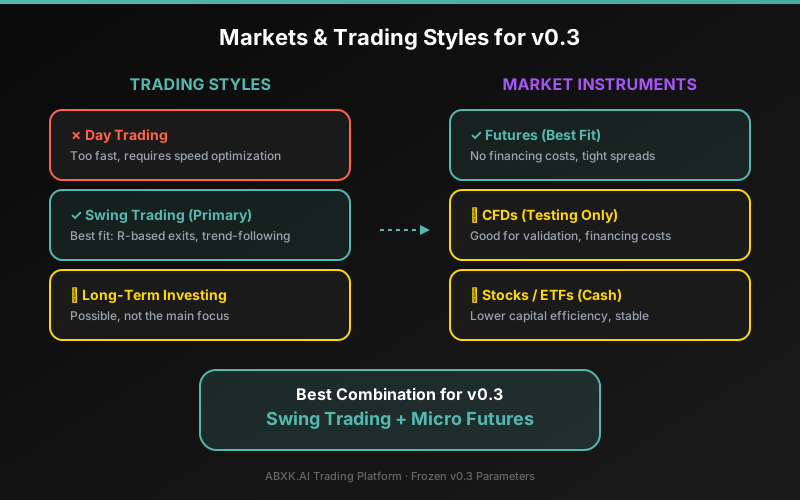
We tested our frozen v0.3 exit strategy across different markets and trading styles. Here is what we learned about CFDs, futures, stocks, and why swing trading …
The AI Trading Platform is an internal research project operated exclusively by ABXK.AI. It is not publicly accessible and cannot be used by visitors.
Any results, insights, or examples shared on this website or on social media are provided for informational and educational purposes only and do not constitute financial advice.