

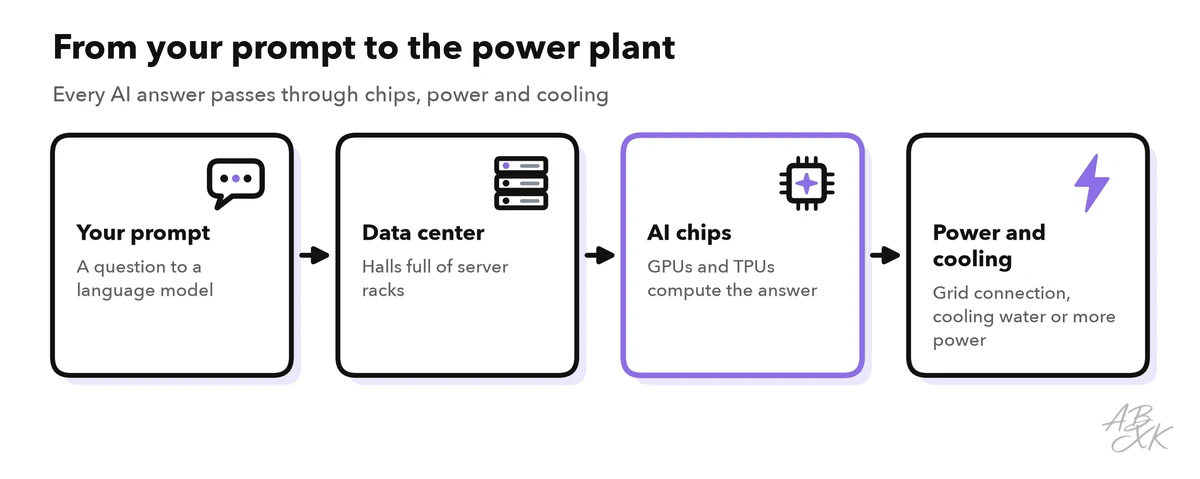
When you ask a language model a question, the answer does not come from your phone. Your question travels to a data center, where thousands of specialized chips run the model and send the answer back within seconds. Every self-driving car, every robot foundation model and every speech decoder for a brain implant was also trained in such a building. AI is software, but it rests on a very physical foundation: chips, buildings, power lines and cooling water.
This is part 5, the last part of Level 0 in our Physical AI learning path. You will learn why AI needs special chips, what is inside an AI data center, how much electricity the largest sites draw and why power, not chips, is now the main bottleneck.
Why AI needs special chips
A neural network consists of millions or billions of numbers, its weights. Running the network means multiplying huge tables of numbers with each other, again and again. An ordinary processor (CPU) works through tasks one after another with a few powerful cores. An AI chip has thousands of simpler cores that do the same calculation on many numbers at once. GPUs, originally built for computer graphics, turned out to be ideal for this. Google designs its own TPUs (tensor processing units) built only for neural networks, and Amazon, AMD, Huawei and others make competing chips.
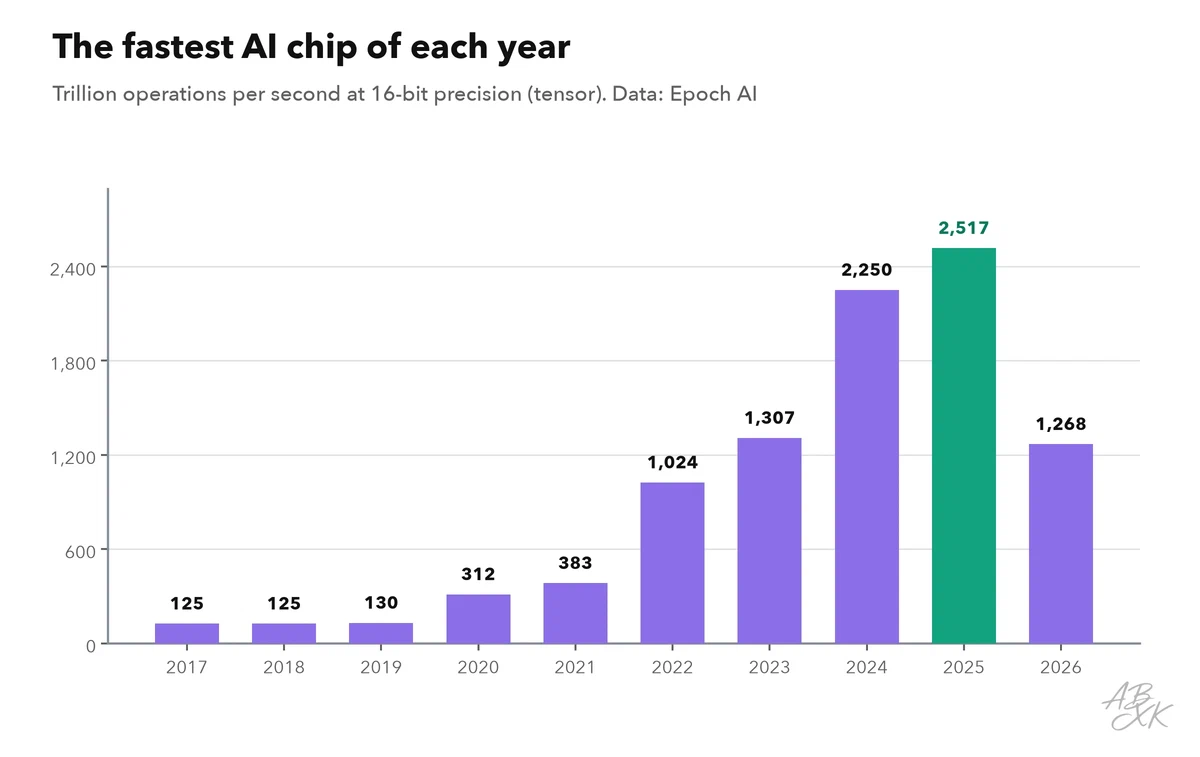
To compare chips of different makers, Epoch AI, a research institute, converts their performance into H100 equivalents: how many Nvidia H100 chips, a widely used AI chip, would deliver the same computing power. The chips also got much faster. The fastest AI chip of 2017 managed 125 trillion operations per second at the 16-bit precision used for training; the fastest today are 20.1 times as fast.
What is inside an AI data center
| Part | What it does | What limits it |
|---|---|---|
| AI chips (GPUs, TPUs) | Run training and answers | Supply, price, power per chip |
| Servers and racks | Hold the chips, connect them at high speed | Heat: the densest new racks need liquid cooling |
| Network | Links thousands of chips into one large computer | Speed between chips limits how large a training run can be |
| Power supply | Brings electricity from the grid, with backup | Grid connections take years to build |
| Cooling | Removes the heat of the chips | Water use or extra electricity |
The largest AI data centers are not single buildings but campuses of several halls. The largest site that Epoch AI tracks already draws 946 megawatts for its chips and servers alone.
| Data center | Owner | Country | IT power (MW) | H100 equivalents | Cost (US$ bn) |
|---|---|---|---|---|---|
| Colossus 2 | SpaceXAI | United States | 946 | 1,111,673 | 35.8 |
| Anthropic-Amazon New Carlisle | Amazon | United States | 910 | 685,912 | 34.5 |
| Microsoft Fairwater Atlanta | Microsoft | United States | 636 | 768,769 | 24.1 |
| DayOne Nusajaya | – | Malaysia | 473 | 583,837 | 17.9 |
| Meta Prometheus | Meta | United States | 471 | 536,343 | 17.8 |
| DayOne Kempas | – | Malaysia | 422 | 480,639 | 16.0 |
| OpenAI Stargate Abilene | Oracle | United States | 421 | 509,348 | 15.9 |
| Microsoft Fairwater Wisconsin | Microsoft | United States | 369 | 445,680 | 14.0 |
| Google Pryor (North) | United States | 368 | 636,685 | 13.9 | |
| Colossus 1 | SpaceXAI | United States | 340 | 275,796 | 12.9 |
| Google New Albany | United States | 333 | 323,901 | 12.6 | |
| Google Columbus | United States | 303 | 331,986 | 11.5 |
Data: Epoch AI, AI data centers, 94 data centers tracked, as of October 18, 2026, licensed CC BY 4.0. IT power = power drawn by chips and servers today, without cooling; H100 equivalents = compute expressed in NVIDIA H100 chips; cost = capital spending on buildings and equipment (2025 US dollars).
Where AI data centers are built
77 of the 94 AI data centers in Epoch AI’s dataset are in the United States, and they account for 84.2% of the IT power of all tracked sites that are running today. The others are spread over 12 countries in total, including large sites in Malaysia. This partly reflects where Epoch AI looks most closely, but it matches the chip data: Nvidia alone accounts for 65.1% of the AI computing power sold since 2024, and most of it goes to a few large US cloud and internet companies. For a company in Europe that uses AI, this means that most models still run on hardware in another country, which matters for data protection, contracts and resilience.
Training and answering need different things
Training a large model means running thousands of chips together for weeks or months. The largest training run in Epoch AI’s data used about 200,000 chips. These chips have to sit close together, linked by the fastest networks, which is why training happens in the largest campuses. Inference, the answering of user requests, can be spread over many data centers near the users. Each single answer needs little computing power, but billions of answers a day add up, and inference uses a growing share of AI compute.
Why power is the bottleneck
The 94 AI data centers in Epoch AI’s dataset draw 13.7 gigawatts for their chips and servers today. With cooling and other systems, the sites need about 17.6 gigawatts. Projects under construction would raise the IT power to 24.4 gigawatts by the end of 2027, and the dataset covers only part of all AI data centers worldwide.
Building a large data center usually takes about one to two years; a new connection to the power grid and new power lines often take longer. That is why AI companies now build data centers next to power plants, run their own gas turbines or buy electricity from nuclear plants in long-term contracts. Water is the second limit: many data centers cool with evaporating water, and dry cooling uses more electricity instead.
The full numbers, including who designs the chips and who owns the compute, are on our page about AI data centers in numbers. Level 1 of this learning path looks at the building blocks of physical AI in more detail: sensors, maps, actuators, brain signals and the chips that run the models.