

Most AI you use lives on a screen: you type a question, and a language model writes an answer. Physical AI leaves the screen. It is AI that senses the real world through cameras, microphones or electrodes and acts in it through wheels, motors or a computer cursor. A robotaxi that drives without a driver, a robot arm that picks parts it has never seen and an implant that turns brain signals into words are all physical AI.
This is part 1 of Level 0 in our Physical AI learning path. You will learn what physical AI is, the loop every such system runs, the fields this learning path covers and why the physical world is so much harder for AI than a chat window. You do not need any prior knowledge.
The loop: sense, decide, act
Every physical AI system runs the same loop many times per second. It senses the world with sensors, understands what it sees, for example “a cyclist, two meters ahead, moving left”, decides what to do and acts through motors or other actuators. The action changes the world, and the loop starts again with fresh sensor data.
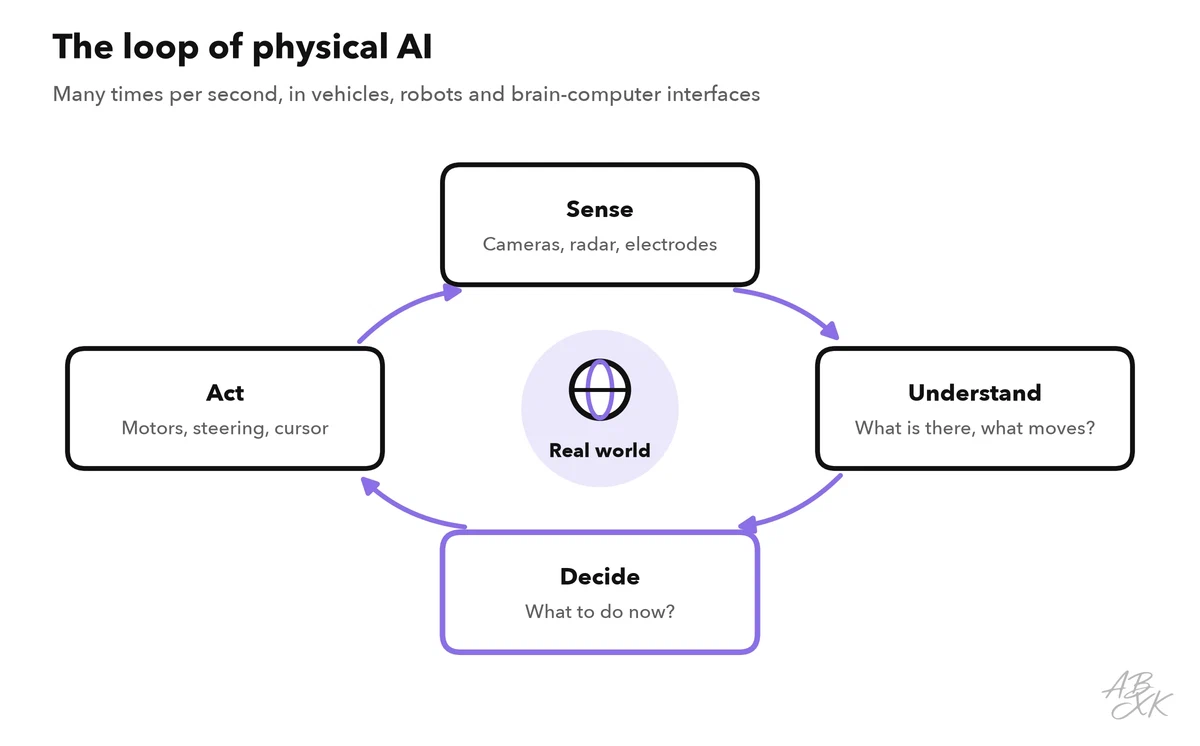
A language model works differently: it gets one input, writes one output and waits. If its answer is wrong, you can ask again. A self-driving car cannot pause the street. It has to decide within fractions of a second, and it cannot take a wrong decision back.
The four fields in this learning path
Physical AI covers many machines, from vacuum robots to drones. This learning path follows four fields where AI already does real work, plus the infrastructure behind them, and each has public data you can check yourself.
| Field | Senses | Decides | Acts | Public data on ABXK.AI |
|---|---|---|---|---|
| Self-driving vehicles | Cameras, radar, lidar | Where to drive and how fast | Steering, brakes, motor | Crash reports filed with the US road safety authority |
| Robots | Cameras, force and touch sensors | How to grasp, where to step | Motors in joints and grippers | Notable AI models for robots |
| Brain-computer interfaces | Electrodes on or in the brain | Which movement or word was intended | Cursor, robot arm, synthetic voice | Clinical studies in the US trial registry |
| Chips and data centers | — | — | Supply the computing power | Chips, data centers and power use |
The last row is not a machine that acts on its own. It is the physical foundation of all AI: every model, including the ones in robots and cars, is trained in data centers full of chips that draw large amounts of electricity.
Why the physical world is harder than a chat
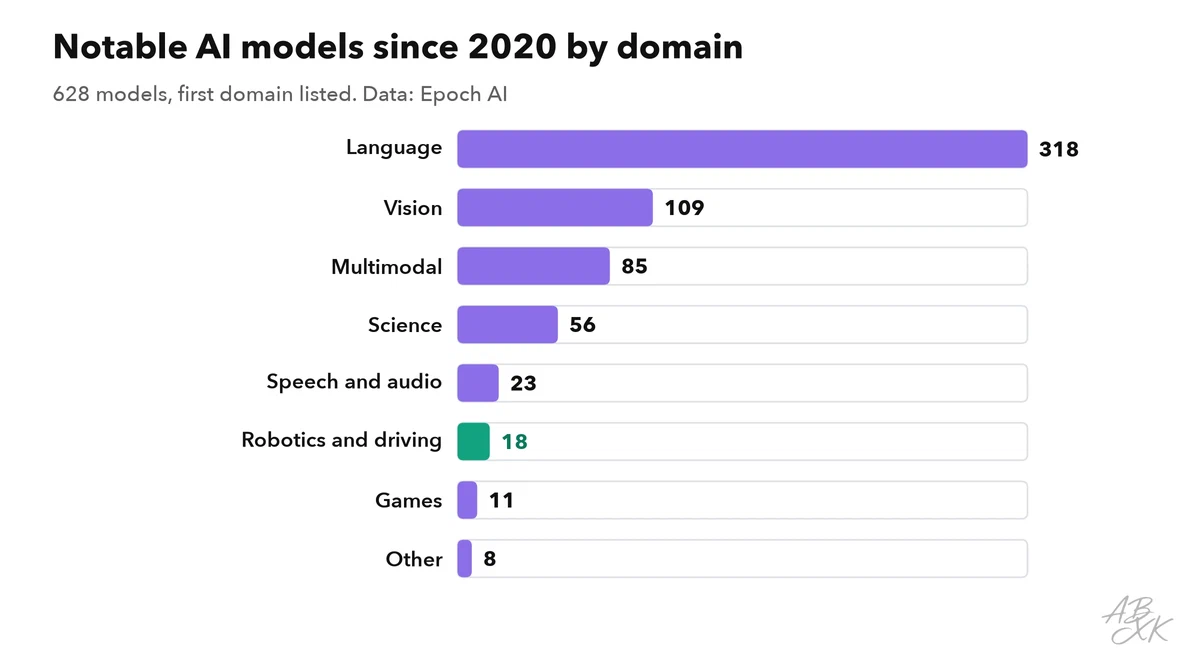
Physical AI is still a small part of AI research. Of the 628 notable AI models that Epoch AI, a research institute, recorded since 2020, only 2.9% were built for robots or vehicles; most were language and image models.
There are four main reasons:
- Mistakes cost more. A wrong word in a chat is annoying. A wrong steering decision can hurt people. Physical AI has to be safe in rare situations, not just in typical ones.
- There is little data. Language models learn from text collected from the internet. There is no internet of robot movements: every example of a robot grasping a cup has to be recorded with real hardware or produced in a simulation.
- Time is short. A car at 50 km/h (31 mph) covers almost 14 meters per second. Sensing, understanding and deciding have to fit into fractions of a second, on a computer inside the vehicle.
- The world is open-ended. A street has endless rare situations, called edge cases: a mattress on the highway, a police officer waving drivers through a red light. A model cannot have seen them all.
How physical AI learns
Because real data is scarce, physical AI combines several ways of learning. Engineers program rules where the task is fixed, such as a welding robot on an assembly line. Robots learn from demonstrations, when a person guides the robot or steers it remotely and the model copies the movement. They practice in simulation, millions of attempts in a virtual world before the first attempt in the real one. Since 2023, foundation models for robots have joined these methods: large models that link images, language and movement, so that a robot can follow an instruction such as “put the red cup in the sink”. 19 of the 31 notable robotics models in Epoch AI’s data were published in 2022 or later.
| Model | Organization | Published | Task |
|---|---|---|---|
| GEN-1.5 | Generalist | August 19, 2026 | Grasping and moving objects |
| MolmoAct 2 | Allen Institute for AI | April 5, 2026 | Grasping and moving objects |
| π0.6 (pi-0.6) | Physical Intelligence | November 17, 2025 | Grasping and moving objects |
| Eagle 2 | Nvidia | January 20, 2025 | – |
| RDT-1B | Tsinghua University | October 10, 2024 | Grasping and moving objects |
| GR-2 | ByteDance | October 8, 2024 | Video |
| Table Tennis Agent | Google DeepMind | August 7, 2024 | Sports |
| OpenVLA | Stanford University | June 13, 2024 | Grasping and moving objects |
| Octo-Base | University of California (UC) Berkeley | May 20, 2024 | Grasping and moving objects |
| ManiGaussian | Tsinghua University | March 13, 2024 | Grasping and moving objects |
| RT-Trajectory | Google DeepMind | November 3, 2023 | Grasping and moving objects |
| RT-2-X | Google DeepMind | October 13, 2023 | Grasping and moving objects |
| Robot Parkour | Shanghai Qi Zhi institute | September 12, 2023 | Imitating movement |
| Swift | Intel Labs | August 30, 2023 | Drone flight |
| RT-2 | Google DeepMind | July 28, 2023 | Grasping and moving objects |
| Agile Soccer Robot | Google DeepMind | April 26, 2023 | Imitating movement |
| PaLM-E | March 6, 2023 | Questions about images | |
| RT-1 | December 13, 2022 | Grasping and moving objects | |
| Gato | DeepMind | May 12, 2022 | Atari |
| 6-Act Tether | Facebook AI Research | August 3, 2021 | Object detection |
| SemExp | Carnegie Mellon University (CMU) | July 2, 2020 | Object detection |
| DD-PPO | Georgia Institute of Technology | December 19, 2019 | Object detection |
| Walking Minotaur robot | University of California (UC) Berkeley | June 19, 2019 | Imitating movement |
| MetaMimic | October 11, 2018 | Grasping and moving objects | |
| Deep Deterministic Policy Gradients | Google DeepMind | September 9, 2015 | Grasping and moving objects |
| Truck backer-upper | Stanford University | June 18, 1989 | Self-driving |
| Q-learning | University of London | January 1, 1989 | Route finding |
| ASE+ACE | University of Massachusetts Amherst | September 1, 1983 | Pole balancing |
| Heuristic Reinforcement Learning | Purdue University | October 1, 1965 | System control |
| SNARC | Harvard University | January 8, 1952 | Maze solving |
| Theseus | Bell Laboratories | July 2, 1950 | Maze solving |
Data: Epoch AI, Data on AI models (1078 notable models), retrieved on October 18, 2026, licensed CC BY 4.0; our analysis.
What to check when you read news about physical AI
Physical AI attracts bold claims. These questions help you separate demonstrations from real use:
- Demo or service? A video of a robot folding laundry shows one success. Ask how often it works and in how many homes it runs.
- Who is in control? Many robots and some vehicles are steered remotely by people in difficult moments. That is legitimate, but it matters for what the AI can do alone.
- How much real use? Miles driven without a driver, hours of operation or patients treated say more than any announcement.
- What do the public records say? For self-driving cars and brain implants, regulators publish crash reports and trial registrations. This learning path uses them.
The next parts of Level 0 look at each field in turn, starting with how self-driving cars see the road. For the data behind this learning path, see the overview of Physical AI.