

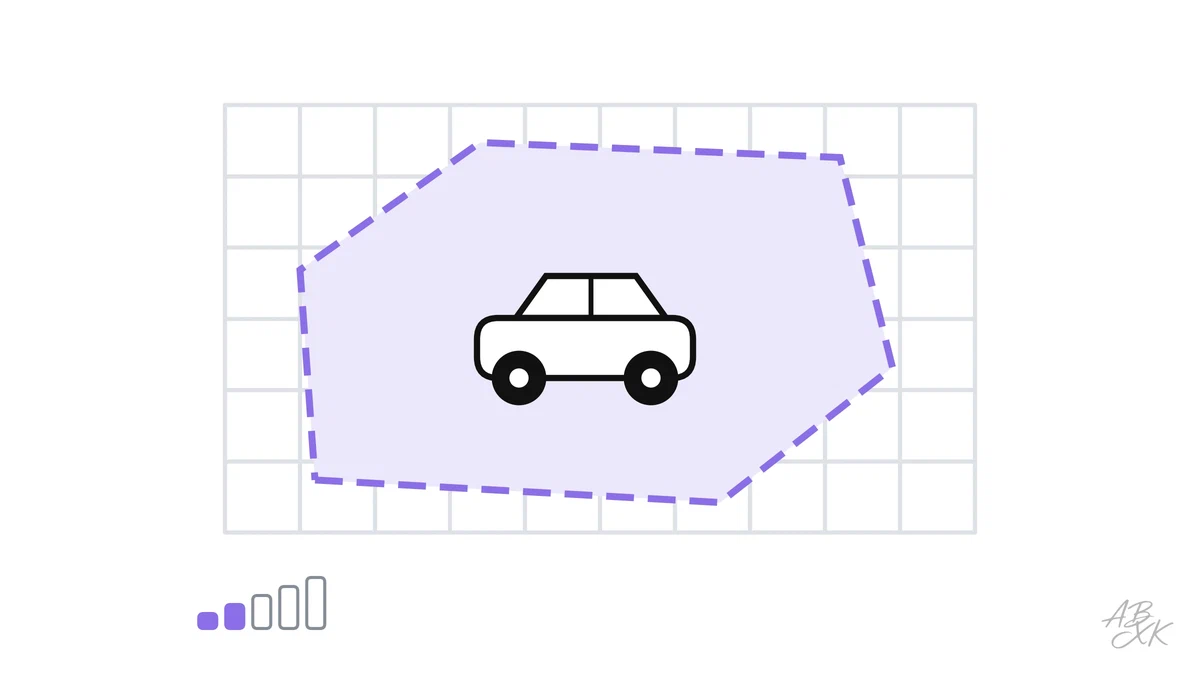
No self-driving car today can drive everywhere. Each one is designed for a specific set of conditions: certain cities, certain types of roads, certain speeds, certain weather. Engineers call this set the operational design domain, or ODD. It is one of the most important ideas for understanding automated driving, because it explains why a robotaxi can drive without anyone at the wheel in one city and not at all in the next.
This is part 3 of Level 1 in our learning path Physical AI. You will learn what an ODD contains, why it is the key difference between Level 4 and Level 5 automation and what thousands of US crash reports reveal about where and when automated vehicles actually drive today.
What an operational design domain contains
The term comes from the SAE standard J3016, which also defines the six levels of driving automation. An ODD describes everything that must be true for the system to drive safely. If a condition leaves the ODD, for example heavy snow sets in, the system has to bring the car to a safe stop or hand over control.
| Part of the ODD | Example of a limit | What the crash reports show |
|---|---|---|
| Area | Selected districts of a few cities, marked on a map | Most reports come from a handful of cities |
| Road type | City streets, but no highways | Highways are rare |
| Speed | Up to a set maximum | Most crashes at low speed or standing still |
| Weather | No snow, limited heavy rain | Mostly clear weather, rain is rare |
| Time | Day and night | About a third of the reports are at night |
| Occupants | No driver, a safety driver or a remote operator | Most vehicles had no one at the wheel |
The difference between Level 4 and Level 5 lies exactly here. A Level 4 system drives itself completely, but only inside its ODD. A Level 5 system would have no ODD limits at all and could drive anywhere a human can. No Level 5 system exists today. Every company that operates robotaxis defines an ODD and expands it step by step: a new district, a new city, higher speeds, highways, rain.
What the crash reports reveal
In the United States, operators of vehicles with an automated driving system have to report crashes to the National Highway Traffic Safety Administration (NHTSA). We analyzed all 1,551 reports in the current file. A crash can only happen where a car drives, so the reports also show where these vehicles are on the road. They do not show how safe they are, because the file contains no information on the miles driven.
The operators stated that in 98.9% of the crashes the vehicle was operating inside its ODD. The reports come from 77 cities, but they are heavily concentrated: the four cities with the most reports account for 62.4% of all of them.
| City | Reports | Share |
|---|---|---|
| San Francisco (CA) | 396 | 25.5% |
| Los Angeles (CA) | 260 | 16.8% |
| Austin (TX) | 199 | 12.8% |
| Phoenix (AZ) | 113 | 7.3% |
| Atlanta (GA) | 79 | 5.1% |
| Dallas (TX) | 75 | 4.8% |
| Tempe (AZ) | 48 | 3.1% |
| Las Vegas (NV) | 43 | 2.8% |
Data: NHTSA, Standing General Order 2021-01, crash reports for vehicles with an automated driving system (ADS), crashes from June 2025 to August 2026, latest version of each report; retrieved on October 18, 2026, our analysis.
The type of road shows the same pattern. 69.5% of the crashes happened on ordinary streets and 19.8% at intersections. Only 2.1% were on highways or freeways, which suggests that most automated vehicles still spend little time there.
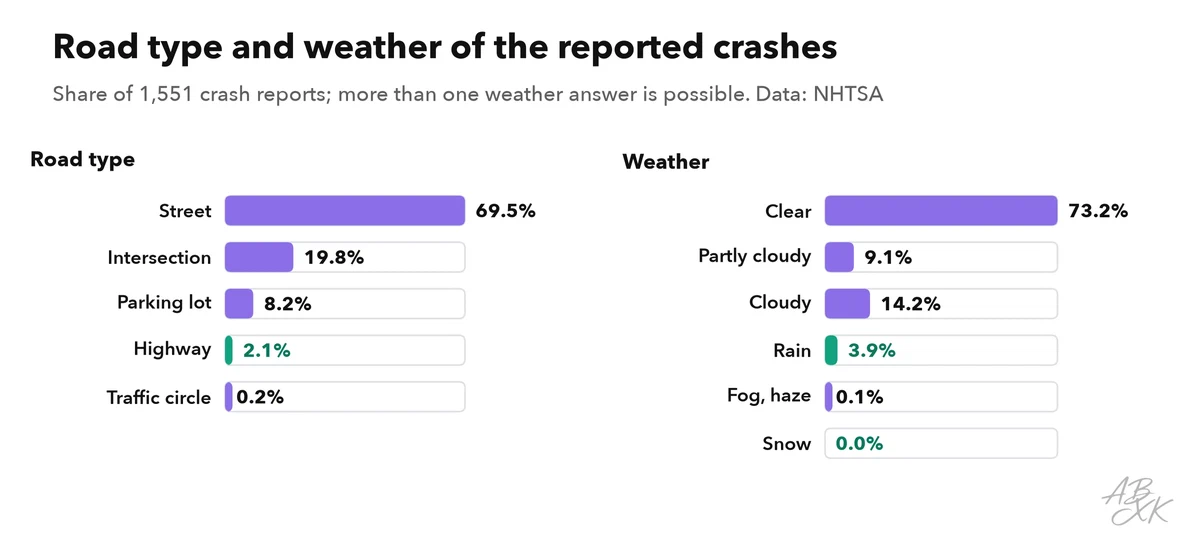
The weather tells a similar story. 73.2% of the reports mention clear weather. Rain appears in 61 reports, fog, smoke or haze in 1, snow in 0. The cities with the most reports have mild winters, and rain is still the exception there. A wet road surface appears in 2.3% of the reports.
| Weather | Reports | Share |
|---|---|---|
| Clear | 1,136 | 73.2% |
| Partly cloudy | 141 | 9.1% |
| Cloudy | 220 | 14.2% |
| Rain | 61 | 3.9% |
| Fog, smoke, haze | 1 | 0.1% |
| Snow | 0 | 0.0% |
| Severe wind | 1 | 0.1% |
| Dust storm | 1 | 0.1% |
Source as for the first table on this page.
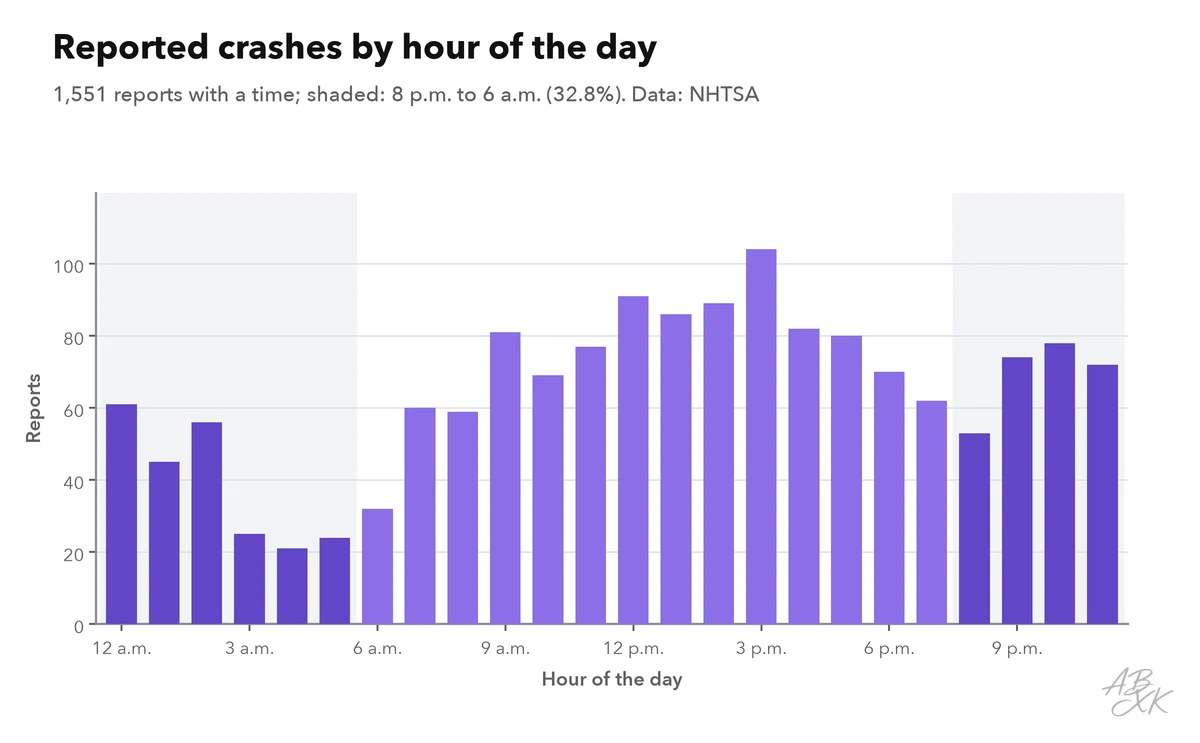
Time of day is different. 32.8% of the reported crashes happened between 8 p.m. and 6 a.m. Robotaxis serve passengers around the clock, and darkness is part of the ODD for most of them. Lidar and radar send out their own signals and do not need daylight, and cameras work with street lights and headlights.
In 83.3% of the reports, there was no one in the driver’s seat at all. That is the clearest sign that inside their ODD, these systems already drive without human backup.
How an ODD grows
An operator expands an ODD only after showing that the system can handle the new conditions. That usually means millions of miles in simulation, test drives with safety drivers, and then driverless service in a limited area. Each step adds new edge cases: a highway brings higher speeds and merging traffic, a new city brings new road layouts and local driving habits, snow covers lane markings and changes how sensors see the road.
When you read news about automated driving, the ODD is the first thing to check:
- Where exactly? A whole city or a few districts? With or without highways?
- Under which conditions? Day and night? Rain? Snow?
- With whom on board? A safety driver, a remote operator or no one?
- Compared with what? Crash numbers only mean something next to the miles driven in the same ODD.
How we analyzed the reports
We used the incident reports for automated driving systems that NHTSA publishes under its Standing General Order 2021-01, and for each report the latest version. The categories for city, road type and weather come from the reports themselves; a report can name more than one weather condition. Night means a reported time between 8 p.m. and 6 a.m. Personal data in the file is redacted by NHTSA. The next part leaves the road and turns to the brain: what an EEG can and cannot reveal about our intentions.