

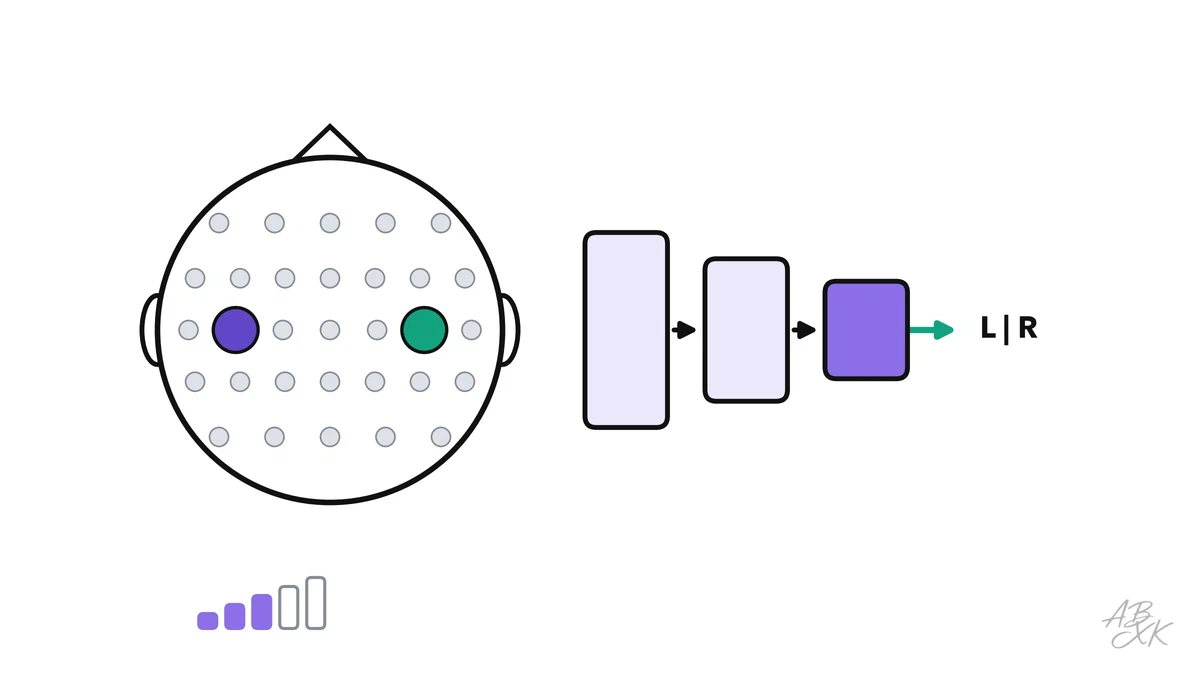
In Level 1 of this learning path, we tested whether a computer can tell from an EEG which hand a person imagines moving. The answer was sobering: the decoder was right 58.9% of the time for the median person, where guessing gives 50%, and only 31 of 106 people reached the 70% that BCI research often names as the minimum for useful control. So what would make such a decoder better?
This is part 5 of Level 2 in our learning path Physical AI. We ran four more experiments on the same public recordings: we changed the number of electrodes, the amount of training data and the source of the training data, and we compared imagined with real movements. You will learn how a decoder is built from simple steps, why more electrodes do not automatically help and why a decoder trained on strangers beat one trained on the person’s own data.
How the decoder works
A decoder for brain signals is a chain of simple steps. Each step throws away what does not help and keeps what does:
| Step | What it does | In our decoder |
|---|---|---|
| Filter | Keeps the frequencies that matter | Mu and beta rhythms, 8 to 30 waves per second |
| Window | Cuts out the moment of the task | 0.5 to 2.5 seconds after the cue |
| Spatial filters | Combine electrodes into a few strong signals | Common spatial patterns, four signals |
| Features | Turn each signal into a number | The strength of each signal |
| Classifier | Decides left or right | Linear discriminant analysis |
| Test | Measures accuracy on unseen attempts | Five-fold cross-validation |
More electrodes are not automatically better
We gave the decoder 2, 3, 21 or all 64 electrodes. With just the two electrodes over the hand areas, C3 and C4, the median person reached 57.8%. Adding the electrode in the middle raised it to 59.9%, and the 21 electrodes over the motor cortex reached 60%. All 64 electrodes, though, did not do better: 58.9%.
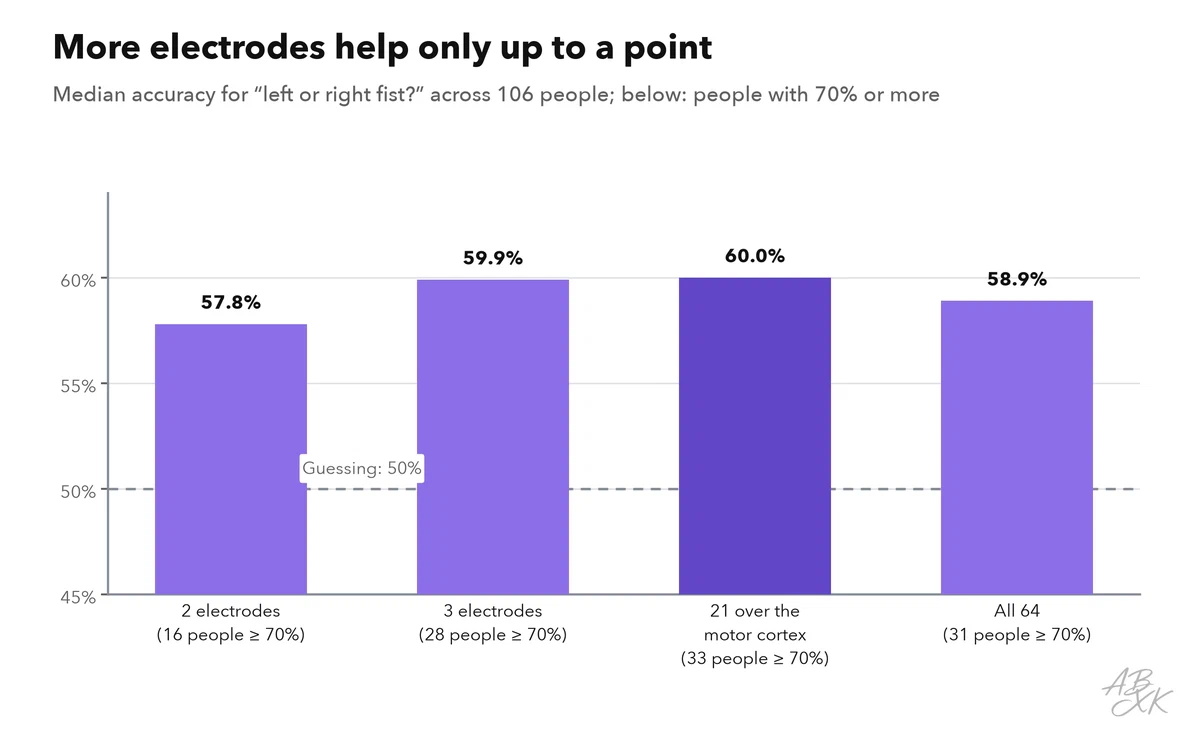
The reason is the small amount of data. Every extra electrode adds numbers that the decoder has to learn from the same few dozen attempts, and the more numbers it learns from little data, the more it adapts to noise instead of the real pattern. The electrodes over the motor cortex carry the useful signal; the others mostly add noise.
Training data matters
We also gave the decoder fewer of the person’s own attempts to learn from. With only 10 attempts, the median accuracy was 52.4%, barely better than guessing. With 20 attempts, it was 53.6%, with 30 attempts 55.3%. Every extra minute of calibration helps, and a few dozen attempts are clearly not enough for most people.
Learning from other people’s brains
That raises an obvious question: why not learn from other people? For each person, we trained the decoder on all attempts of the other 105 people, several thousand in total, and tested it on the person it had never seen. The result surprised us: the median accuracy was 62.2%, higher than with the person’s own data. For 54 of 106 people, the decoder trained on strangers did better than the one trained on their own attempts, and 32 people reached 70% or more.
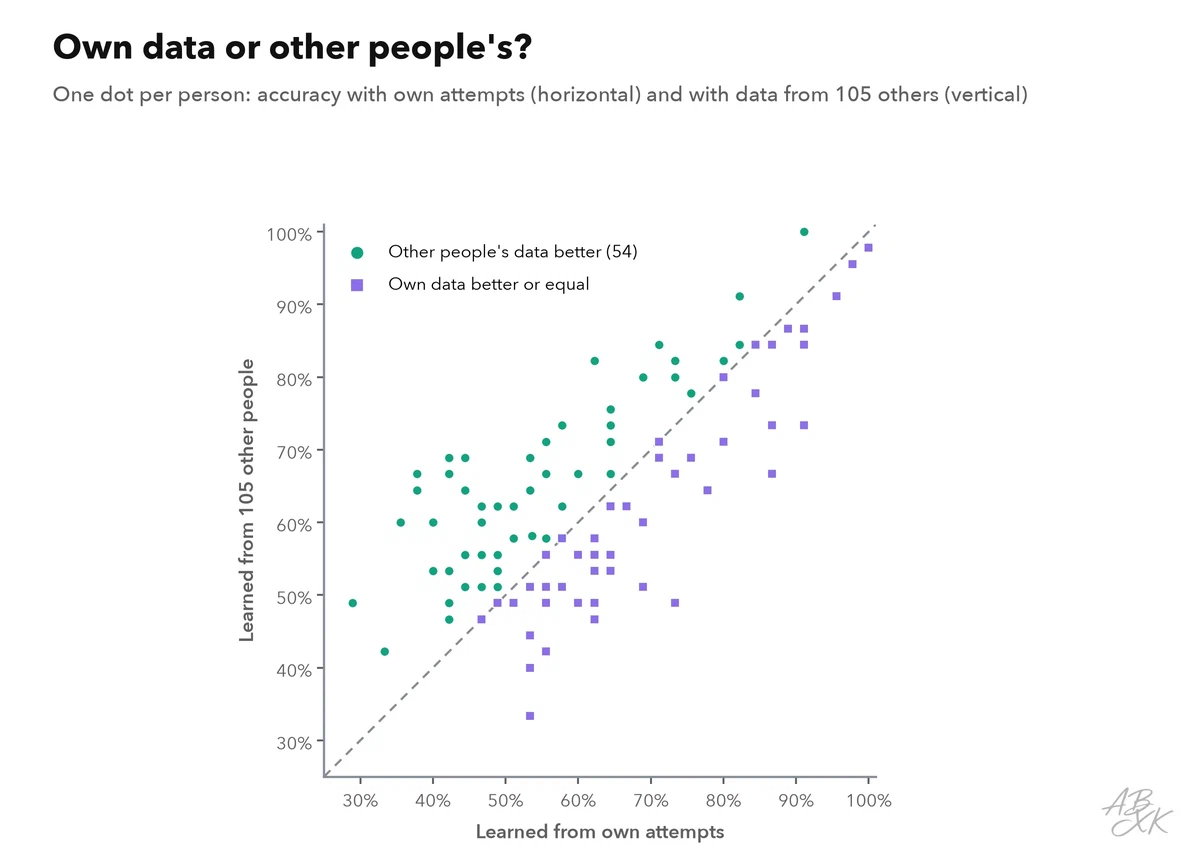
Many attempts from many people give a stable picture of the typical pattern, which a few dozen own attempts cannot. But brains differ: for about half of the people, their own data was still better. Research therefore combines both, starting with a model trained on many people and adapting it to the new user with a few minutes of their own data.
Real movement instead of imagination
The recordings also contain runs in which the same people really opened and closed their fists. With these, the median accuracy was 60%, only slightly higher than for imagined movements, and 58 of 106 people were decoded better when they moved. For this decoder, imagining a movement and making it turned out to be surprisingly similar. That is good news for people with paralysis, for whom imagination is all they have.
| Variant | Recognized correctly (median) | People with 70% or more |
|---|---|---|
| 2 electrodes (C3, C4) | 57.8% | 16 |
| 3 electrodes (C3, Cz, C4) | 59.9% | 28 |
| 21 electrodes over the motor cortex | 60.0% | 33 |
| All 64 electrodes | 58.9% | 31 |
| Only 10 own attempts to learn from | 52.4% | 10 |
| 20 own attempts to learn from | 53.6% | 16 |
| 30 own attempts to learn from | 55.3% | 23 |
| Learned from 105 other people | 62.2% | 32 |
| Real movement instead of imagination | 60.0% | 28 |
Our own experiment with the EEG Motor Movement/Imagery Dataset (G. Schalk et al., BCI2000; PhysioNet, license ODC-By 1.0), retrieved on October 18, 2026: 106 participants; imagination from runs 4, 8, 12, real movement from runs 3, 7, 11. Band-pass 8–30 Hz, window 0.5–2.5 s after the cue, common spatial patterns and linear discriminant analysis. Per person five-fold cross-validation; amount of training data: 10 random splits; other people: trained on all others, tested on the person left out. Fixed seed.
What this means for brain-computer interfaces
- Calibration is the bottleneck. Every new user needs training data, and our results show that a few dozen attempts are too few. Models trained on many people can shorten the setup.
- The right place beats many electrodes. A small cap over the motor cortex can work as well as a full one, and it is faster to put on.
- Practice helps both sides. The decoder learns from the user, and with feedback, the user learns to produce clearer patterns.
- The physics stays. No amount of data removes the blurring of the skull, which is why implants remain far ahead for complex tasks.
How we ran the experiment
We used the EEG Motor Movement/Imagery Dataset from the BCI2000 project on PhysioNet, the same 106 people as in Level 1, with three runs of imagined and three runs of real fist movements per person. All variants use the same chain of steps; the electrode sets differ only in the channels they use. For the amount of training data, we drew 10 random splits per person and size; for other people’s data, we trained on all other people and tested on the person left out. All random choices use a fixed seed.