

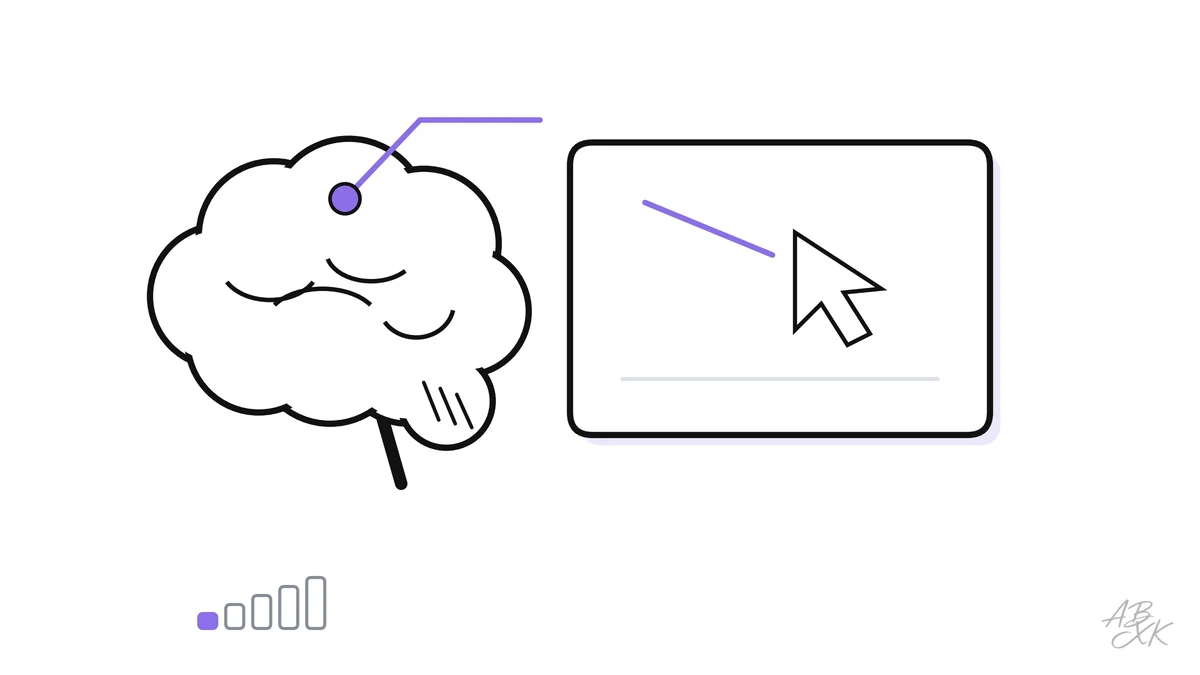
A person with a severe spinal cord injury cannot move their hands, yet the part of the brain that plans hand movements still works. When they try to move, nerve cells fire in patterns that a computer can learn to read. A brain-computer interface (BCI) does exactly that: it records brain activity and turns it into commands, so the person can move a cursor, type or speak through a synthetic voice.
This is part 4 of Level 0 in our Physical AI learning path. You will learn what a BCI actually measures, the steps from brain signal to command, where AI comes in, how implanted and non-invasive systems differ and what the clinical trial registry shows about who uses them today.
What a BCI measures
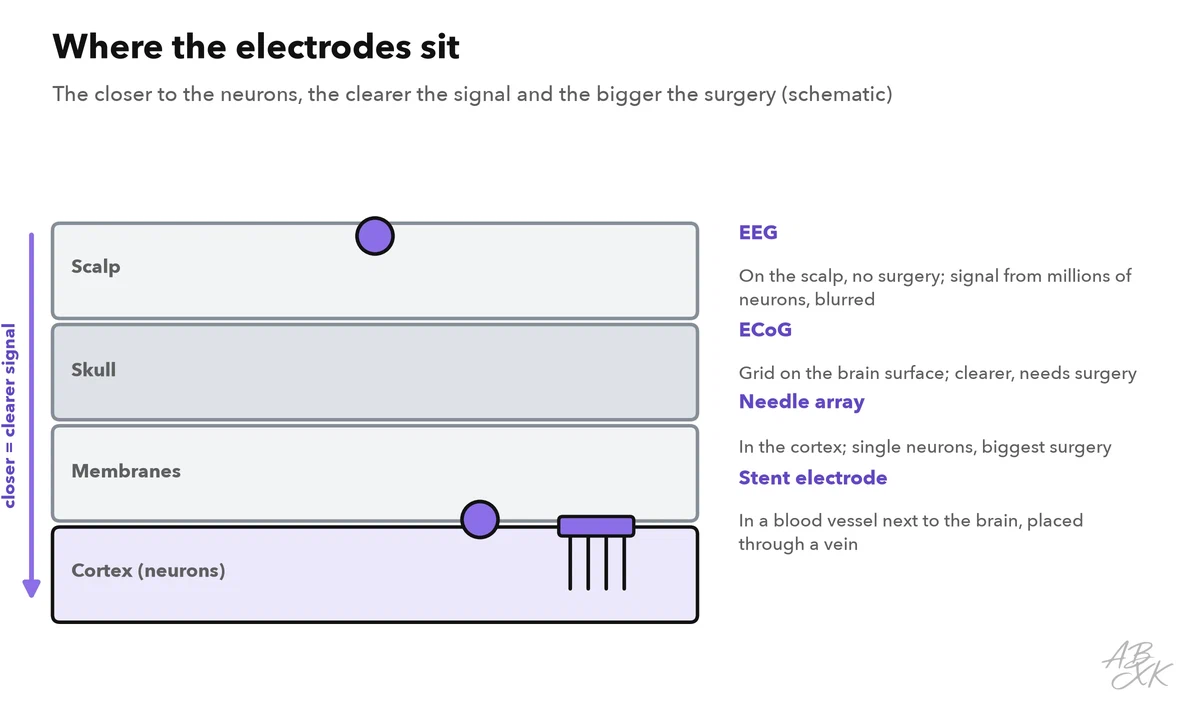
The brain contains billions of nerve cells, called neurons, that communicate with short electrical pulses. When you plan a movement, groups of neurons in the motor cortex, a strip on the top of the brain, fire in a typical pattern. This pattern appears even if the signal no longer reaches the muscles, for example after a spinal cord injury or in ALS. A BCI uses electrodes to pick up this activity: either from many neurons at once, like the noise of a crowd heard from outside a stadium, or from single neurons, like individual voices heard from inside.
The closer the electrodes are to the neurons, the clearer the signal. That is the basic trade-off of every BCI: clarity against surgery.
From brain signal to command
Every BCI runs the same chain of steps, many times per second.
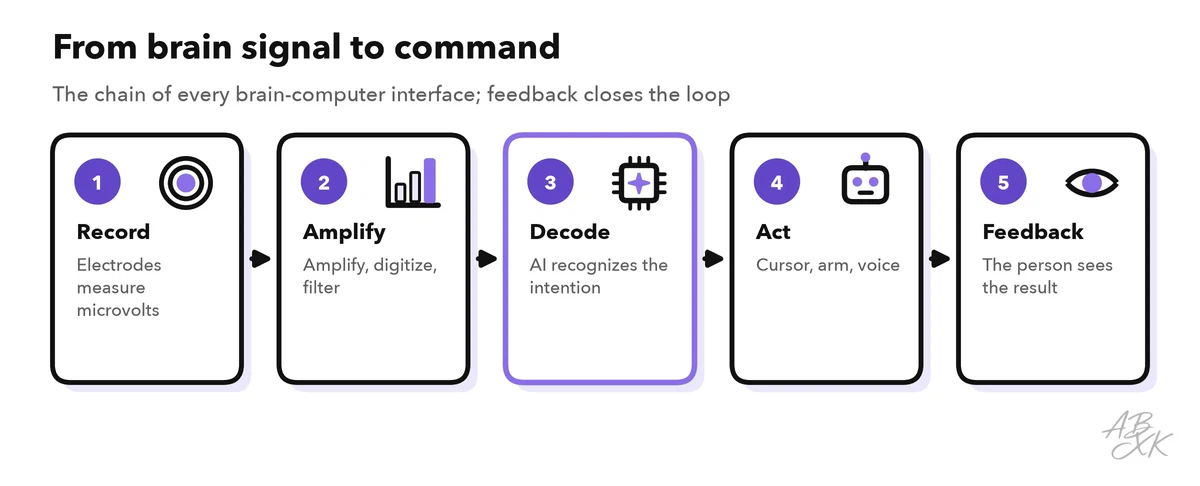
- Record: electrodes pick up tiny voltages, measured in millionths of a volt.
- Amplify and digitize: an amplifier strengthens the signal, and a converter turns it into numbers. Filters remove noise, for example from muscles or power lines.
- Decode: an AI model, the decoder, turns the numbers into the most likely intention: “cursor up and to the left”, “the letter B”, “the sound ah”.
- Act: the command moves a cursor, a robotic arm or a speech synthesizer.
- Feedback: the person sees or hears the result and adjusts their effort. The brain and the decoder learn together, which is why BCIs are called closed-loop systems.
Before a BCI works, the decoder has to be calibrated. The person tries or imagines specific movements or words while the system records, and the model learns which patterns belong to which intention. Because electrodes shift slightly and the brain changes, the decoder has to be updated regularly. Better decoders that need less recalibration are one of the main goals of current research.
Where AI comes in
Early BCIs used simple statistical methods that mapped the firing rate of neurons to the direction of a cursor. Today, neural networks do much more. Speech BCIs are the best example: a decoder trained on attempted speech recognizes the sounds a person tries to make, and a language model, the same kind of AI that writes text in ChatGPT or Gemini, assembles them into the most likely words and sentences. The language model corrects many errors of the decoder, just as autocorrect fixes typos on a phone.
| Non-invasive (EEG) | Implanted | |
|---|---|---|
| Where the electrodes sit | In a cap on the scalp | On or in the brain, or in a blood vessel |
| What the decoder reads | Activity of millions of neurons, blurred by the skull | Groups of neurons or single neurons |
| Typical uses | Rehabilitation after stroke, simple choices, spelling letter by letter | Cursor and robot arm control, typing, speech for people who cannot speak |
| Main limit | Low speed and precision | Surgery and long-term stability of the implant |
Risks and open questions
Implanted BCIs raise questions that no other AI application raises in this form. Surgery on the brain carries a risk of bleeding and infection. Electrodes in the brain tissue can lose signal over the years as the body forms scar tissue around them, so long-term stability is one of the key measures in every implant study. An implant also depends on the company that supports it: if a manufacturer gives up a product, patients may be left with a device that no one maintains. And brain data is unusually sensitive, because it can reveal health conditions and, in the future, perhaps more. Some US states, such as Colorado and California, now treat neural data as sensitive personal data in their privacy laws, and in the EU such data is health data under the GDPR.
What the trial registry shows
We analyzed all 280 studies on ClinicalTrials.gov, the clinical trial registry of the US National Library of Medicine, whose entry mentions a brain-computer or brain-machine interface. 59 of them use implanted electrodes, 129 are non-invasive, and in the rest the entry does not say clearly which kind of interface is used.
| Type | Studies | Share |
|---|---|---|
| Non-invasive (EEG, fNIRS and similar) | 129 | 46.1% |
| Not clear from the entry | 92 | 32.9% |
| Implanted electrodes | 59 | 21.1% |
Data: ClinicalTrials.gov (U.S. National Library of Medicine), all 280 studies whose entry contains “brain-computer interface” or “brain-machine interface”; retrieved on October 18, 2026. Implanted/non-invasive split: ours, by keywords in the title, interventions, keywords and brief summary.
Implant studies are small: half of them enroll or plan to enroll 6 participants or fewer, because every participant needs brain surgery. But they are the fastest-growing group: 35 of the implant studies started in 2024 or later. All tables, the countries and the list of ongoing implant trials are on our page about brain-computer interface trials.
A BCI connects a brain to a computer, and every computer needs chips and power. The last part of Level 0 follows AI to its physical foundation: chips, data centers, electricity and water.