

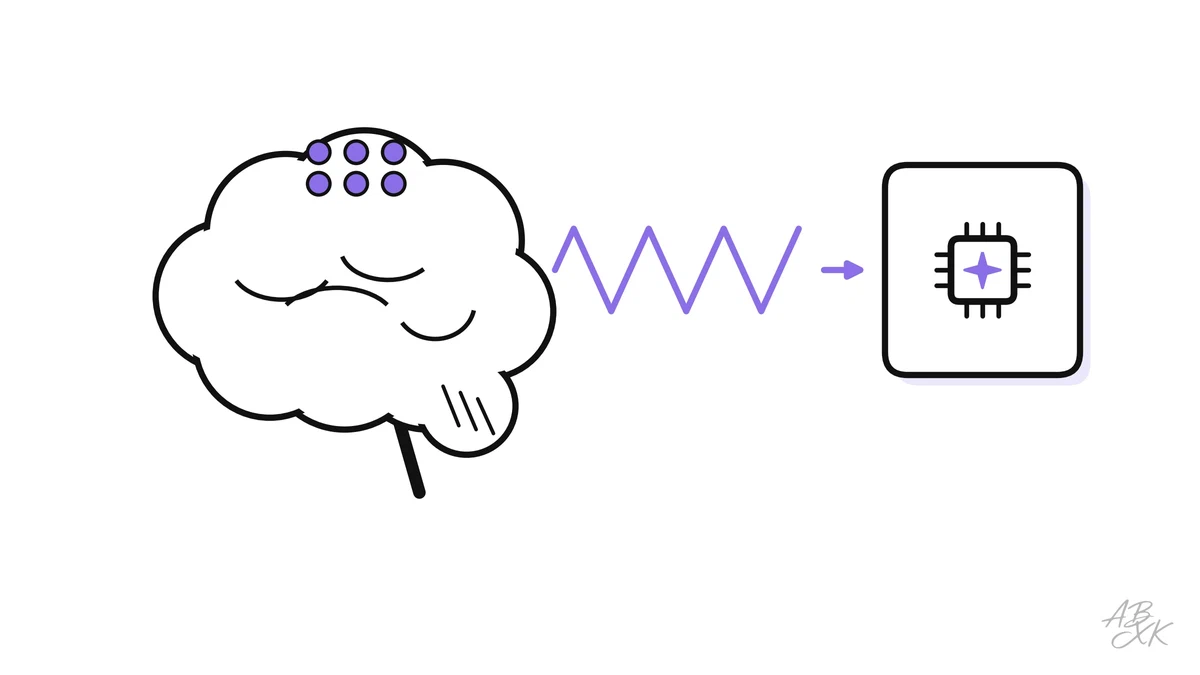
A brain-computer interface (BCI) records brain activity and turns it into commands: a cursor moves, a robotic arm grasps, a synthetic voice speaks words a person can no longer say. AI models do the decoding, translating patterns of electrical activity into intended movements, letters or sounds. To see how far the field really is, we analyzed all 280 studies on ClinicalTrials.gov, the largest public registry of clinical studies, whose entry mentions a brain-computer or brain-machine interface, and counted the research papers on PubMed.
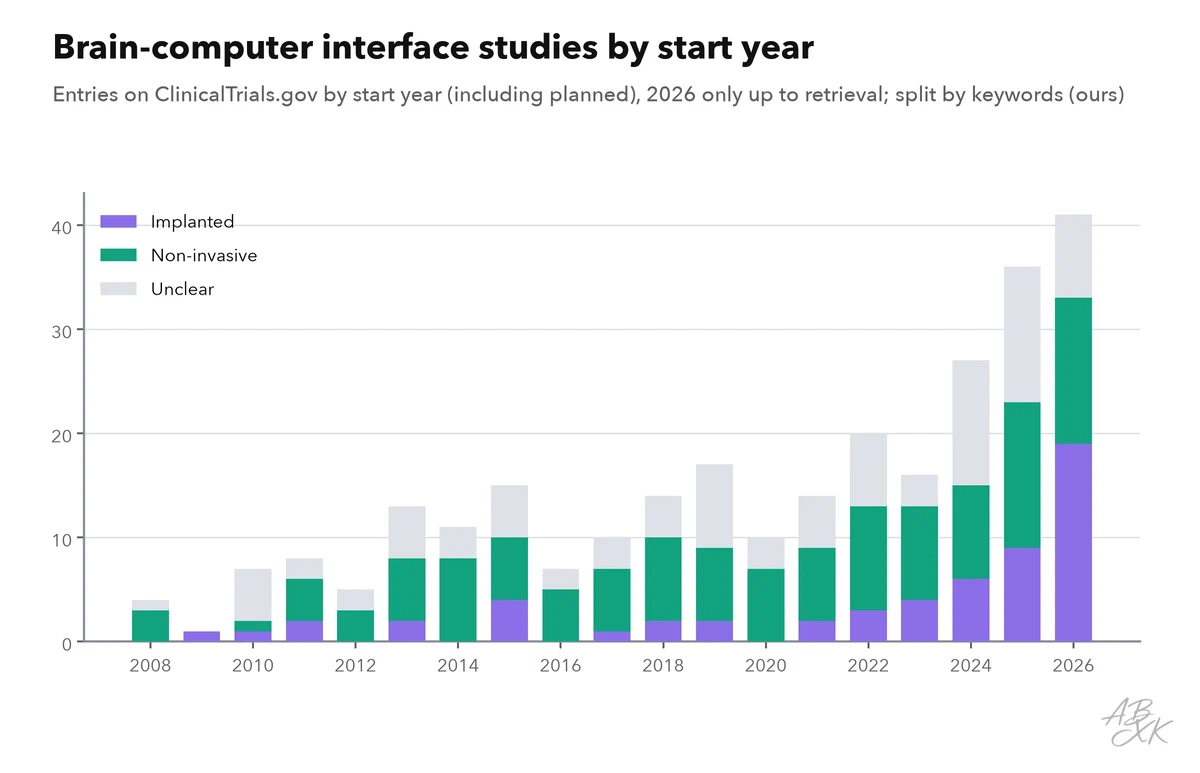
Two kinds of brain-computer interfaces
Non-invasive systems read brain activity from outside the head, mostly with an EEG cap of electrodes on the scalp, sometimes with near-infrared light (fNIRS). They are safe and cheap, but the skull blurs the signal, so they work for simple choices such as “left or right” rather than for typing at speed. Implanted systems place electrodes on or in the brain: tiny needle arrays in the motor cortex, thin grids on its surface (ECoG), or electrodes inside a blood vessel next to the brain. They need surgery, and in return the signal is clear enough to control a cursor, a robotic arm or synthetic speech.
| Type | Studies | Share |
|---|---|---|
| Non-invasive (EEG, fNIRS and similar) | 129 | 46.1% |
| Not clear from the entry | 92 | 32.9% |
| Implanted electrodes | 59 | 21.1% |
Data: ClinicalTrials.gov (U.S. National Library of Medicine), all 280 studies whose entry contains “brain-computer interface” or “brain-machine interface”; retrieved on October 18, 2026. Implanted/non-invasive split: ours, by keywords in the title, interventions, keywords and brief summary.
The difference shows in the size of the studies. Half of the implant studies enroll or plan to enroll 6 participants or fewer, half of the non-invasive studies 30 or fewer. In the US, a trial with an implanted device that carries a significant risk needs an investigational device exemption from the FDA, and every participant needs brain surgery, so implant studies start with a handful of people.
| Non-invasive (EEG, fNIRS) | Implanted | |
|---|---|---|
| Where the electrodes sit | On the scalp | On or in the brain, or in a blood vessel next to it |
| Signal quality | Blurred by the skull | Clear, down to single neurons with needle arrays |
| Typical use in studies | Rehabilitation after stroke, simple control | Computer and robot arm control, speech for people who cannot speak |
| Risk | Very low | Surgery, infection, long-term stability of the implant |
| Typical study size | Dozens of participants | A few participants |
Who the studies are for
Stroke is the most common condition, with 112 studies. Most of them are rehabilitation trials: a patient imagines moving a paralyzed hand, an EEG-based BCI detects the attempt and triggers a robotic glove or electrical muscle stimulation, which links intention and movement again. The implant studies focus on other patients: 40 of the 59 concern a spinal cord injury or paralysis of all four limbs, 26 concern ALS, a disease in which people gradually lose control of all muscles, including those needed for speech.
| Condition | Studies |
|---|---|
| Stroke | 112 |
| Spinal cord injury, tetraplegia | 69 |
| ALS, locked-in syndrome | 52 |
| Parkinson's, epilepsy, other neurological | 38 |
| Other | 35 |
| Other paralysis, loss of speech | 27 |
| Mental health, disorders of consciousness | 26 |
| Healthy volunteers | 21 |
Source as for the first table on this page.
Where the research happens
Studies with sites in the United States lead by far. The studies cover 35 countries in total, and only 13.2% are led by companies; most come from universities and hospitals.
| Country | Studies |
|---|---|
| United States | 96 |
| China | 27 |
| Singapore | 22 |
| France | 21 |
| Switzerland | 10 |
| Canada | 10 |
| United Kingdom | 7 |
| Italy | 6 |
| Taiwan | 6 |
| Germany | 5 |
Source as for the first table on this page.
The implant trials running now
Implants are the fastest-growing part of the registry: 35 of the 59 implant studies started in 2024 or later, and 46 are recruiting or still running. 18 of these ongoing studies have sites in the US and 11 in China. The titles show where the field is heading: wireless systems that are fully implanted instead of a cable through the skull, more recording channels, and speech decoding, including a study of speech in Mandarin Chinese.
| Study | Title in the registry | Country | Start | Participants |
|---|---|---|---|---|
| NCT07521930 | Interfacing With NeuroTechnology to Expand Neural Throughput (INTENT) | United States | 2027-01 | 5 |
| NCT06898138 | Acute Stimulation and Modulation of Stereotyped High-Frequency Oscillations | United States | 2026-11-01 | 8 |
| NCT05470478 | iBCI Optimization for Veterans With Paralysis | United States | 2026-10-02 | 2 |
| NCT07745686 | VALSE: Integration of Neuromodulation and Exoskeleton Systems for Mobility in Individuals With Chronic Spinal Cord Injury | Switzerland | 2026-09-15 | 12 |
| NCT07610850 | Brain-controlled Spinal Cord Stimulation in Participants With Chronic Stroke for Lower and Upper Limb Rehabilitation | Switzerland | 2026-09-01 | 3 |
| NCT07647315 | Wireless Implantable Mandarin Chinese Speech Neuroprosthesis Evaluation | China | 2026-09-01 | 4 |
| NCT07791459 | BrainGate2: Feasibility Study of an Intracortical Neural Interface System for Persons With Aphasia | – | 2026-08 | 5 |
| NCT07640711 | Innovative Brain-Computer Interface for People With Spinal Cord Injury | Netherlands | 2026-08 | 1 |
| NCT07784088 | Implantable Wireless Brain-Computer Interface Systems in Patients With Tetraplegia | China | 2026-07-15 | 34 |
| NCT07720882 | A Clinical Study of a Fully Implanted, Wireless and Functional BCI for Upper-Limb Functional Replacement in Tetraplegia Due to Spinal Cord Injury: Efficacy and Safety | China | 2026-07-07 | 32 |
| NCT07465796 | A First-in-Human Study of the CIPHER System During Brain Surgery for Newly Diagnosed Glioma | Australia | 2026-05-22 | 10 |
| NCT07533903 | Functional Outcomes and Control Using Synchron BCI - Australia | Australia | 2026-05-22 | 10 |
| NCT07457645 | Safety and Efficacy of High-Channel Implanted BCI for Motor Function Improvement in Tetraplegia Patients | China | 2026-05-15 | 10 |
| NCT07553416 | Prospective, Randomized, Parallel-Controlled Study of Brain Computer Interface Integrated Robotic Mirror Therapy for Post-Stroke Upper Limb Motor Function Disorder | China | 2026-05-01 | 40 |
| NCT07603752 | Implantable Wireless Brain-Machine Interface System for Spinal Cord Injury: Efficacy and Safety Study | China | 2026-04-28 | 34 |
| NCT07477613 | Implantable Brain-Computer Interface for Upper-Limb Recovery After Stroke | France | 2026-04-08 | 10 |
| NCT07446114 | Functional Outcomes and Control Using Synchron BCI - Canada | Canada | 2026-03-18 | 10 |
| NCT07460037 | Chinese-Specific Speech Imagery Coding Using High-Density ECoG | China | 2026-03-15 | 50 |
| NCT05936619 | MindEx: A Novel, Multifocal, Cognitive Brain-Machine Interface System | United States | 2026-02-20 | 2 |
| NCT07225582 | Development of Optimal Sensory Feedback Strategies to Maximize Function After Tetraplegia | United States | 2026-01-13 | 3 |
| NCT06939660 | BCI-Assisted SCS-EXS for Gait Optimization | China | 2025-04-23 | 3 |
| NCT06642519 | Brain-Machine Interface for Freezing of Gait | Canada | 2025-04-10 | 10 |
| NCT06944834 | A Study on the Safety and Functionality of the Implantable Wireless Brain-Computer Interfaces for Motor Rehabilitation | China | 2025-04 | 5 |
| NCT06829212 | Research on Wireless Brain Implant System for General Control of External Devices | China | 2025-03 | 4 |
| NCT06511934 | Feasibility of the BrainGate2 Neural Interface System in Persons With Tetraplegia (BG-Tablet-01) | United States | 2024-07-22 | 6 |
| NCT06432907 | StereoEEG Motor Neuronal Potentials Decoding | Russia | 2024-06-06 | 30 |
| NCT06243952 | Brain Controlled Spinal Cord Stimulation In Participants With Spinal Cord Injury For Lower Limb Rehabilitation | Switzerland | 2024-05-03 | 3 |
| NCT06207591 | Investigation on the Cortical Communication System | Netherlands | 2023-12-15 | 2 |
| NCT05920174 | Clinical Trial to Evaluate the Safety and Efficacy of an Implantable Neural Acquisitor & Stimulator System in Patients With Motor Disability | China | 2023-10-17 | 9 |
| NCT06094205 | Feasibility of the BrainGate2 Neural Interface System in Persons With Tetraplegia (BG-Speech-02) | United States | 2023-10-16 | 2 |
| NCT05665998 | Brain Controlled Spinal Cord Stimulation in Participants With Cervical Spinal Cord Injury for Upper Limb Rehabilitation | Switzerland | 2023-05-22 | 3 |
| NCT05035823 | COMMAND Early Feasibility Study: Implantable BCI to Control a Digital Device for People With Paralysis | United States | 2022-04-27 | 6 |
| NCT03567213 | Investigation on the Cortical Communication (CortiCom) System | United States | 2021-12-14 | 3 |
| NCT05439655 | Acute Recording of Stereotyped High-Frequency Oscillations | United States | 2021-09-01 | 17 |
| NCT03698149 | ECoG BMI for Motor and Speech Control | United States | 2018-11-09 | 3 |
| NCT03161067 | Investigation on the Bidirectional Cortical Neuroprosthetic System | United States | 2017-08-01 | 5 |
| NCT02550522 | Brain Computer Interface: Neuroprosthetic Control of a Motorized Exoskeleton | France | 2015-09 | 5 |
| NCT01894802 | Cortical Recording and Stimulating Array Brain-Machine Interface | United States | 2013-12-01 | 30 |
| NCT01958086 | Visuomotor Prosthetic for Paralysis | United States | 2013-10-01 | 2 |
| NCT00912041 | BrainGate2: Feasibility Study of an Intracortical Neural Interface System for Persons With Tetraplegia | United States | 2009-05 | 27 |
Source as for the first table on this page.
Research output
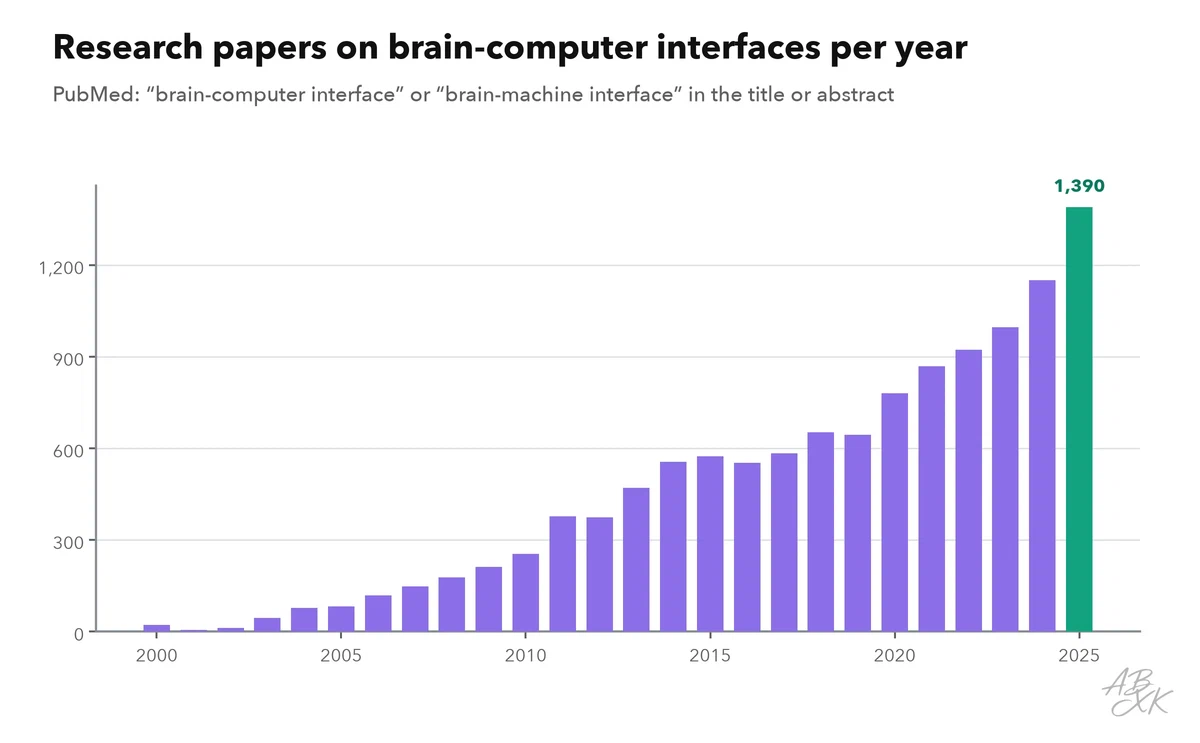
PubMed lists 1,390 papers from 2,025 with a brain-computer or brain-machine interface in the title or abstract, 2.4 times as many as in 2015. Research grows much faster than clinical use: in the same year, only 36 new studies with participants started.
What the numbers cannot tell
A registry entry shows what a team plans, not what it achieved; results appear later, if at all. Not every study is registered at ClinicalTrials.gov: studies that only appear in other registries, such as the Chinese Clinical Trial Registry, are missing here. The split between implanted and non-invasive studies is our own, based on keywords in each entry, and 92 entries do not say clearly enough which kind of interface they use.
How we counted
We retrieved all studies from the ClinicalTrials.gov API whose entry contains “brain-computer interface” or “brain-machine interface”, with or without a hyphen, and grouped them by start date, status, condition, country of the study sites and type of interface. Implanted means the entry mentions an implant, intracortical or surface electrodes on the brain, depth electrodes or a device in a blood vessel; non-invasive means it mentions EEG, fNIRS, MEG or a non-invasive method. Papers were counted on PubMed by publication year with the same terms in the title or abstract. The source and date are below each table.
How such an interface turns brain signals into commands is explained in our learning path in Physical AI.