

Every answer from a language model, every generated image and every training run happens in a physical building: halls full of AI chips, connected to power lines and cooling systems. These buildings are now the largest physical footprint of AI. Epoch AI, a research institute that tracks the development of AI, records the largest AI data centers with satellite imagery, permits and public documents, and estimates the chip sales and ownership of AI compute. We evaluated these datasets: 94 data centers, 74 of them already running, chip sales by designer and the distribution of compute among owners.
How much power AI data centers draw
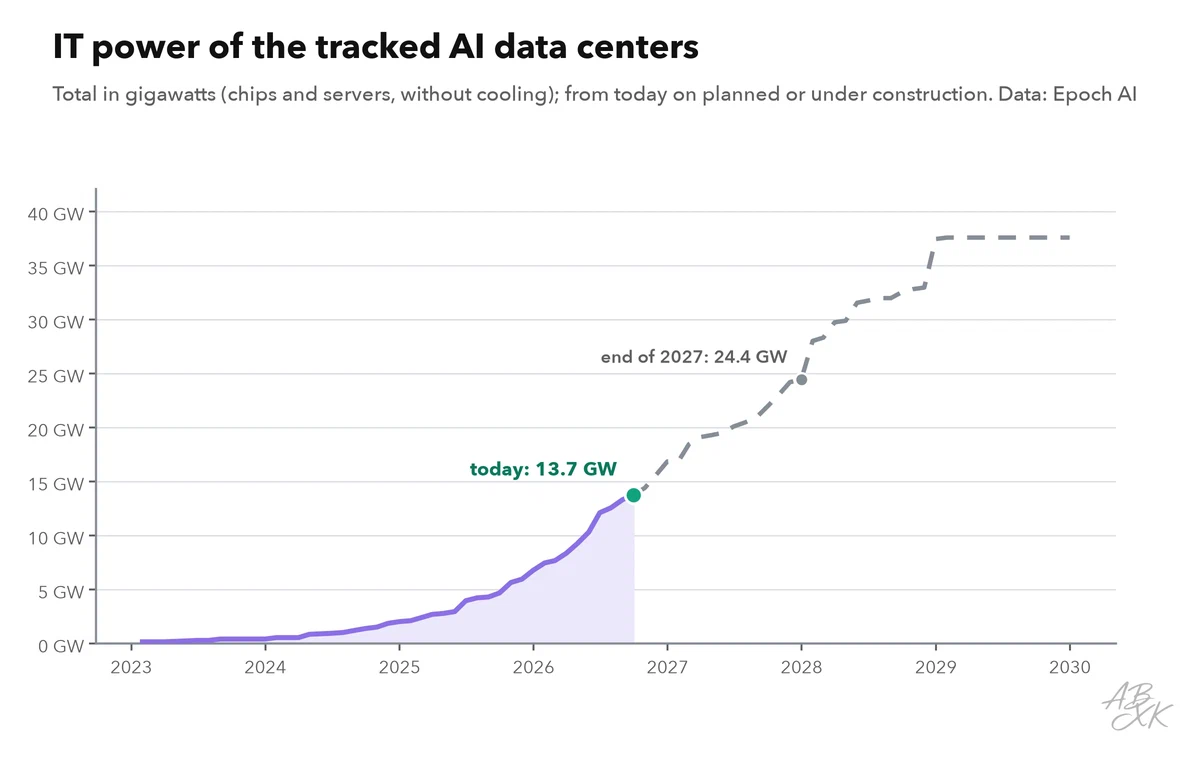
The data centers in the dataset draw 13.7 gigawatts for their chips and servers today. Including cooling and other systems, the sites need about 1.28 times as much, 17.6 gigawatts in total. Projects that are already under construction would raise the IT power to 24.4 gigawatts by the end of 2027, 1.8 times today’s level.
The dataset does not contain every AI data center in the world. Epoch AI estimates that it covers 44% of the AI compute deployed worldwide as of October 2026, with the best coverage for sites that went into operation from 2024 onward and for the US. The real totals are therefore higher.
| What the data shows | How it was estimated |
|---|---|
| IT power in megawatts | From cooling equipment seen on satellite images, permits and company statements |
| Compute in H100 equivalents | From the IT power and the energy efficiency of the most likely chips, or from reported chip numbers |
| Capital cost | From the IT power with a general cost-per-watt model |
| Dates of construction and operation | Mainly from commercial satellite imagery |
According to Epoch AI, 80% of the estimates are within a factor of 1.4 for power and 1.5 for compute, and the dates within six months.
The largest AI data centers
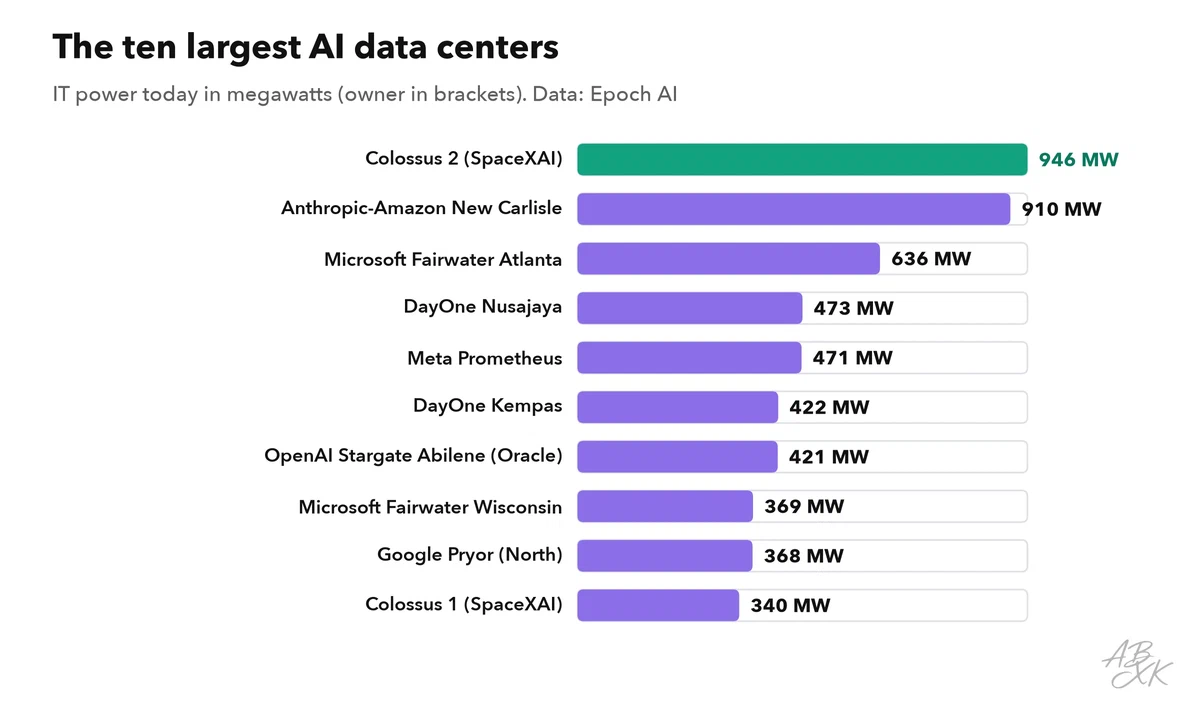
The largest site in the dataset already draws 946 megawatts for its IT alone. Almost all of the largest sites are in the US; two of the top entries are in Malaysia. The table lists the owner of the site, which is not always the company that uses the chips: several sites are built by cloud providers or developers and rented to AI labs.
| Data center | Owner | Country | IT power (MW) | H100 equivalents | Cost (US$ bn) |
|---|---|---|---|---|---|
| Colossus 2 | SpaceXAI | United States | 946 | 1,111,673 | 35.8 |
| Anthropic-Amazon New Carlisle | Amazon | United States | 910 | 685,912 | 34.5 |
| Microsoft Fairwater Atlanta | Microsoft | United States | 636 | 768,769 | 24.1 |
| DayOne Nusajaya | – | Malaysia | 473 | 583,837 | 17.9 |
| Meta Prometheus | Meta | United States | 471 | 536,343 | 17.8 |
| DayOne Kempas | – | Malaysia | 422 | 480,639 | 16.0 |
| OpenAI Stargate Abilene | Oracle | United States | 421 | 509,348 | 15.9 |
| Microsoft Fairwater Wisconsin | Microsoft | United States | 369 | 445,680 | 14.0 |
| Google Pryor (North) | United States | 368 | 636,685 | 13.9 | |
| Colossus 1 | SpaceXAI | United States | 340 | 275,796 | 12.9 |
| Google New Albany | United States | 333 | 323,901 | 12.6 | |
| Google Columbus | United States | 303 | 331,986 | 11.5 |
Data: Epoch AI, AI data centers, 94 data centers tracked, as of October 18, 2026, licensed CC BY 4.0. IT power = power drawn by chips and servers today, without cooling; H100 equivalents = compute expressed in NVIDIA H100 chips; cost = capital spending on buildings and equipment (2025 US dollars).
Who designs the chips
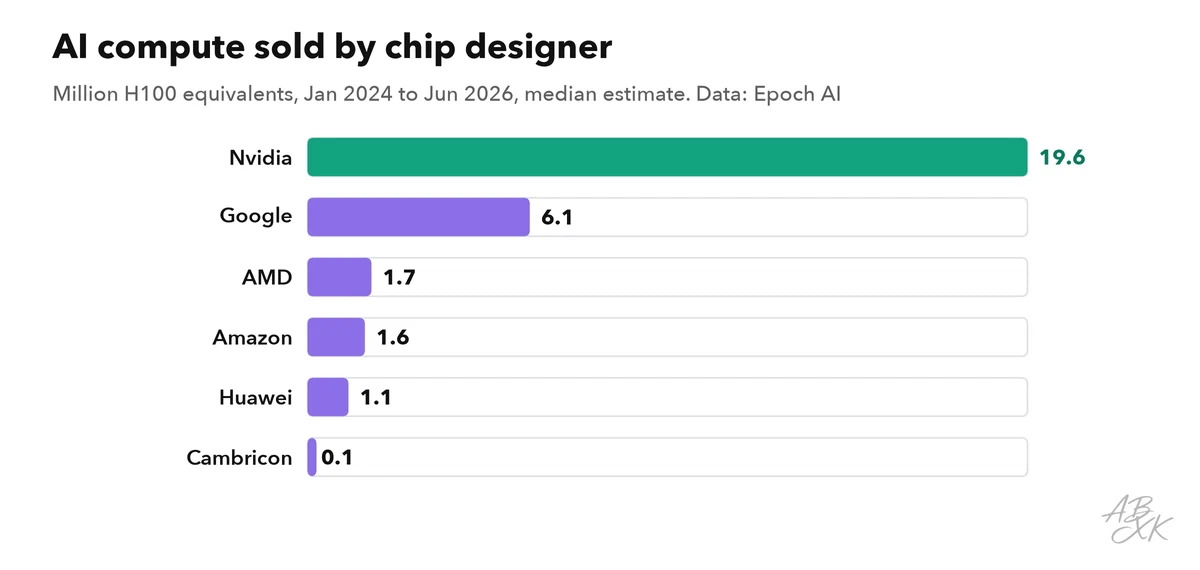
From the start of 2024 to mid-2026, Nvidia accounts for 65.1% of the AI compute sold, measured in H100 equivalents, a unit that converts the performance of any chip into the number of Nvidia H100 chips it equals. Google follows with its own TPU chips, which it uses in its data centers and rents out, then AMD, Amazon with its Trainium chips and the Chinese designers Huawei and Cambricon.
| Designer | Compute (million H100 equivalents) | Chips (million) | Power (MW) |
|---|---|---|---|
| Nvidia | 19.60 | 11.26 | 11,341 |
| 6.05 | 6.10 | 2,878 | |
| AMD | 1.74 | 1.16 | 1,027 |
| Amazon | 1.56 | 2.60 | 1,229 |
| Huawei | 1.12 | 1.82 | – |
| Cambricon | 0.06 | 0.23 | 46 |
Data: Epoch AI, Data on AI chip sales (median estimate), retrieved on October 18, 2026, licensed CC BY 4.0. One time window for all designers; “–” = not reported.
Who owns the compute
The large cloud and internet companies own most of the AI compute: Google, Microsoft, Amazon and Meta lead, followed by chips in China and Oracle. Epoch AI lists chips that reached China through smuggling as a separate, estimated line. “Others” covers smaller cloud providers, companies and research centers.
| Owner | Compute (million H100 equivalents) | Share |
|---|---|---|
| 5.05 | 24.1% | |
| Microsoft | 3.42 | 16.3% |
| Others | 3.36 | 16.1% |
| Amazon | 2.45 | 11.7% |
| Meta | 2.30 | 11.0% |
| China (bought legally) | 1.16 | 5.5% |
| Oracle | 1.14 | 5.5% |
| CoreWeave | 0.83 | 4.0% |
| China (smuggled, estimated) | 0.66 | 3.2% |
| xAI | 0.55 | 2.6% |
Data: Epoch AI, Data on AI chip owners (median estimate, cumulative since 2022), retrieved on October 18, 2026, licensed CC BY 4.0.
How fast the chips got
The fastest AI chip of 2017 managed 125 trillion operations per second at 16-bit precision, the precision used for most AI training. The fastest chips today are 20.1 times as fast. Lower precisions such as 8-bit and 4-bit, which newer chips support for running models, add even more speed, but they are not comparable across all chips, so the table uses 16-bit.
| Year | Chip | Maker | TFLOP/s |
|---|---|---|---|
| 2017 | NVIDIA V100 SXM2 | NVIDIA | 125 |
| 2018 | NVIDIA V100 DGXS 16 GB | NVIDIA | 125 |
| 2019 | NVIDIA V100S PCIe 32 GB | NVIDIA | 130 |
| 2020 | NVIDIA A100 SXM4 80 GB | NVIDIA | 312 |
| 2021 | AMD Radeon Instinct MI250X | AMD | 383 |
| 2022 | Biren BR100 | Biren | 1,024 |
| 2023 | AMD Instinct MI300X | AMD | 1,307 |
| 2024 | NVIDIA B200 | NVIDIA | 2,250 |
| 2025 | AMD Instinct MI355X | AMD | 2,517 |
| 2026 | Microsoft Maia 200 | Microsoft | 1,268 |
Data: Epoch AI, Data on machine learning hardware (178 chips), retrieved on October 18, 2026, licensed CC BY 4.0.
Why power, not chips, is the bottleneck
A data center that draws hundreds of megawatts around the clock needs a new grid connection and often new power lines, and those take longer to build than the data center itself. That is why AI companies now plan data centers next to power plants, build their own gas turbines or sign long-term contracts for nuclear power. Water is the second physical limit: evaporative cooling uses water, and dry cooling uses more electricity. Only 8 of the tracked data centers have a published water figure, so the dataset cannot yet show the total water use of AI.
How we counted
We used four datasets from Epoch AI: AI data centers, AI chip sales, AI chip owners and machine learning hardware, all licensed CC BY 4.0 and retrieved on the date given below each table. Power is IT power, the electricity drawn by chips and servers; the factor for cooling and other systems is the ratio of total site power to IT power across all tracked sites. For the time series, each data center keeps its last reported value until its next entry; values after today are plans and estimates. Chip sales cover the same time window for all designers, because Epoch AI’s series start at different dates.
How chips, sensors and models work together in machines that act in the real world is the subject of our learning path in Physical AI.