

AI development is expensive. Compute costs, data processing, and engineering time can quickly make budgets grow too high. We’ve seen projects where teams spent more on failed experiments than on the final working solution.
At ABXK.AI, we build AI systems for research and production. Over time, we’ve learned that reducing costs isn’t about cutting corners — it’s about working smarter. The most expensive AI project isn’t the one with the highest cloud bill. It’s the one that wastes months on approaches that don’t work. The goal isn’t to spend less — it’s to get better results per dollar spent.
Here’s how we keep costs down without losing quality.
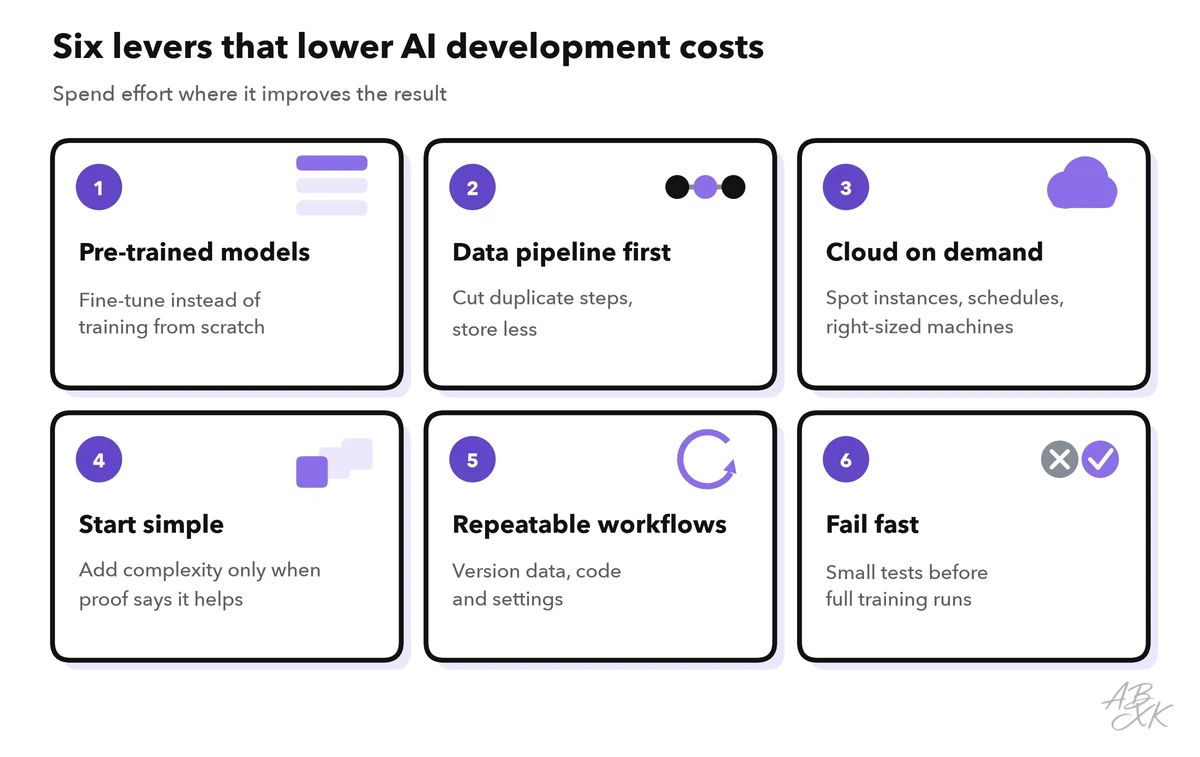
Six project levers that reduce AI development costs while maintaining quality. The levers for each LLM call follow in their own table below.
Start With Pre-Trained Models
Training a model from scratch is rarely necessary. Pre-trained models like GPT, BERT, or open-source vision models already contain knowledge from millions of dollars of computer processing. You can fine-tune them for your specific use case for much less money.
Instead of training on massive datasets from day one, you take an existing model and adapt it to your needs. Fine-tuning requires less data and less compute time, and it reaches usable results much faster.
We’ve seen teams spend weeks training custom models when a fine-tuned version would have worked just as well. The cost difference can be 10 times or more, especially when you include the time engineers spend.
Keep in mind that pre-trained models aren’t perfect for every task. If your field is very specialized or your data is very different from what the model was trained on, you may need more customization. Test early to find out.
Optimize Your Data Pipeline First
Bad data pipelines cost money in ways you might not notice. Slow processing means longer experiment cycles. Poor data quality means wasted training runs. Extra storage means unnecessary cloud bills.
Start by checking your data flow from source to model. Look for slow parts, repeated processing, and data you’re storing but never using. Clean up the pipeline before adding more computing power.
We once cut a client’s data processing costs by 40% just by removing duplicate transformations and compressing intermediate files. No change to the model, no change to results — just cleaner infrastructure.
One thing to avoid: premature optimization. Get a working pipeline first, then profile it to find the real bottlenecks. Optimizing the wrong thing wastes time.
Use Cloud Resources Strategically
Cloud computing makes AI accessible, but it also makes overspending easy. Running powerful computers all day, using machines that are too big, or keeping unused resources on can waste money quickly.
Match your computing power to your actual needs. Use spot instances (cheaper servers that can be stopped) for training jobs that can handle interruptions. Scale down during quiet periods. Choose the right machine types for your work—sometimes CPU is enough.
We’ve seen teams run expensive GPU computers around the clock when their actual training jobs only needed a few hours per day. Simple scheduling can cut compute costs by 50% or more.
Idle machines cost energy and water, not just money. According to the International Energy Agency, electricity demand from data centers is rising four times faster than demand from all other sectors (Source: reported by The Guardian, March 2026), and one study estimates that AI systems used 312.5 to 764.6 billion liters of water in 2025 (Source: de Vries-Gao, Patterns, December 2025). Switching off what you do not use cuts both.
Spot instances are cheap but can be interrupted. Design your training jobs to save progress regularly so you don’t lose work. Also, watch out for data transfer costs—they add up when moving large datasets.
Cut the Cost of Every LLM Call
If your product calls a language model through an API, the token bill often grows faster than the cloud bill. The big providers document the same few levers, and most of them cost nothing in quality:
| Lever | How it works | Saving according to the providers |
|---|---|---|
| Batch processing | Send requests that nobody waits for (reports, classification, evaluations) as one batch; results arrive within 24 hours | 50% on input and output tokens at OpenAI, Anthropic and Google (platform.openai.com, platform.claude.com, ai.google.dev) |
| Prompt caching | Keep the long, unchanged start of a prompt (instructions, documents) identical so the provider can reuse it | At Anthropic, cached input costs about a tenth of the normal input price; writing to the cache costs 25% extra for a five-minute lifetime (platform.claude.com). OpenAI and Google also bill cached input at a reduced rate |
| A smaller model for simple steps | Route classification, extraction and short answers to a small model, keep the large one for hard steps | Anthropic’s price list shows a factor of 40 per token between its current Haiku and Opus models (platform.claude.com, October 2026) |
| Less reasoning for routine tasks | Lower the reasoning effort where the task is easy | Reasoning tokens are billed as output tokens, so every saved reasoning step is saved money |
| Shorter prompts and answers | Remove unused context, cap the answer length, ask for structured output | Proportional to the tokens you no longer send or receive |
Measure before and after each change on a sample of real requests. A cheaper call that needs a second attempt is not cheaper.
Avoid Over-Engineering Early
It’s tempting to build complex systems from the start. Multi-model architectures, custom training frameworks, complex AI management systems—they all sound impressive. But complexity costs money, and early in a project, you don’t know what you actually need.
Start simple. Use basic models and straightforward infrastructure. Add complexity only when you have proof that it improves results. Every layer of complexity adds development time, work to maintain it, and things that can go wrong.
Some of our most successful experiments used surprisingly simple approaches. A well-tuned logistic regression can beat a complex neural network if the problem doesn’t need that level of power.
There’s a difference between simple and sloppy. Simple means choosing the right level of complexity for the problem. Sloppy means skipping validation and testing. Keep standards high even when the approach is simple.
Invest in Repeatable Workflows
When experiments aren’t repeatable, you waste time re-running tests, debugging different results, and doubting your findings. Making experiments repeatable isn’t just about good science—it’s about saving time.
Save versions of your data, code, and settings. Use tools that track experiments automatically. Make it easy to recreate any result from any point in your project history.
We’ve seen projects where teams couldn’t repeat their own best results because they lost track of which data version and settings produced them. They had to re-run weeks of experiments. Proper tracking prevents this completely.
Don’t make the tracking system too complex. Start with simple version control and experiment logs. Add more advanced tools only when the project size needs it.
Fail Fast and Learn Cheap
The biggest cost in AI development isn’t compute—it’s time spent on approaches that don’t work. The faster you identify dead ends, the less you spend on them.
Run small-scale tests before committing to full training runs. Validate assumptions with quick experiments. Set clear success criteria upfront so you know when to stop.
At ABXK.AI, we build prototypes specifically to test whether an idea is worth pursuing. If a quick experiment shows no signal, we move on without investing in a full implementation. This single habit has saved us more money than any infrastructure optimization.
“Fail fast” doesn’t mean “give up easily.” Some ideas need refinement before they show results. The goal is to distinguish between ideas that need iteration and ideas that are fundamentally flawed.
Explore our tools or read how we use VibeCoding to ship experiments faster.