

Every day, people mention brands in posts, reviews, forums, videos and news articles. Most of these mentions never reach the company. Some are praise you could share, some are questions nobody answers, and a few are the first signs of a problem that is about to grow. Brand monitoring finds these mentions. AI helps you sort them, spot patterns and draft replies faster.
This is part 4 of Level 2 in our AI Work learning path. In Level 1, you used AI for marketing content, the messages you send out. This part covers the other direction: what others say about you and how you respond. You will learn the difference between monitoring and listening, how to set up search queries, what sentiment analysis can and cannot do, when an alert means a crisis, how AI can draft replies that people approve and what a useful monthly report contains.
Monitoring, listening, managing: three different jobs
Three terms are often mixed up. They describe different jobs, and many teams need all three:
| Job | Question it answers | Typical result |
|---|---|---|
| Brand monitoring | What are people saying about us right now? | A feed of mentions, alerts, replies |
| Social listening | What patterns show up over weeks and months? | Topics, sentiment trends, share of voice |
| Social media management | How do we plan, publish and respond on our own channels? | A content calendar, approvals, one inbox, reports |
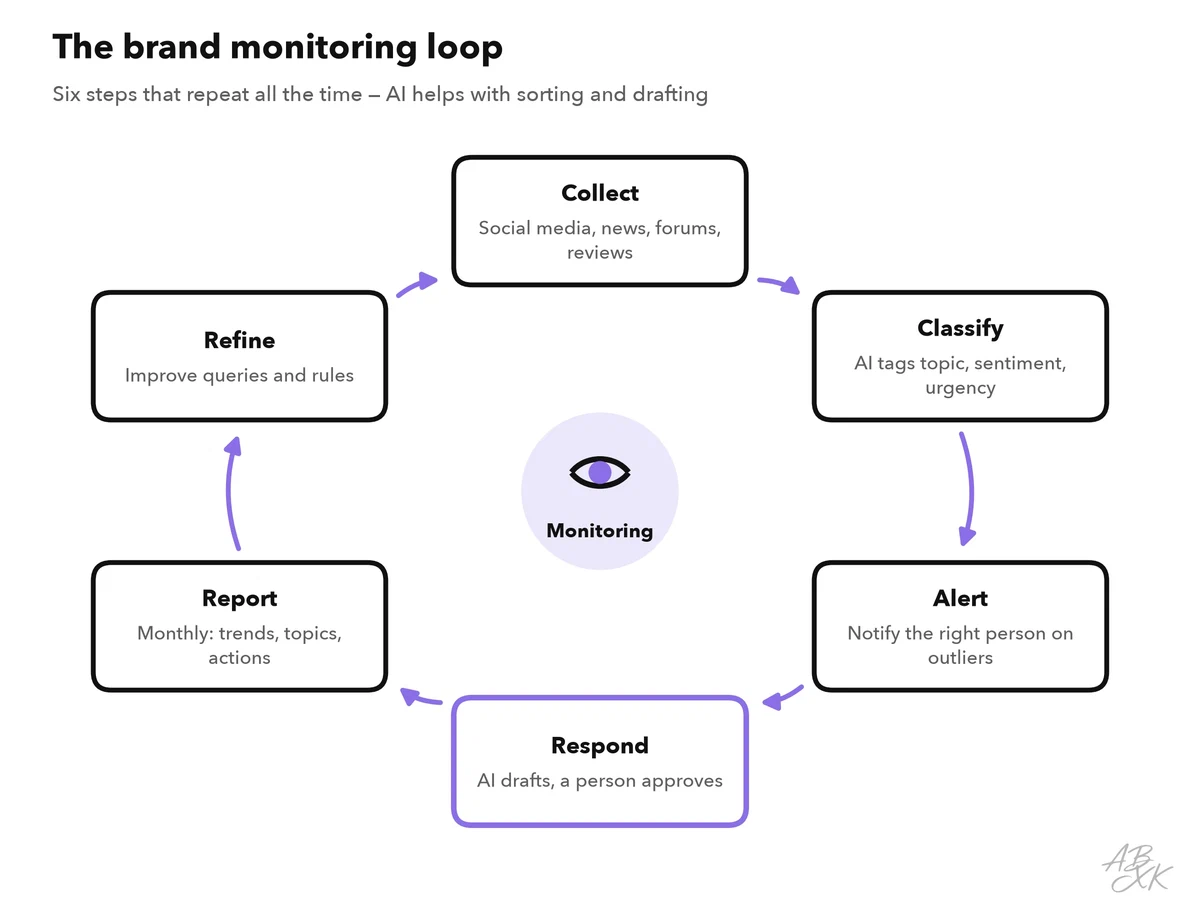
Brand monitoring, also called media monitoring, collects mentions of your brand across the web. Social listening analyzes those mentions over time to find patterns, such as a topic that keeps coming back. Social media management tools handle your own accounts: they plan and publish posts and bring comments and messages into one place. Together, they form a loop that never really ends:
Our comparison lists tools for these jobs in the area Marketing & Advertising. According to the vendor, Brand24 collects brand mentions from social media, news, blogs, forums, podcasts and reviews:
For the other jobs, Vista Social plans, publishes, replies and reports across several social profiles. SleekFlow brings messages from WhatsApp, Instagram and live chat into one inbox, and Rebolt bundles website, social media and AI-assisted marketing for home service businesses. All three descriptions come from the vendors:



Short descriptions from our tool comparison, based on the vendors' information — not tested by ABXK.
Set up queries that find the right mentions
A monitoring tool only finds what its query describes. A query is a saved search: a set of words and rules that decides which mentions the tool collects. A good query has five building blocks:
- Brand names in all spellings. If your brand is called Northwind, include “Northwind”, “North Wind” and “#northwind”.
- Product names and campaign hashtags, so you can see feedback per product and per launch.
- Common misspellings, because people type fast.
- Competitors, so you can compare how often people talk about you and about them.
- Exclusions. Many names have other meanings. A query for a brand called Jaguar needs to exclude posts about the animal, or your feed will fill up with wildlife photos.
Most tools combine these blocks with the operators AND, OR and NOT. Start broad, read what comes in for a few days, then add exclusions until most results are relevant.
Know the limits, too. Monitoring tools only see what they can access: public posts, news sites, blogs, forums and review sites. Private groups and messenger chats stay invisible, and each platform decides how much data it shares. So “no mentions” does not mean “nobody is talking about us”.
What sentiment analysis can and cannot do
Sentiment analysis labels each mention as positive, negative or neutral. Modern tools use language models, which understand context much better than the old keyword lists did. But human language is full of traps:
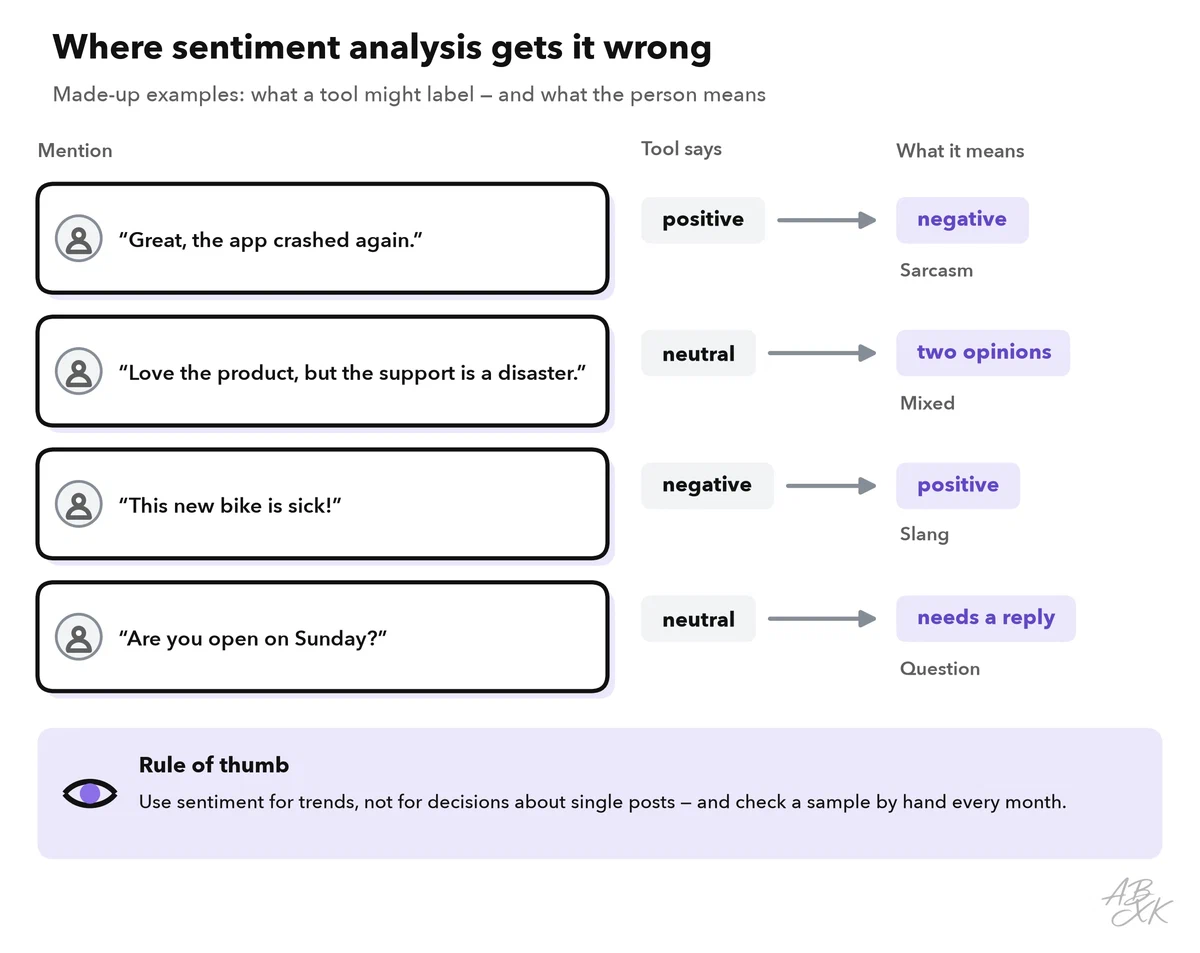
- Sarcasm and irony. “Great, the app crashed again” uses a positive word to say something negative.
- Mixed opinions. “Love the product, but the support is a disaster” holds two opinions. One label cannot capture both.
- Slang. In “This new bike is sick!”, the word “sick” is praise.
- Neutral, but urgent. “Are you open on Sunday?” has no mood at all, yet it needs a reply today.
The practical rule: use sentiment for trends, not for decisions about single posts. A rising share of negative mentions about delivery is a useful signal, even if some labels are wrong. To know how far you can trust the trend, read a sample of mentions by hand every month and compare your judgment with the tool’s labels. Check each language you monitor separately.
Alerts and crisis signals
Nobody reads every mention in real time. Alerts notify the right person when something unusual happens. Useful triggers are a sudden jump in the number of mentions, a sharp shift toward negative sentiment, a mention by an account with a large reach, such as a journalist, and risk words such as “recall”, “lawsuit”, “data breach” or “food poisoning”.
Agree in advance who acts on which signal. Four alert levels are a practical start:
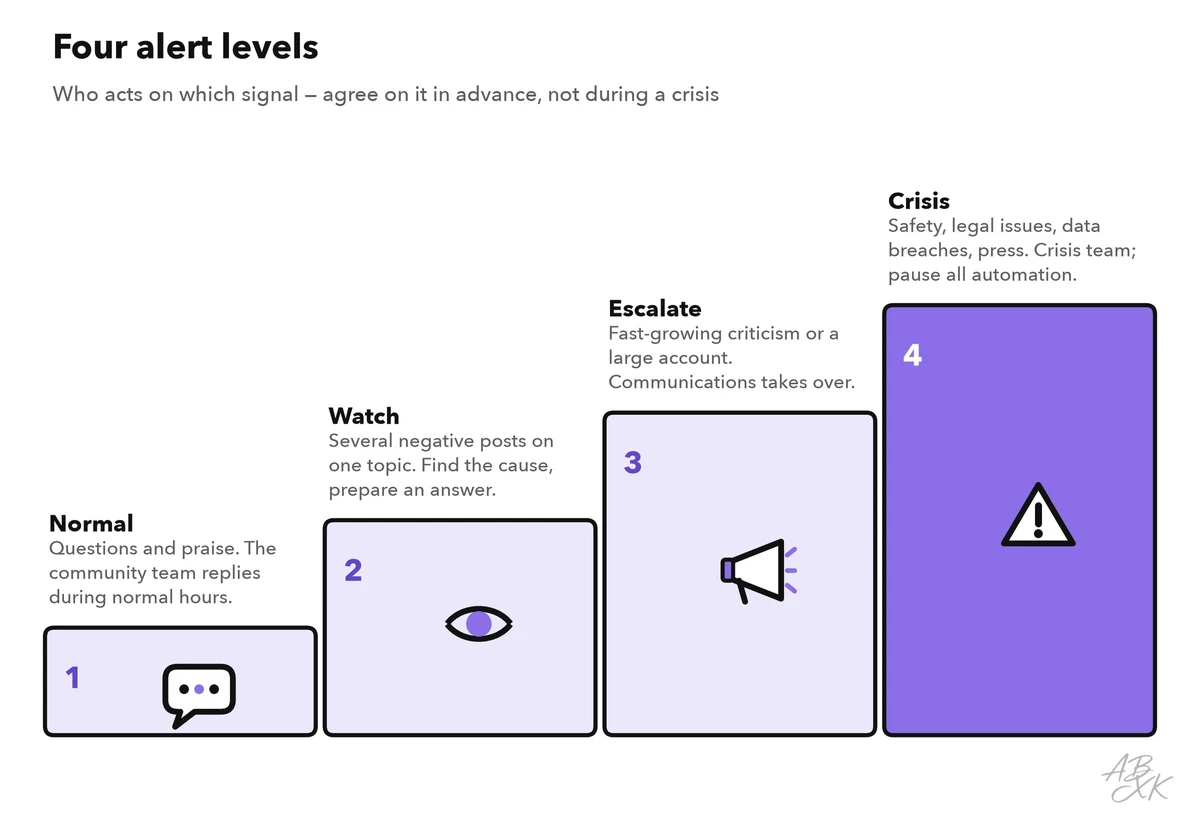
At the crisis level, pause all scheduled posts and automatic replies. A cheerful product post in the middle of a recall looks careless, even if it was planned weeks ago. Prepare short holding statements in advance: approved first replies that show you are aware of the problem before all the facts are in.
AI-drafted replies, approved by people
AI can draft replies to comments, reviews and messages in your brand voice, which saves a lot of time. Give it two things: a short guide to your brand voice and a list of approved facts, such as delivery times, return rules and opening hours. Then let a person approve each reply before it goes out. They check three points: Are the facts right? Does the tone fit? Does the reply promise anything, such as a refund, that nobody approved?
Not every reply needs the same reviewer. Routine thank-you replies can be approved in batches by the community manager. Complaints go to customer service. Anything about safety, legal issues or the press goes to the communications lead. Level 3 shows how to design such human checks and escalation paths in detail.
People also ask AI assistants about brands, and the answers draw on what is written about you online. Level 3 shows how to check how your brand shows up in AI answers.
A monthly report that leads to action
A monitoring report is only useful if it changes something. Keep it short and include the same metrics every month, so trends become visible:
| Metric | What it shows | Watch out |
|---|---|---|
| Mentions | Volume per month, compared with the month before | A spike can mean a campaign, a crisis or a wave of bot posts |
| Share of voice | Your share of all mentions compared with chosen competitors | Comparable only if the queries are built the same way |
| Sentiment trend | Share of positive and negative mentions over time | Report the error rate from your manual sample |
| Top topics | What people talk about most: delivery, price, quality | Group by topic, not by single posts |
| Response time | Time from a mention to the first reply | Count only mentions that need a reply |
| Actions | What changed because of the feedback | The proof that monitoring is worth the effort |
End each report with two or three decisions: a fix for a product page, a new answer in the FAQ, a topic for the next campaign. A report without actions is just a collection of charts.