

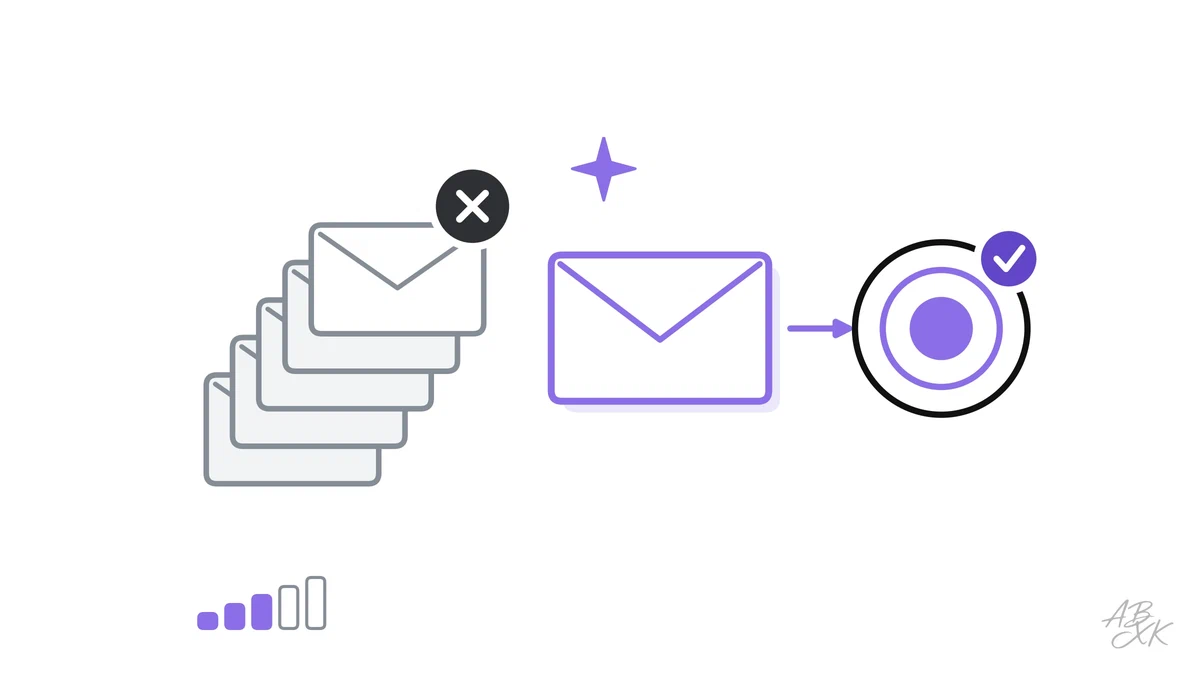
Sales tools now make it easy to send hundreds of “personalized” emails a day. That is exactly the risk. Messages that only look personal, sent in large numbers, annoy the people you want to win, end up in spam folders and can break the law. Good outreach automation works the other way around: fewer, better messages to the right people, with a person in control.
This is part 3 of Level 2 in our AI Work learning path. In Level 1, you learned how to find and qualify leads with AI. This part covers what comes next: sequences, personalization at scale, email deliverability, the legal rules, AI sales agents, human review and the metrics that show whether your outreach works.
What a sequence is and when it must stop
A sequence, also called a cadence, is a planned series of messages to one contact over several days or weeks. It can mix channels such as email, phone and LinkedIn. Sales engagement platforms send the steps on schedule and track what happens.
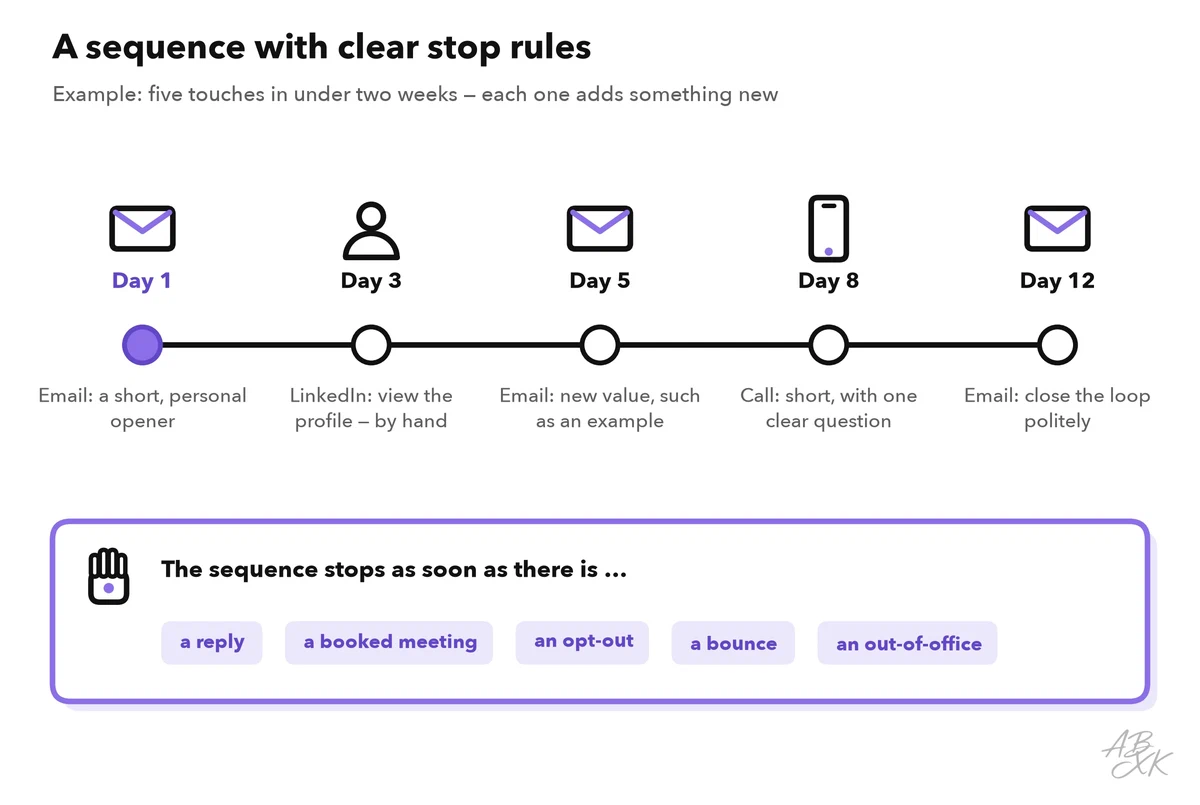
Three rules make a sequence respectful:
- Every step adds something new: a useful observation, a relevant example or a clear question. “Just following up” is not a reason to write.
- The sequence stops at the first signal: a reply, a booked meeting, an opt-out, a bounce or an out-of-office message. A reply must never be followed by an automatic “friendly reminder”.
- Short beats long. A few well-spaced touches work better than a long chain of reminders that trains people to ignore you.
Do LinkedIn steps by hand. LinkedIn’s user agreement forbids bots and other unauthorized automated methods to add contacts or send messages (Source: LinkedIn User Agreement, linkedin.com).
Personalization that is real
AI promises “personalization at scale”. It can research a company, find a reason to write and draft a first line. The table shows four levels of personalization:
| Level | Example | Effort | Risk |
|---|---|---|---|
| Merge fields | “Hi Anna” plus the company name | Low | Feels generic; a wrong name is embarrassing |
| Segment | One message for all logistics firms of a certain size | Low | Works only if the segment is narrow |
| Trigger | A reference to a new job opening, a new location or a product launch | Medium | The trigger must be real and current |
| One-to-one | Research on the person’s role and the company’s challenge | High | Worth it only for your most important accounts |
For the last two levels, AI can do the research and the first draft. It can also invent facts: a funding round that never happened, a wrong job title or a quote from an interview the person never gave. Check every claim about a prospect before you send it. A simple test helps: if the prospect asked “Where did you read that?”, could you answer? If not, delete the sentence.
Deliverability: reaching the inbox
Deliverability describes whether your emails reach the inbox rather than the spam folder. It depends on five layers, and a problem in any one of them can push your messages into spam:
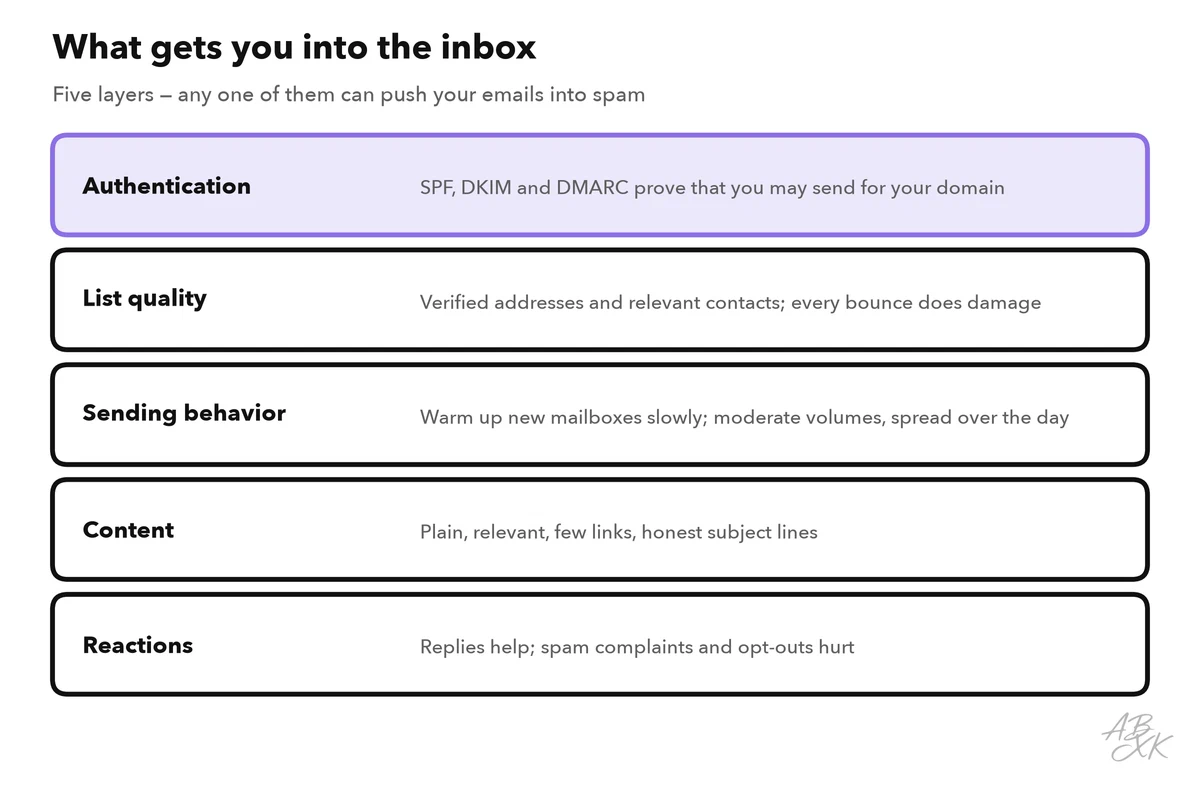
The first layer is technical. SPF lists the servers allowed to send email for your domain. DKIM adds a digital signature to each message. DMARC tells receiving servers what to do when a message fails these checks. Google’s sender guidelines require SPF or DKIM from all senders who write to Gmail accounts. Senders of more than 5,000 messages a day need both SPF and DKIM, plus DMARC, and their marketing messages must offer one-click unsubscribe. Google asks senders to keep the spam rate reported in its Postmaster Tools below 0.1 percent and never to reach 0.3 percent (Source: Google, Email sender guidelines, support.google.com).
The other layers are habits:
- Verify addresses before you send. Bounces signal a bad list to mail providers.
- Warm up new mailboxes slowly and keep daily volumes moderate. Many teams send cold outreach from a separate domain or subdomain, so a problem does not hit the domain that sends invoices and support replies.
- Write plain emails: short, few links, no images that carry the message, and a subject line that matches the content.
- Watch the reactions. Replies help your reputation. Spam complaints hurt it more than anything else.
The legal rules: consent, opt-out, honesty
Part 1 of Level 1 covered the data protection basics for business contacts: the legal basis, the duty to inform and the right to object. Automation adds one challenge: a tool writes to many people at once, so every rule must also work at scale. Three points matter most:
- United States. The CAN-SPAM Act also covers business-to-business email and requires honest sender details and subject lines. For automated sequences, two deadlines matter: you must honor an opt-out within 10 business days, and the opt-out mechanism must keep working for at least 30 days after you send (Source: Federal Trade Commission, CAN-SPAM Act compliance guide, ftc.gov).
- European Union. An objection to direct marketing needs no reason, and there is no exception: once someone objects, you may no longer use their data for it (GDPR, Article 21). Every tool that sends must therefore know about every objection.
- Germany. Under the Act against Unfair Competition (UWG), advertising by email generally requires the recipient’s prior express consent, also between businesses. A narrow exception covers existing customers.
Keep one suppression list: everyone who opted out never gets outreach again, in any tool and from any colleague. This overview is not legal advice, so check your outreach with your legal team, especially before you write to contacts in several countries.
AI sales agents and human review
An SDR (sales development representative) is the person who makes first contact with potential customers and books meetings for the sales team. AI SDRs are AI agents that take over parts of this job: they pick contacts, write and send messages and answer replies.
Our comparison lists such tools in the area Sales & Leads. According to the vendors, AiSDR handles first outreach by email, LinkedIn and text message and replies to responses. Reply.io covers lead search, email warm-up and validation and multichannel sequences. Amplemarket combines prospecting, data enrichment and outreach. Close is a CRM with built-in calling, email and automation, and Claap records sales calls and updates the CRM once a reply turns into a meeting:





Short descriptions from our tool comparison, based on the vendors' information — not tested by ABXK.
The more an AI agent does on its own, the more human review matters. Three review modes work in practice:
- Approve before sending for every new segment, every new template and your most important accounts.
- Spot checks once quality is stable: a person reads a sample of messages every day.
- Automatic sending with guardrails only for fixed templates and verified data.
Replies are the riskiest part. A prospect who writes “please remove me”, “we have a complaint” or “I’m on parental leave” needs a careful answer, or none at all. Let the AI sort replies, but let people answer them:
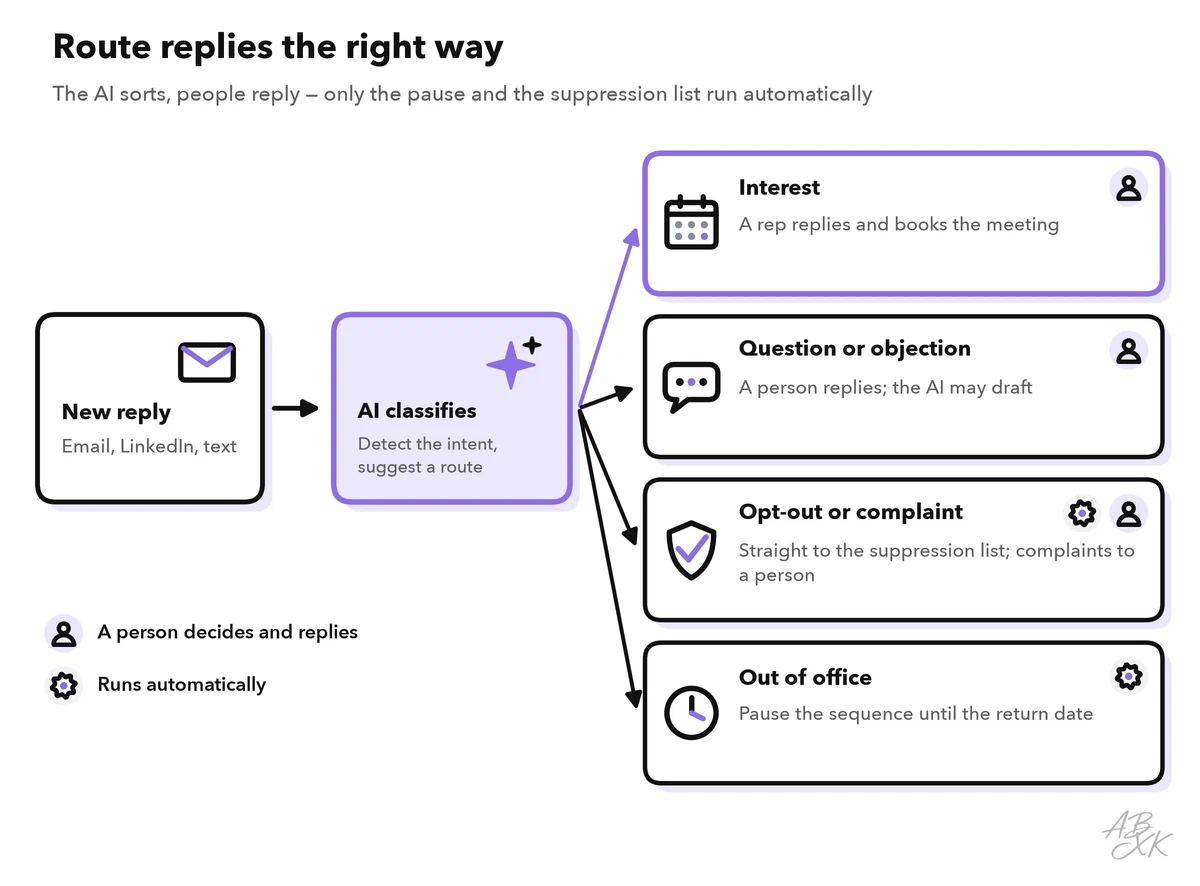
Level 3 shows how to set such human checks and escalation paths for any AI workflow.
Metrics that show whether outreach works
For years, the open rate was the favorite metric. Today it is unreliable. Apple’s Mail Privacy Protection, introduced in 2021, loads email images in the background, so many emails count as “opened” even if nobody read them. Measure further down the funnel instead:
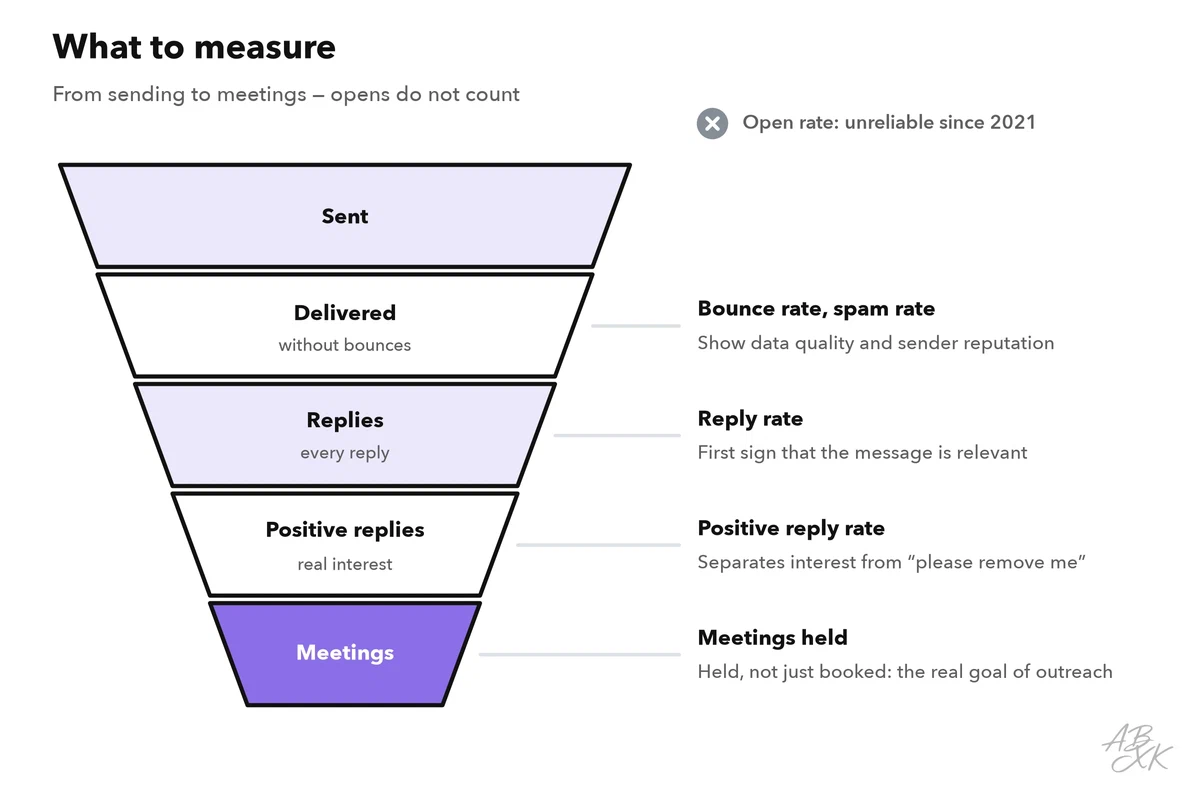
| Metric | How to calculate it | What it tells you |
|---|---|---|
| Bounce rate | Bounces ÷ emails sent | The quality of your contact data |
| Spam complaint rate | Complaints ÷ emails delivered | Your reputation with mail providers |
| Reply rate | Replies ÷ emails delivered | Whether your messages are relevant at all |
| Positive reply rate | Interested replies ÷ emails delivered | Real interest, not “please remove me” |
| Opt-out rate | Opt-outs ÷ emails delivered | A rising rate means the wrong audience or too many messages |
| Meetings held | Meetings that took place ÷ contacts reached | The real goal of outreach |