

Ask ten companies for their AI strategy, and many will show you a list: the assistant everyone may use, a chatbot on the website, three pilots in different departments. A list like this is not a strategy. It does not say which goals AI should serve, which projects come first, what the company must build up to scale them or what it will not do. The usual result is a pile of pilots that never reach daily work.
This is part 1 of Level 4, the expert level of our AI Work learning path. Levels 0 to 3 covered single use cases, tool choice, workflows and pilots. Now you zoom out to the whole company. You will learn how to set an ambition, manage use cases as a portfolio, name the capabilities you need, decide between buying and building, plan a roadmap in three horizons and fund it in stages. The other parts of this level go deeper into ROI, governance, adoption and agentic workflows.
Strategy means making choices
An AI strategy is a short set of decisions that links business goals to AI use cases — and to the capabilities those use cases need. It answers four questions: Where should AI create value for us? In which order? What do we need to build up for it? How will we know that it works?
The first decision is the ambition. Three levels are common:
- Efficiency: do today’s work with less effort, for example faster replies in customer service or less manual data entry.
- Better service and products: improve quality, speed or the customer experience, for example answers around the clock or more relevant offers.
- New business: offer something that only works with AI, for example a new service built on your own data.
Many companies start with efficiency. That is fine, but say it openly. An efficiency ambition needs a different portfolio, budget and set of metrics than an ambition to build new business.
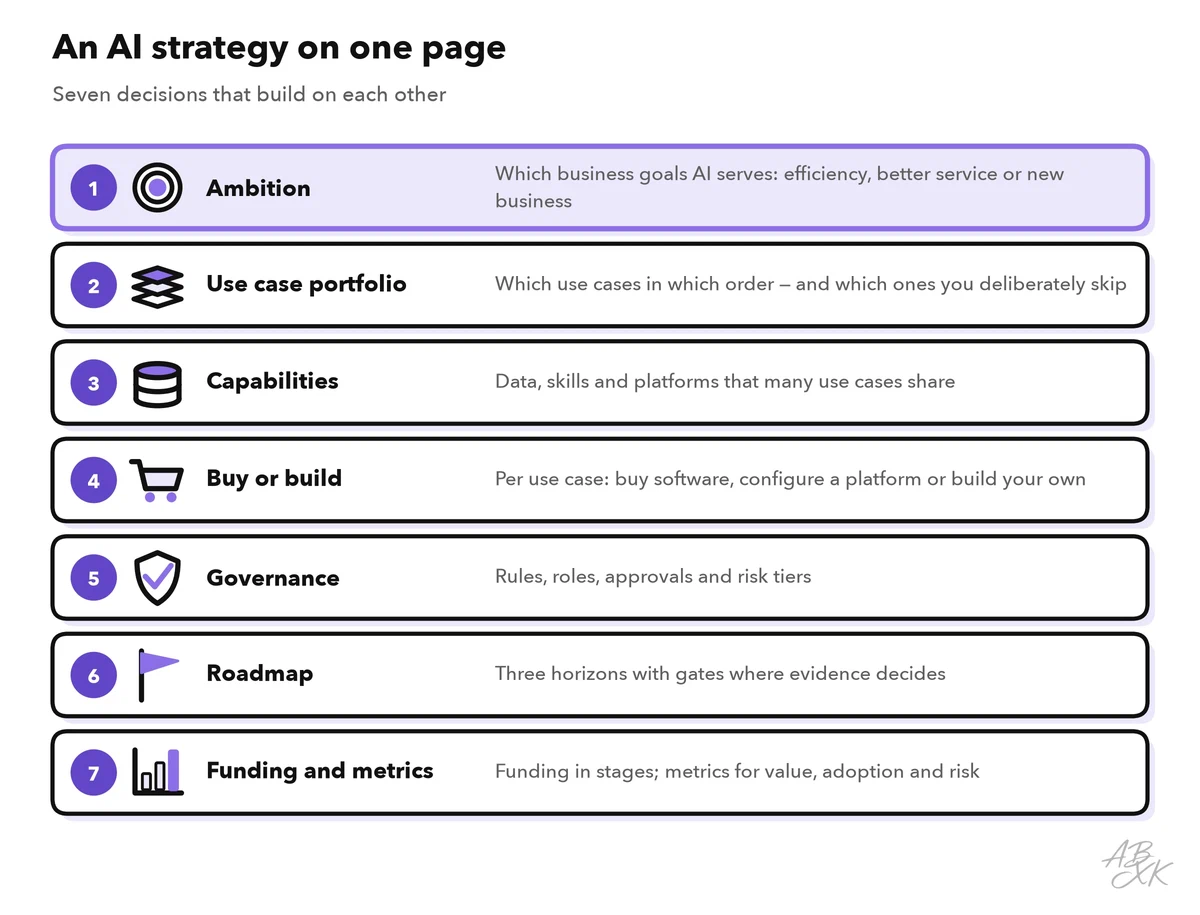
Write the strategy on one page. If it needs thirty slides, it is usually a list of projects in disguise. The figure shows the seven decisions that belong on that page, and the rest of this article walks through them.
Manage use cases as a portfolio
A use case is a specific task in a specific process where AI helps, such as “draft replies to delivery questions in the help desk”. Collect use cases from all departments. Level 3 used a similar matrix to pick a single pilot; here, it sorts the whole portfolio. Score each use case on two axes:
- Value: the effect on a business goal, how often the task occurs and how much time, revenue or risk is involved.
- Feasibility: whether the data exists and is good enough, whether the process is clear, how high the risk is, how hard the integration is and whether you have the skills.
Many use cases fail on feasibility. A use case can be valuable and still not ready, for example because customer data sits in five systems. Level 0 explains why AI needs good business data.
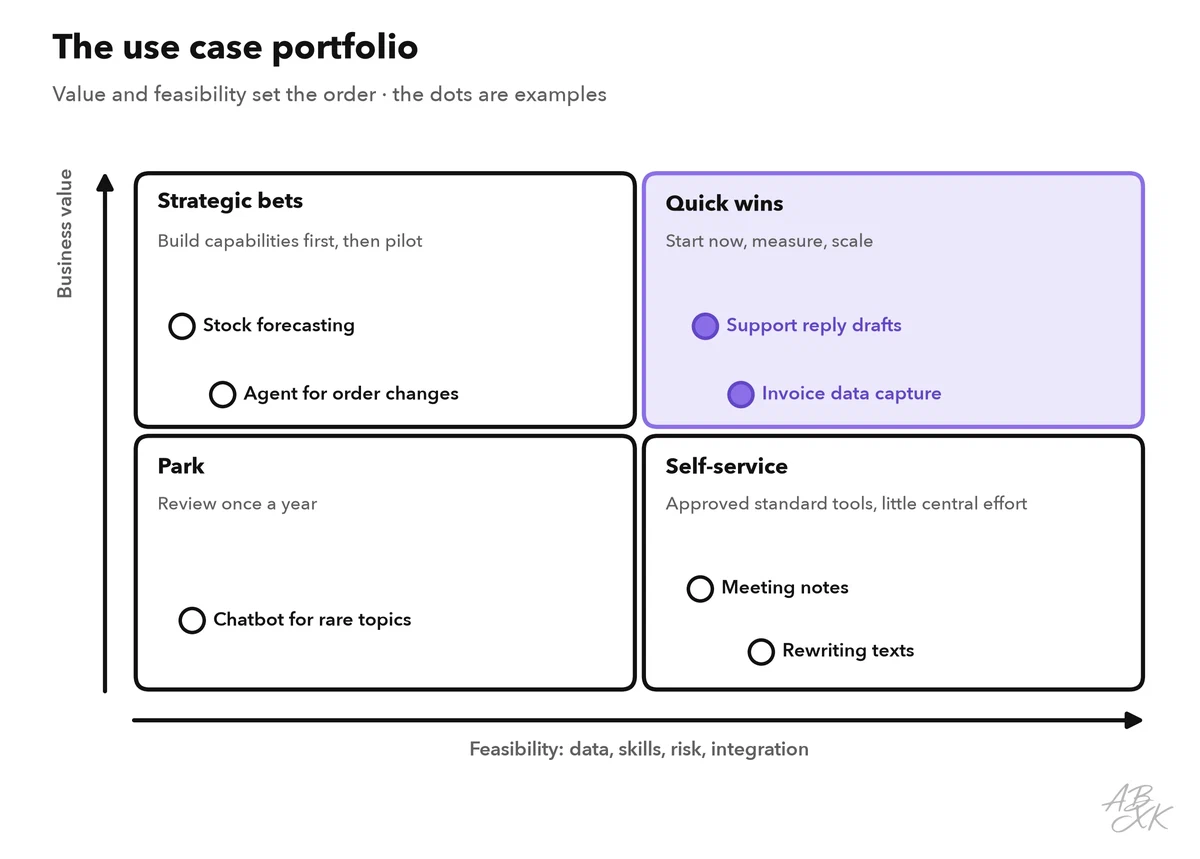
The four fields lead to four different actions. Quick wins go into the next pilot wave. Strategic bets do not start as pilots. They start with the capability they lack, often data. Self-service cases need no central project: approve a standard tool and let teams use it. Use cases you park come back at the next annual review.
Then balance the portfolio. Quick wins alone save time, but they never change how the company works. Strategic bets alone show no results for a year and lose support. A balanced portfolio combines several quick wins that build skills and trust with a few strategic bets and some small experiments. The table shows how an example portfolio could look:
| Use case (example) | Value | Feasibility | Decision |
|---|---|---|---|
| Draft replies to common support questions | High: many tickets every day | High: help pages and ticket history exist | Quick win, horizon 1 |
| Capture data from supplier invoices | High: a lot of manual typing | High: standard documents, clear rules | Quick win, horizon 1 |
| Forecast stock levels | High: less overstock, fewer stockouts | Low: sales data spread across systems | Strategic bet: fix the data first, horizon 2 |
| Agent that changes orders on its own | High: saves many steps | Low: needs write access and strong controls | Strategic bet, horizon 3 |
| Meeting notes | Medium | High: ready-made tools exist | Self-service with an approved tool |
| Chatbot for rare topics | Low: few requests | Low: little content to learn from | Park |
Name the capabilities you need
Pilots fail to scale for the same reasons again and again: missing data, missing skills, no platform to run them on. These are capabilities — abilities the company builds once and reuses across many use cases. Three matter most:
- Data. Clean core data in the CRM, the help desk and the ERP system, an owner for each important data set, and documentation that a bot can use as its knowledge.
- Skills. Basic AI literacy for everyone, champions in each team, and a few specialists who can evaluate AI outputs, write prompts and connect systems. In the EU, the AI Act asks companies that use AI systems to support AI literacy among their staff (Article 4).
- Platforms. An approved assistant, a list of approved tools, an integration layer that connects AI to your systems, single sign-on, logging and access to more than one model.
The capability view changes the budget discussion. Without it, every project pays again for data access, security reviews and training. With it, the second and third use case can reuse what the first one built.
Decide where to buy, configure or build
For each use case, choose one of three sourcing options:
| Option | What it means | Strengths | Weaknesses | Fits when |
|---|---|---|---|---|
| Buy | Business software with AI built in, used as delivered | Fast start, the vendor maintains it | Little differentiation, data sits with the vendor, risk of lock-in | The task is the same in many companies |
| Configure | Your own assistants and automations on an approved platform | Faster than code, fits your process | Limited by the platform, needs internal owners | The process is yours, the technology is standard |
| Build | Your own solution on model APIs, possibly with open-weight models | Full control, can set you apart | Slow, costly to maintain, needs specialists | Your data or process is a real advantage |
A useful rule: buy where AI is a commodity, build where it makes you different. For standard tasks in sales, service, marketing, e-commerce and operations, there is usually something to buy. Our tool comparison for AI Work currently lists 46 tools. Here are three examples where AI is at the core of the product. According to the vendors, Typewise runs AI agents for customer service that work in CRM and ERP systems, DataSnipper automates the extraction and cross-referencing of documents in audit and finance, and Claap turns sales calls into structured notes and CRM updates:



Short descriptions from our tool comparison, based on the vendors' information — not tested by ABXK.
Whatever you choose, plan for change. The language models behind these products improve every few months, and the leading model changes often. The chart shows who held the record on the Epoch Capabilities Index, a score that combines many benchmarks into one number per model. You can compare the current models in our LLM database.
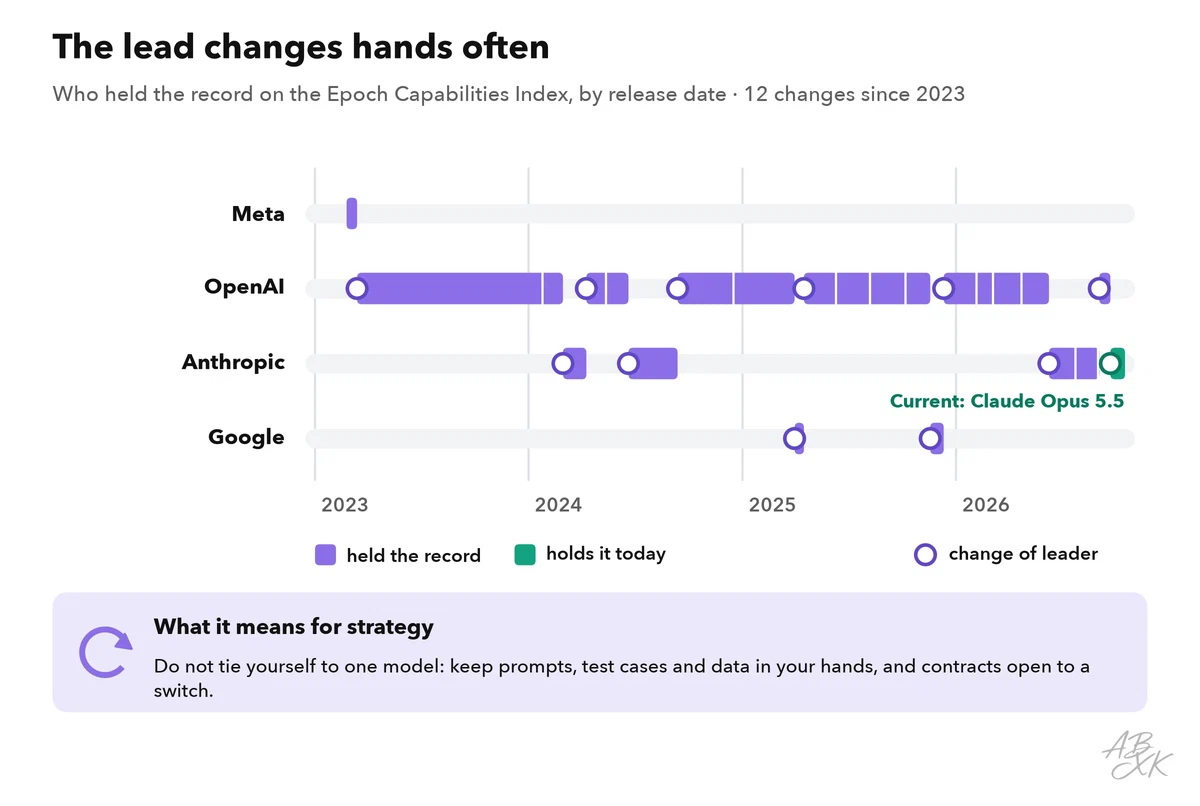
Three habits keep you flexible. Keep your prompts, test cases and data in your own hands. Prefer tools that let you switch the model behind them. And agree on data export and exit terms before you sign a contract.
Plan the roadmap in three horizons
A roadmap turns the portfolio into a sequence. A proven structure comes from strategy work: the three horizons model, which the McKinsey consultants Mehrdad Baghai, Stephen Coley and David White described in their book The Alchemy of Growth. In the original model, the horizons are not phases. They are portfolios that a company manages at the same time: today’s core business, emerging businesses and options for the future. For an AI roadmap, read them as the time when the main results are due:
- Horizon 1 (0–6 months): foundations and quick wins. Approved tools and rules, AI basics for all staff, an AI inventory and two or three quick wins in daily use.
- Horizon 2 (6–18 months): scale what works. Roll the quick wins out to more teams, connect AI to core systems and start the strategic bets.
- Horizon 3 (18–36 months): redesign processes. Change whole processes instead of single tasks, including agents that act within clear controls.
Work on all three starts early. The data work for a horizon 2 bet often begins in horizon 1.
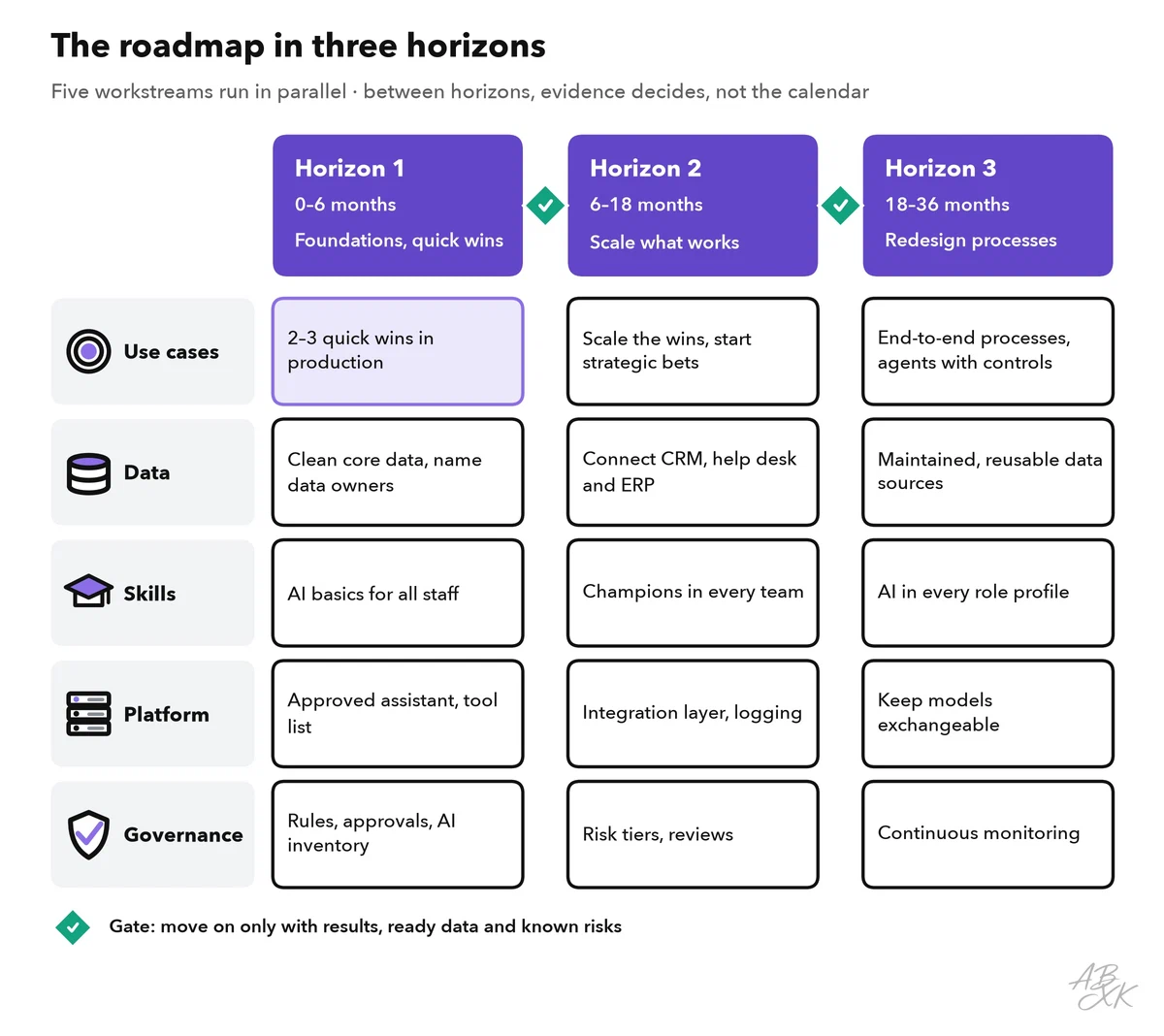
Between the horizons sit gates: decision points where you check results, data readiness and risks. Move on when the evidence is there, not when the calendar says so. Each use case also passes its own small gates, from idea to pilot to production. Level 3 shows how to run an AI pilot project with clear success criteria and a go/no-go decision.
Fund in stages and measure progress
Fund AI like a portfolio, not like one large project. Give a small budget for discovery, more for a pilot and the full budget for scaling only when the pilot has shown results. Fund the shared capabilities centrally, because no single department will pay for a platform that everyone uses. Let the departments that receive the benefit co-fund their use cases. That keeps the business case honest.
Plan the full cost, not only licenses: integration, data work, training, change management, human review of AI outputs and usage-based model costs that grow with volume. Part 2 of this level shows how to measure the ROI of AI at work with all of these costs included.
Measure progress on five levels, from the portfolio down to risk:
| Level | Example metric | Warning sign |
|---|---|---|
| Portfolio | Use cases per stage: idea, pilot, production, stopped | Many pilots, nothing in production, nothing stopped |
| Adoption | Share of licensed users who use the tool every week | Licenses bought, use drops after the first month |
| Value | Realized benefit compared with the business case | “Hours saved” that change no business goal |
| Capabilities | Staff with AI training, data sets with a named owner | Every project rebuilds data access and training |
| Risk | AI incidents, overdue reviews, tools outside the inventory | Customers find problems before your controls do |
A stopped pilot is not a failure. A portfolio that never stops anything is not being managed. Software for strategy execution and goals can host such a scorecard. According to the vendors, ElevateForward.ai helps turn strategy into actions and track their execution, and Databox combines dashboards, automated reports and goals:


Short descriptions from our tool comparison, based on the vendors' information — not tested by ABXK.
Governance belongs on the strategy page too: who approves new tools and use cases, which risk tiers exist and who answers for decisions made with AI. Part 3 covers AI governance for business teams in detail.
Common mistakes in AI strategies
Check your draft against these patterns. Each one looks harmless at first and becomes expensive later:
| Mistake | What happens | Better |
|---|---|---|
| Starting with tools | Licenses without use cases, low use | Start from business goals and use cases |
| Too many pilots at once | Budget spread thin, nothing reaches production | Fewer pilots, each with a scaling plan and a decision date |
| No shared foundations | Every project rebuilds data access and controls | Fund data, platform and training centrally |
| Betting on one model | You are locked in when the lead changes | Own your prompts, test cases and data; keep exit terms |
| Governance as an afterthought | Shadow AI, late stops by legal or the works council | Set rules and approval paths in horizon 1 |
| Counting activity, not value | Many pilots, no proof of value | Track realized value and stopped use cases |
| Ignoring energy and water | Large models for small tasks; costs and emissions grow with every request | Use the smallest model that does the job; ask vendors for energy and water figures |
The last row is missing from many lists. AI’s footprint is growing fast: according to the International Energy Agency, electricity demand from data centers is rising four times faster than demand from all other sectors (Source: reported by The Guardian, March 2026). One study estimates that AI systems alone caused 32.6 to 79.7 million metric tons of CO₂ in 2025, a range that includes New York City’s 52.2 million metric tons in 2023, and used 312.5 to 764.6 billion liters of water (Source: de Vries-Gao, Patterns, December 2025). Large providers publish few AI-specific figures, so ask for them in every tender.