

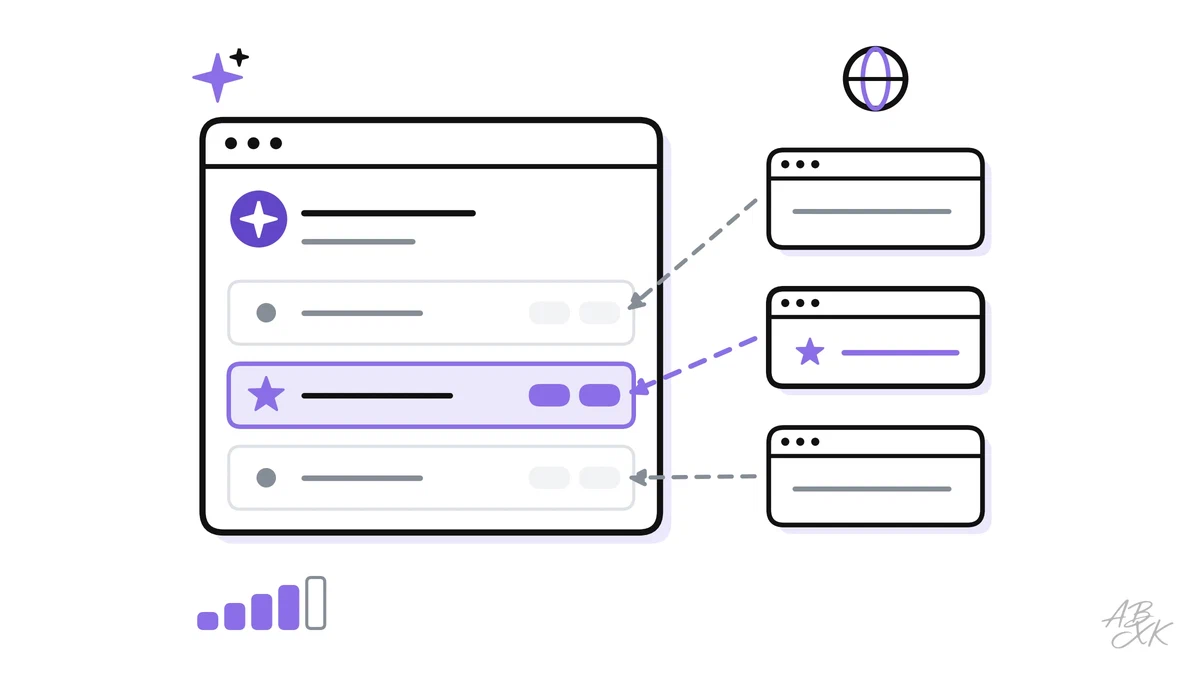
Many people now ask an AI assistant before they search the web: “Which accounting software suits a small agency?” or “Who repairs commercial dishwashers near me?” The answer names a few providers and often links a few sources. If your company is not among them, you lose the customer’s attention before anyone visits your website. Optimizing for this is often called generative engine optimization (GEO) or AI search visibility. The core is less mysterious than the names suggest.
This is part 4 of Level 3 in our AI Work learning path. You will learn how AI assistants and AI search find their answers, what influences whether your brand is mentioned, how to monitor mentions in AI answers and how to fix what you find. The last section shows where optimization ends and manipulation begins.
How AI assistants find their answers
An assistant such as ChatGPT, Gemini, Claude or Perplexity can know about your brand in two ways.
The first is memory. The large language model behind the assistant learned from huge amounts of text up to a cutoff date. It knows a lot about big brands, little about small ones, and its knowledge gets older every day. Behind each assistant sits a model from its vendor, and vendors replace these models often. The table shows a recent model from each of five companies behind well-known assistants:
| Model | Released | Weights | ECI | Rank |
|---|---|---|---|---|
| GPT-6.1 Sol OpenAI | Sep 29, 2026 | closed | 166.3 | 3 |
| Gemini 4 Argon Google DeepMind | Sep 30, 2026 | closed | 164.6 | 5 |
| Claude Opus 5.5 Anthropic | Sep 22, 2026 | closed | 166.8 | 1 |
| Grok 4.7 xAI | Sep 21, 2026 | closed | 154.4 | 39 |
| Muse Spark 1.3 Meta AI | Sep 2, 2026 | closed | 156.8 | 22 |





ECI = Epoch Capabilities Index, one overall score across many benchmarks; rank among all models with an ECI. Data: Epoch AI, retrieved on October 17, 2026, licensed CC BY 4.0. All models: LLM database.
Which model answers inside an assistant at a given moment is decided by the vendor and is not always visible to users. What all models share is that memory is unreliable for exact facts. The test SimpleQA Verified asks short factual questions with exactly one correct answer, without web search. Even the best models in our LLM database get a share of them wrong:
| # | Model | Released | Result |
|---|---|---|---|
| 1 | Gemini 4 Argon (high) Google DeepMind | Sep 30, 2026 | 76.0% |
| 2 | GPT-6 Astra (max) OpenAI | Sep 3, 2026 | 75.6% |
| 3 | GPT-6.1 Sol (max) OpenAI | Sep 29, 2026 | 73.9% |
| 4 | Gemini 3.1 Pro Preview Google DeepMind | Feb 19, 2026 | 73.5% |
| 5 | Claude Opus 5.5 (max) Anthropic | Sep 22, 2026 | 72.2% |
Short factual questions with exactly one correct answer, answered without tools. It shows how much a model really knows and how often it invents an answer instead of admitting that it does not know. Data: Epoch AI, retrieved on October 17, 2026, licensed CC BY 4.0. All models: LLM database.
The second way is live search, also called retrieval. For current or specific questions, many assistants search the web, read a few pages and write an answer with links to their sources, called citations. Google describes a “query fan-out” technique for AI Overviews and AI Mode: the system issues several related searches across subtopics and data sources to build one answer (Source: Google Search Central, developers.google.com).
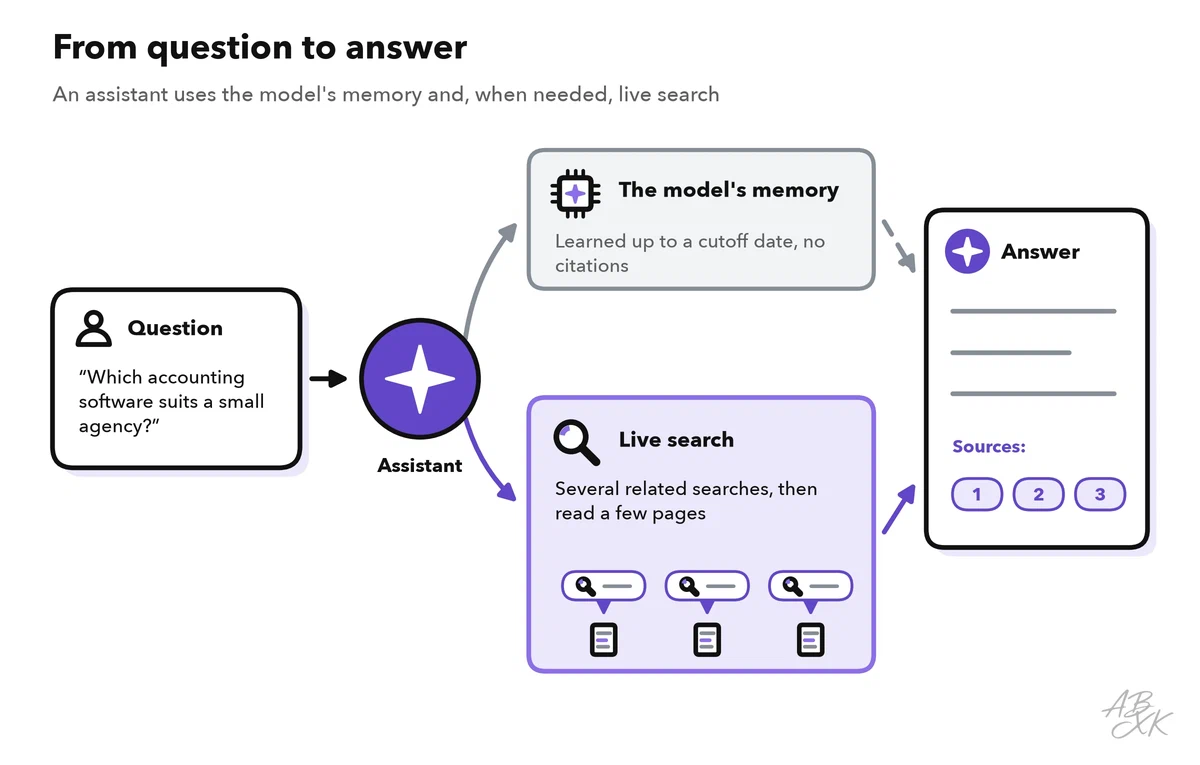
For your brand, this means: you cannot edit what a model has memorized, but you can influence what live search finds. And when an assistant cites a page, people can check the facts.
What makes a brand show up
No one outside the vendors knows exactly how each assistant picks its sources, and the methods change. Google states that there are no additional requirements and no special optimizations needed to appear in its AI Overviews or AI Mode. To be shown as a supporting link, a page must be indexed and eligible to appear in Google Search with a snippet (Source: Google Search Central, developers.google.com). So the basics of good search engine optimization still apply. Five levers matter most:
| Lever | What to do | How to check |
|---|---|---|
| Findable | Let search crawlers read your pages; do not hide key facts in images or PDFs | Your pages appear in normal web search for your company name |
| Clear facts | One page each for who you are, what you offer, for whom, where and how to reach you | A stranger finds each fact in under a minute |
| Structured data | Mark up company, products and locations with schema.org, matching the visible text | A structured data testing tool shows no errors |
| Third-party coverage | Earn mentions in trade press, reviews, comparisons and directories | Search for your category and see which sites appear |
| Consistency | The same name, address and offer everywhere, including old profiles | No outdated facts on the first results pages |
Crawler access deserves a closer look, because AI vendors use separate crawlers for separate purposes. OpenAI uses OAI-SearchBot to show websites in ChatGPT’s search features and GPTBot to collect content that may be used to train its models. The two settings are independent: a site can block training and still appear in ChatGPT search (Source: OpenAI, openai.com). Google’s control token Google-Extended decides whether Google may use your content to train its Gemini models and to ground answers in the Gemini apps and on its Vertex AI platform. Grounding means that the model receives your pages as a source while it answers. According to Google, the token does not affect your inclusion in Google Search. Check your robots.txt file, the file that tells crawlers what they may read, against these purposes.
Structured data is code on a web page that states facts in a machine-readable form, using the shared vocabulary of schema.org. Google’s guidelines ask that it matches the text visible on the page. Markup that claims something the page does not show is a problem, not an advantage.
Third-party coverage can matter as much as your own site. Many answers cite independent sources such as trade articles, review platforms, comparison pages and forums. Outdated or wrong facts on those pages are repeated in answers. You cannot control these sites, but you can earn coverage with useful information, keep your directory entries current and ask for corrections.
Monitor your brand in AI answers
Monitoring starts with a prompt set: 20 to 50 questions your customers really ask. Mix four types: category questions (“best payroll software for small firms”), comparisons (“Brand A or Brand B?”), problem questions (“how do I fix…”) and questions about your brand (“Is Brand A reliable?”). Run the same set every month in the assistants your customers use, and record each answer.
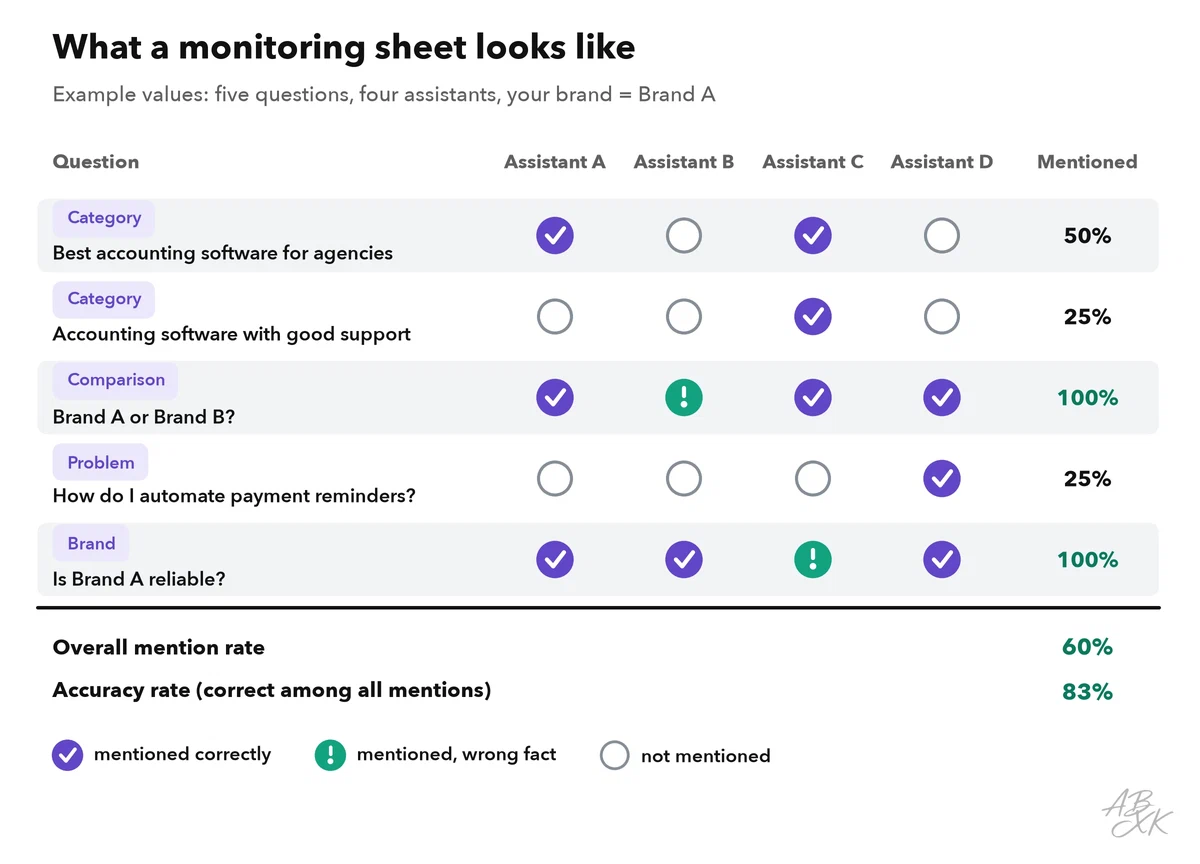
Level 2 showed how to set up social media and brand monitoring; AI answers are a new channel for the same work. Record five things per answer: whether your brand is mentioned, its position in the list, how it is described, whether the facts are correct and which sources are cited. From this, you get four metrics. The mention rate is the share of answers that name you. Share of voice compares your mentions with those of your competitors. The citation share counts how often your own domain is cited. The accuracy rate is the share of mentions with correct facts.
Treat single answers with care. AI answers vary between runs, users, locations and days, so ask each question several times and watch trends, not snapshots. And the models change: in our LLM database, the five companies behind well-known assistants together released new models several times in every recent half-year.
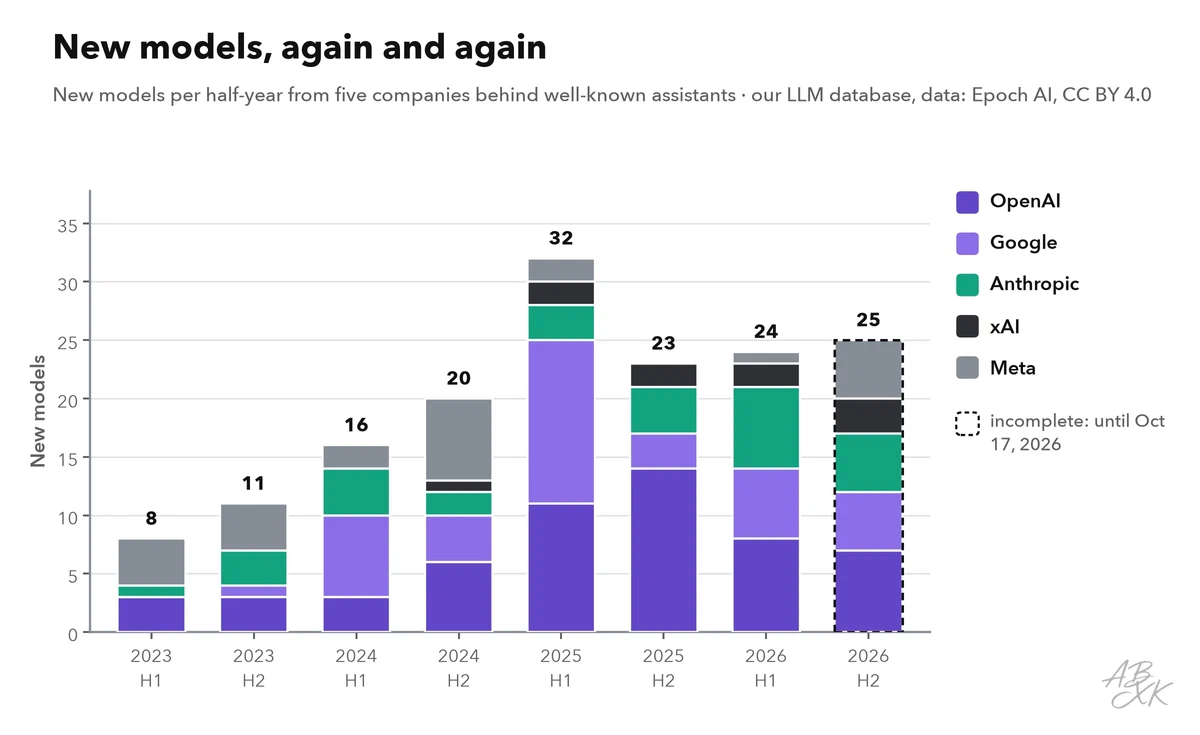
Each new model can change the answers about your brand, so repeat your monitoring after major releases, not only on a fixed date. Specialized tools automate this work. According to the vendors, Rank Prompt tracks how often assistants such as ChatGPT, Perplexity, Claude and Gemini mention and cite a brand, and OmniSEO shows where a brand appears in AI search results and where it is missing. Gushwork is a service that aims to make businesses visible in AI search and Google, and AISQ bundles SEO and other marketing tools for agencies. Brand24 monitors mentions in social media, news, blogs, forums and reviews, sources that assistants may read as well:





Short descriptions from our tool comparison, based on the vendors' information — not tested by ABXK.
This is a young category. Compare the tools with the free option first: your own prompt set in a spreadsheet. Our tool comparison for Marketing & Advertising lists 12 tools.
Fix what you find
Monitoring only pays off if you act on the results. Three findings are common:
- Wrong facts. Open the sources the assistant cites. Correct your own pages first, then ask third-party sites to update theirs. Many assistants also have a feedback button for wrong answers.
- Not mentioned. Check whether crawlers can read your pages and whether a page answers the question at all. Then work on third-party coverage for that topic.
- Negative descriptions. Find the root, often recurring complaints in reviews. Fix the underlying problem and answer reviews openly. Wording on your website cannot hide a real service problem.
Keep a change log: what you changed and when. Since answers vary anyway, only a log shows whether a change made a difference over several months.
Where optimization ends and manipulation begins
Some providers promise to “rank you in ChatGPT” with tricks. Most of them are risky, some are illegal, and AI vendors work against them just as search engines do against spam.
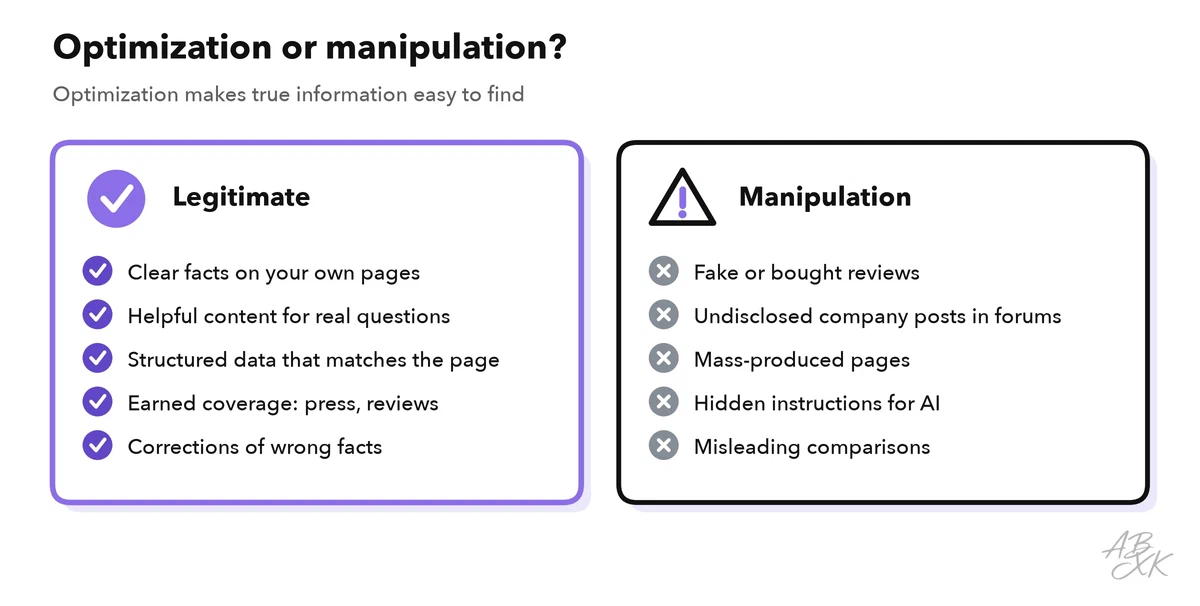
- Fake reviews are banned. In the US, the FTC’s rule on consumer reviews and testimonials has applied since October 21, 2024. It prohibits fake reviews, bought reviews and company-controlled review sites that pose as independent (Source: FTC, ftc.gov). In the EU, fake consumer reviews are a prohibited unfair commercial practice under the Unfair Commercial Practices Directive, as amended in 2019.
- Undisclosed posts by employees or agencies in forums and comment sections mislead readers and the assistants that read them.
- Mass-produced pages that exist only to be found count as spam in Google’s spam policies, which name scaled content abuse.
- Hidden instructions for AI systems, such as invisible text on a page that tells an assistant to recommend a product, are a form of prompt injection. Search engines treat hidden text as spam, and AI vendors defend their assistants against such attacks. Our AI Security section explains prompt injection in more depth.
The test for every measure is simple: would you be comfortable if a customer saw exactly what you did and why? Clear facts, useful pages and honest reviews pass. They also hold up when the next model arrives, because they are true.