

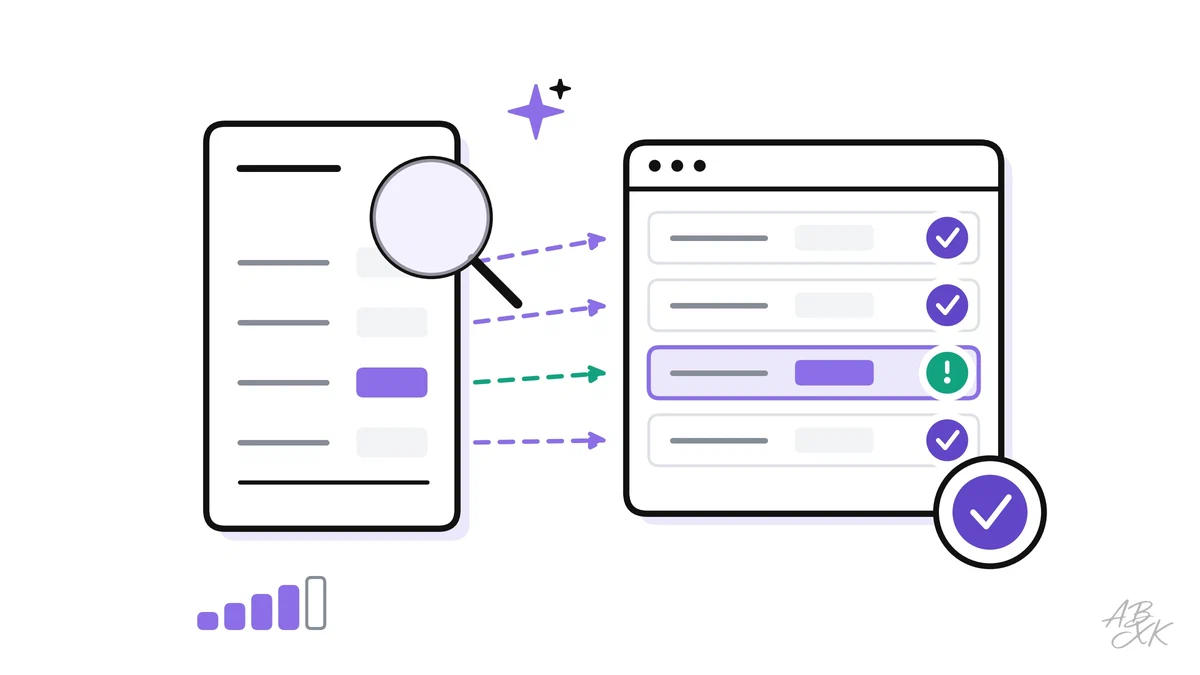
Finance and audit work runs on documents and numbers: invoices, bank statements, contracts, journal entries. Much of it is matching. Does this invoice fit this order? Does this payment fit this invoice? Does this number in the report fit its source? AI tools now read documents, suggest matches and point out unusual entries. But in finance, every number needs evidence, every decision needs an owner, and a single error can end up in the annual accounts.
This is part 3 of Level 3 in our AI Work learning path. Parts 1 and 2 covered pilot projects and the integration with CRM and help desk. This part applies both to one of the most regulated areas of a company. You will learn where AI helps in finance and audit work, how to check extracted data, how reconciliation and audit evidence matching work, how to use anomaly detection, which controls and documentation you need, and where the explainability of AI ends.
Four tasks where AI supports finance and audit
| Task | What the AI does | What people still do |
|---|---|---|
| Document extraction | Reads invoices, receipts and contracts and turns them into data fields | Check uncertain fields, approve new suppliers and bank details |
| Reconciliation | Suggests matches between bank lines, invoices and ledger entries | Clear open items, approve write-offs |
| Audit evidence matching | Finds the source document for a sample item and links the numbers | Judge whether the evidence is sufficient and reliable |
| Anomaly detection | Flags unusual entries, such as duplicate payments | Investigate, decide and document the result |
The four tasks have one thing in common: the AI prepares, and a person decides and signs. In audits, this division follows from the standards. Auditors must obtain sufficient appropriate audit evidence (ISA 500, Audit Evidence), and they must document their work so that an experienced auditor with no previous connection to the audit can understand it (ISA 230, Audit Documentation). Both belong to the International Standards on Auditing (Source: IAASB, iaasb.org).
Specialized tools exist for parts of this work. According to the vendors, DataSnipper automates the extraction and cross-referencing of documents in audit and finance work. Ignition handles proposals, engagement letters, billing and payments for accounting firms in one flow. In small businesses, finance work often starts in job software: Tradify handles quotes, invoices and payments for tradespeople, with AI as a side feature. Our comparison lists 8 tools in Analytics & Operations:



Short descriptions from our tool comparison, based on the vendors' information — not tested by ABXK.
From document to data: extraction with checks
Document extraction turns a PDF or a scan into data fields: supplier, invoice number, date, net amount, VAT, total and bank details. Modern tools combine text recognition with a language model, so they also handle layouts they have never seen. They still make mistakes: a misread digit, a date in the wrong format, a total taken from the wrong line.
Good extraction never runs without checks. The tool reports a confidence for each field, which says how sure it is about the value, and fixed rules test the result:
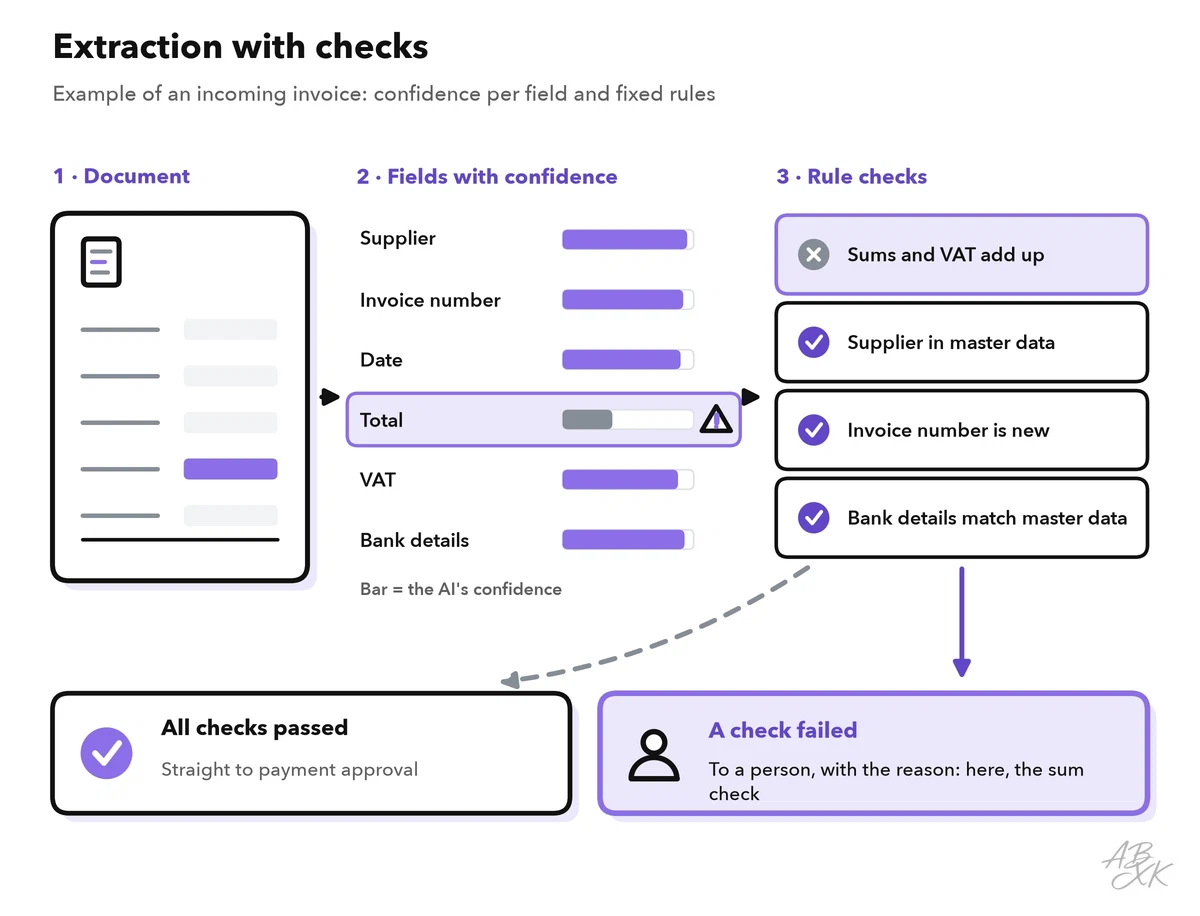
Only invoices that pass every check go straight to approval. Everything else goes to a person, and the failed check is shown, so nobody has to search for the problem.
Some of this work disappears with structured invoices. Since January 1, 2025, businesses in Germany must be able to receive structured electronic invoices from other businesses, and a simple PDF does not count as one. The obligation to send them follows after transition periods (Source: German Federal Ministry of Finance, bundesfinanzministerium.de). A structured e-invoice carries its data in machine-readable form, so there is nothing to extract, only to check.
Reconciliation and audit evidence matching
Reconciliation means comparing two records of the same thing and explaining every difference. Typical examples are the bank reconciliation, where you match bank statement lines with ledger entries, and the three-way match in purchasing: the purchase order, the goods receipt and the invoice must agree before you pay.
Rules handle the easy cases: same amount, same reference. AI helps with the rest: one payment that covers three invoices, a reference with a typo, a partial delivery. It suggests a match and gives a reason, and a person accepts or rejects it. Set a tolerance, the largest difference the system may accept without a person, such as a few cents of rounding. Every larger difference stays an open item until someone explains it.
Auditors do similar work from the other side. To test a sample of transactions, they trace each item to its source: the invoice, the contract, the bank confirmation. AI-powered tools find the right document, extract the numbers and link them to the working paper, the auditor’s record of what was tested and found.
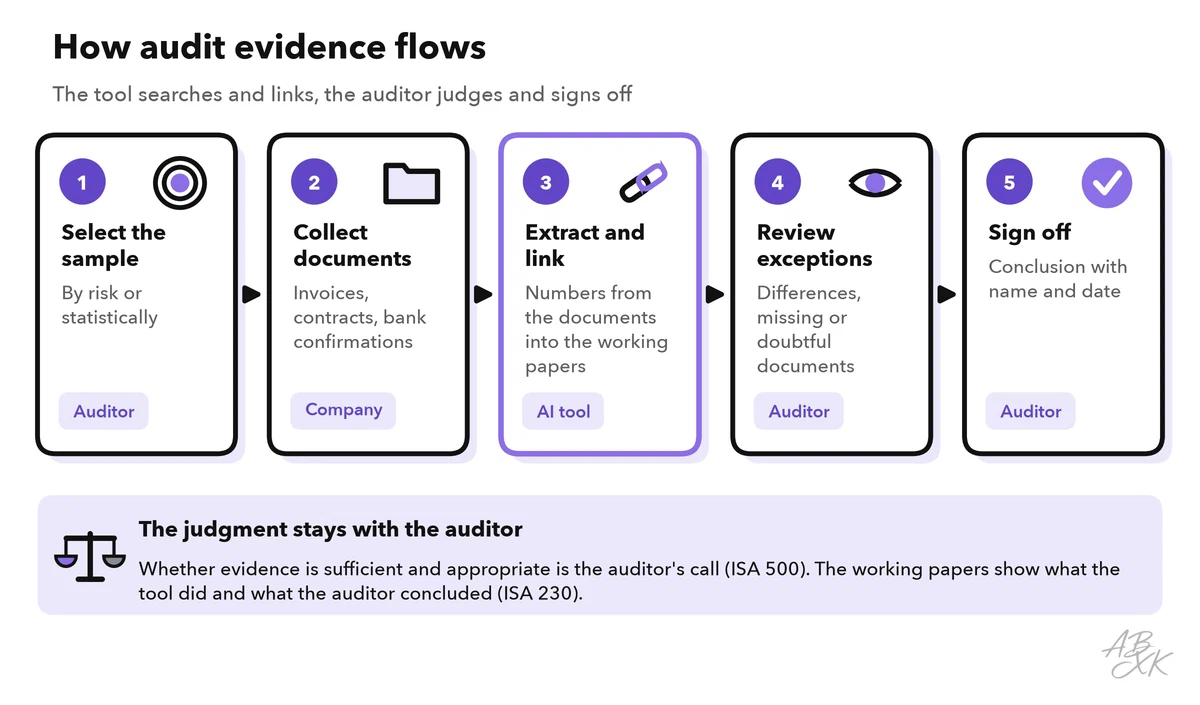
The tool does the searching and linking. The judgment stays with the auditor. Is the document relevant to what is being tested? Is it reliable? An external bank confirmation weighs more than an internal spreadsheet. And what does an exception mean for the audit? Regulators are adapting their rules to this kind of work. In the US, the PCAOB has amended its standard on audit evidence (AS 1105) for technology-assisted analysis of information in electronic form, for audits of fiscal years beginning on or after December 15, 2025 (Source: PCAOB, pcaobus.org).
Anomaly detection: finding the unusual
Anomaly detection looks for entries that do not fit the usual pattern. It uses three kinds of methods, often together:
- Rules: clear tests, such as postings on weekends, round amounts, invoices just below an approval limit or the same invoice paid twice.
- Statistics: comparisons with the normal range, such as an expense three times the monthly average. A classic test is Benford’s law. It describes how often each first digit appears in many natural sets of numbers: a 1 leads about 30 percent of the time, a 9 less than 5 percent. Large deviations can point to invented figures.
- Machine learning: a model learns the normal patterns from past entries and gives each new entry an anomaly score. The higher the score, the more unusual the entry.
Unusual is not the same as wrong. Most flagged entries have a harmless explanation: a year-end bonus, a new supplier, a one-off repair. The value lies in the follow-up, as the example funnel shows:
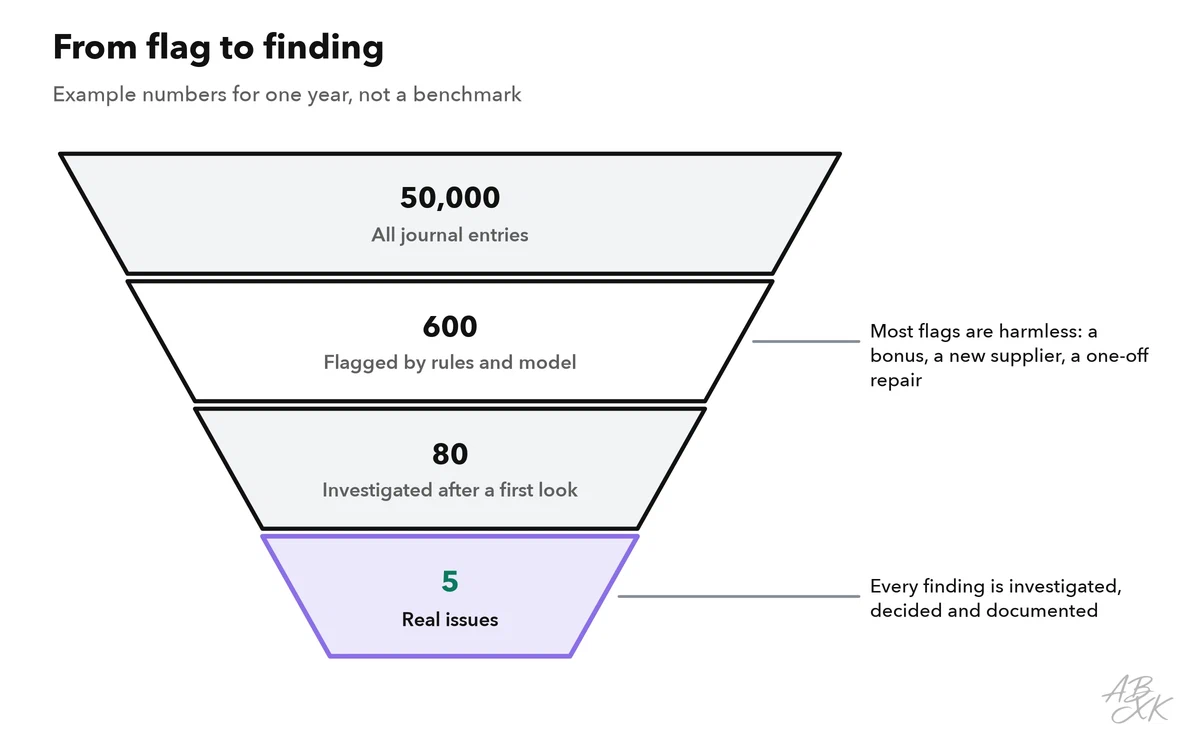
Track two numbers over time. First, how many flags turn out to be real issues: this shows whether the flags are worth the time. Second, how many real issues were found some other way and missed by the system: this shows whether you can rely on it at all.
Controls, documentation and sign-off
In finance, AI does not replace the internal control system, the set of rules, approvals and checks that keeps the books correct. AI becomes part of it, so the AI itself needs controls. One of the oldest is segregation of duties: no single person controls a transaction from start to finish.
| Control | What it means for AI | Evidence |
|---|---|---|
| Segregation of duties | The person who sets the AI’s rules does not approve the payments it prepares | Role list, access reviews |
| Change management | New prompts, rules or model versions are tested and approved before use | Change log with tests and approvals |
| Validation | The tool is tested on known cases, including planted errors, before use and after every change | Test protocol with results |
| Human sign-off | A named person approves every result with financial effect | Approval with name and date |
| Documentation | Every AI step is described: input, output, checks, reviewer | Procedure documentation, working papers |
| Monitoring | Exception and error rates are reviewed every month | Monthly report |
Documentation is not optional. In Germany, the GoBD, the tax authorities’ principles for electronic bookkeeping, require procedure documentation that describes how documents are captured, processed and archived. If AI extracts invoice data for your bookkeeping, that step belongs in it. In an audit, the working papers must show what the tool did and what the auditor concluded, in line with ISA 230. In US public companies, controls over automated steps in financial reporting are part of the internal control assessment under Section 404 of the Sarbanes-Oxley Act. Level 4 shows how to organize such rules across a company in AI governance for business teams.
Where explainability ends
Auditors and controllers must be able to explain why a number is right and why an item was selected. AI makes that harder. A rule says exactly why it fired. An anomaly score from a machine learning model says that an entry is unusual, but often not why. A language model writes a fluent explanation, but research shows that such explanations do not always reflect how the model reached its answer (Source: Turpin et al., “Language Models Don’t Always Say What They Think”, NeurIPS 2023).
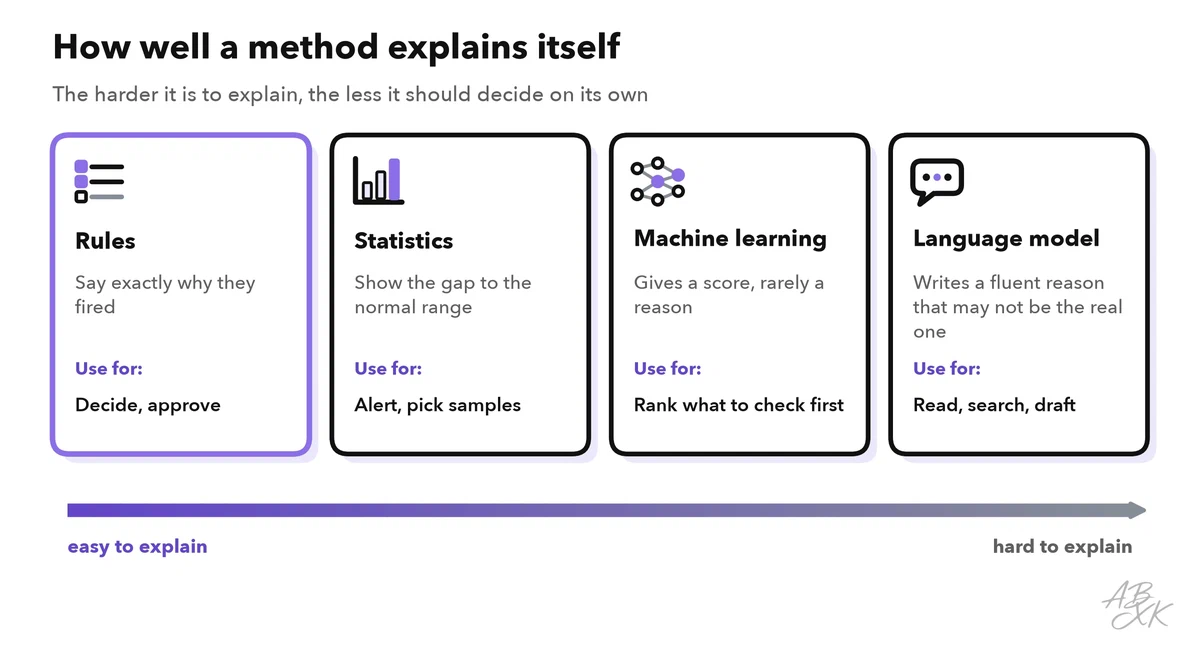
Four habits keep the work explainable:
- Let rules decide, let AI rank. AI scores decide what a person looks at first, not what gets booked or paid.
- Write the reason in plain words. For every selected item, note why it was selected and what you checked.
- Keep the evidence, not the AI’s story. The source document is the evidence. The AI’s text is only a pointer to it.
- Test with known answers. Plant known errors in a test set and check that the tool finds them, before use and after each change.
The table shows who decides in typical situations. Level 3 ends with a closer look at human in the loop and at how to place such checks in any workflow.
| Situation | The AI may | A person must |
|---|---|---|
| Invoice passes all checks | Prepare the booking | Approve the payment run |
| Field with low confidence | Highlight it | Enter or confirm the value |
| Suggested match outside the tolerance | Propose it with a reason | Accept, reject or investigate |
| High anomaly score | Put the entry at the top of the list | Investigate and document the result |
| Change of bank details | Flag the change | Confirm it through a known contact |
| Audit exception | Link it to the source | Evaluate it and draw the conclusion |