

Many companies use more AI than they know. A sales team tries a new prospecting tool. The help desk switches on an AI feature that arrived with an update. Someone connects an assistant to the shared drive. Each step looks small. Together they raise questions that nobody can answer: Which AI do we use, with which data, who is responsible for it, and what happens when something goes wrong?
This is part 3 of Level 4 in our AI Work learning path. Level 0 set up ground rules for using AI at work for individuals. Here you build the operating model behind those rules: an AI inventory, clear roles, an approval process with risk tiers, the basics of the EU AI Act, documentation, training and vendor management.
Governance is an operating model, not a document
AI governance is the set of roles, rules and routines that decides which AI a company uses, for what and under which controls. A policy document is only one part of it. Governance works when it answers four questions every day: What AI do we use? Who owns each use? How do new uses get approved? How do we notice when something goes wrong?
Good governance is also fast. If an approval takes three months, people use unapproved tools anyway. This is called shadow AI. The goal is a fast lane for uses with low risk and a careful review where the risk is real.
Two frameworks help you structure the work. The NIST AI Risk Management Framework groups it into four functions: Govern, Map, Measure and Manage. ISO/IEC 42001 describes a management system for AI that can be certified, similar to ISO/IEC 27001 for information security. You do not need to adopt either one in full, but they give everyone a shared vocabulary (Sources: NIST AI 100-1, AI Risk Management Framework 1.0, 2023, nist.gov; ISO/IEC 42001:2023, iso.org).
Start with an AI inventory
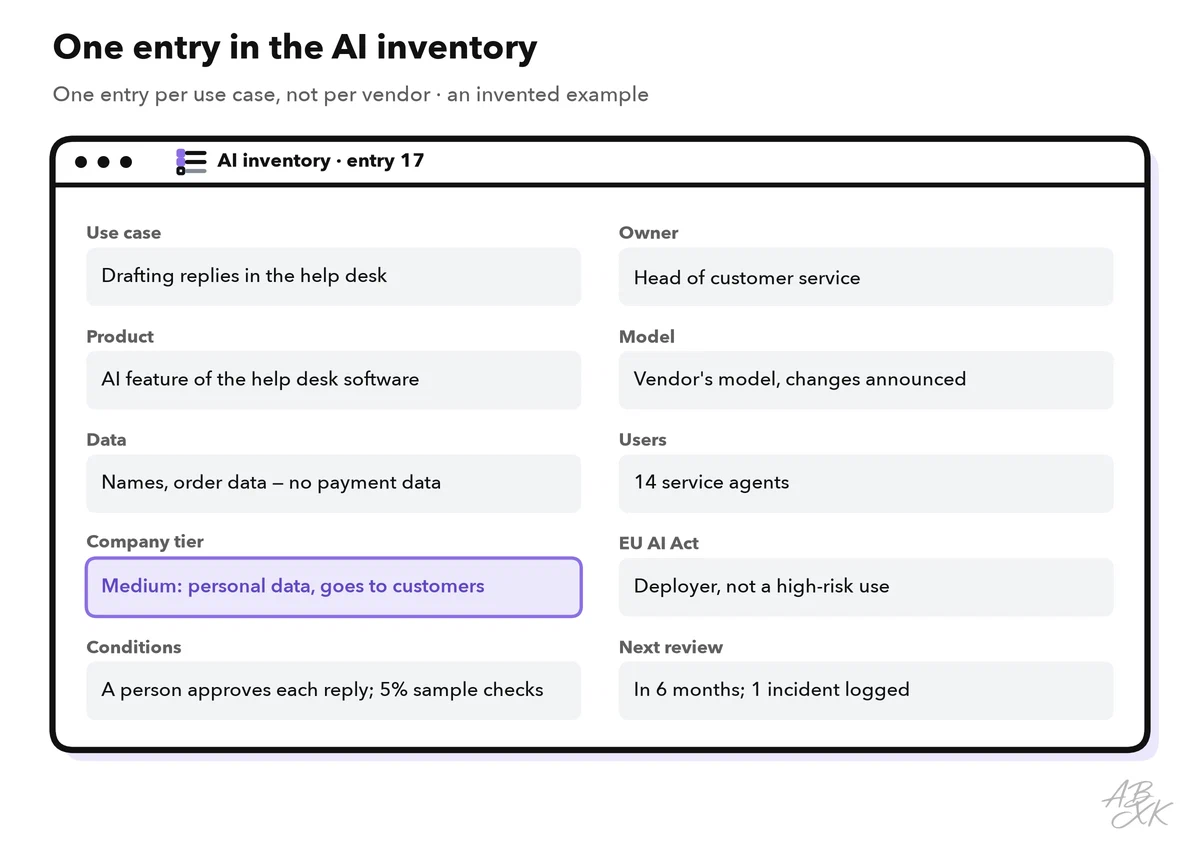
An AI inventory, also called an AI register, lists every AI system and every AI use in the company. Without it, you cannot assess risks, answer customer questions or meet legal duties. Record one entry per use case, not per vendor. The same assistant can be harmless for drafting emails and sensitive for screening job applicants.
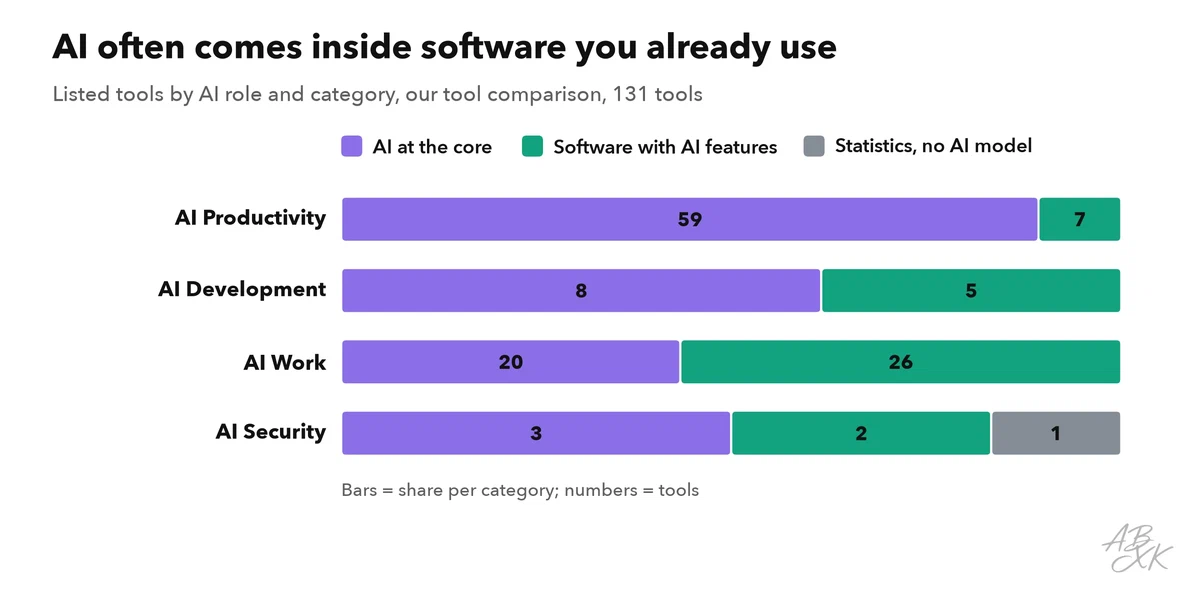
Look for AI in three places: products that teams bought, AI features switched on inside existing software, and AI that your own teams build. The second group is easy to miss. Our tool comparison lists 131 tools across four categories, and the chart shows how often the AI comes as a feature of business software rather than as the product itself:
Fill the inventory from purchasing records, single sign-on logs and a short survey. Offer an amnesty: people who report a tool they already use should not be punished for it. Otherwise shadow AI stays hidden.
Give every role a clear job
Governance fails when everyone is involved and nobody is responsible. Five roles cover the essentials:
- Use case owner: a manager in the business unit who wants the benefit. The owner answers for purpose, data, users and results.
- AI governance lead: runs the process, keeps the inventory and the rules up to date and reports to management. In larger companies, an AI board with members from IT, data protection, legal and the business decides on high-risk cases.
- Reviewers: the data protection officer, IT security, and legal or compliance. Each one checks their area and sets conditions.
- Works council or employee representatives: wherever AI affects employees. In Germany, the works council has a say when a company introduces technical systems that can monitor the behavior or performance of employees (Section 87(1) No. 6 of the Works Constitution Act). Many AI tools log who did what, so involve the works council early.
- Users: follow the rules, check outputs and report problems.
The table assigns the main activities in the RACI pattern: R is responsible (does the work), A is accountable (decides and answers for it — only one per row), C is consulted before, I is informed after.
| Activity | Use case owner | Governance lead | Reviewers | Works council | Users |
|---|---|---|---|---|---|
| Propose a use case | A, R | I | – | – | C |
| Set the risk tier | C | A, R | C | – | – |
| Review data protection, security and legal questions | C | I | A, R | I | – |
| Approve a medium- or high-risk use | R | A | C | C if staff are affected | I |
| Keep the inventory entry current | A, R | C | – | – | – |
| Train users | A | R | C | I | I |
| Monitor results and report incidents | A, R | I | C | – | R |
| Review once a year or retire | A | R | C | I | I |
Approve new uses by risk tier
Not every AI use needs the same review. Sort each use case into a risk tier when the request comes in, and let the tier decide how deep the review goes. Four tiers are a practical start for business teams:
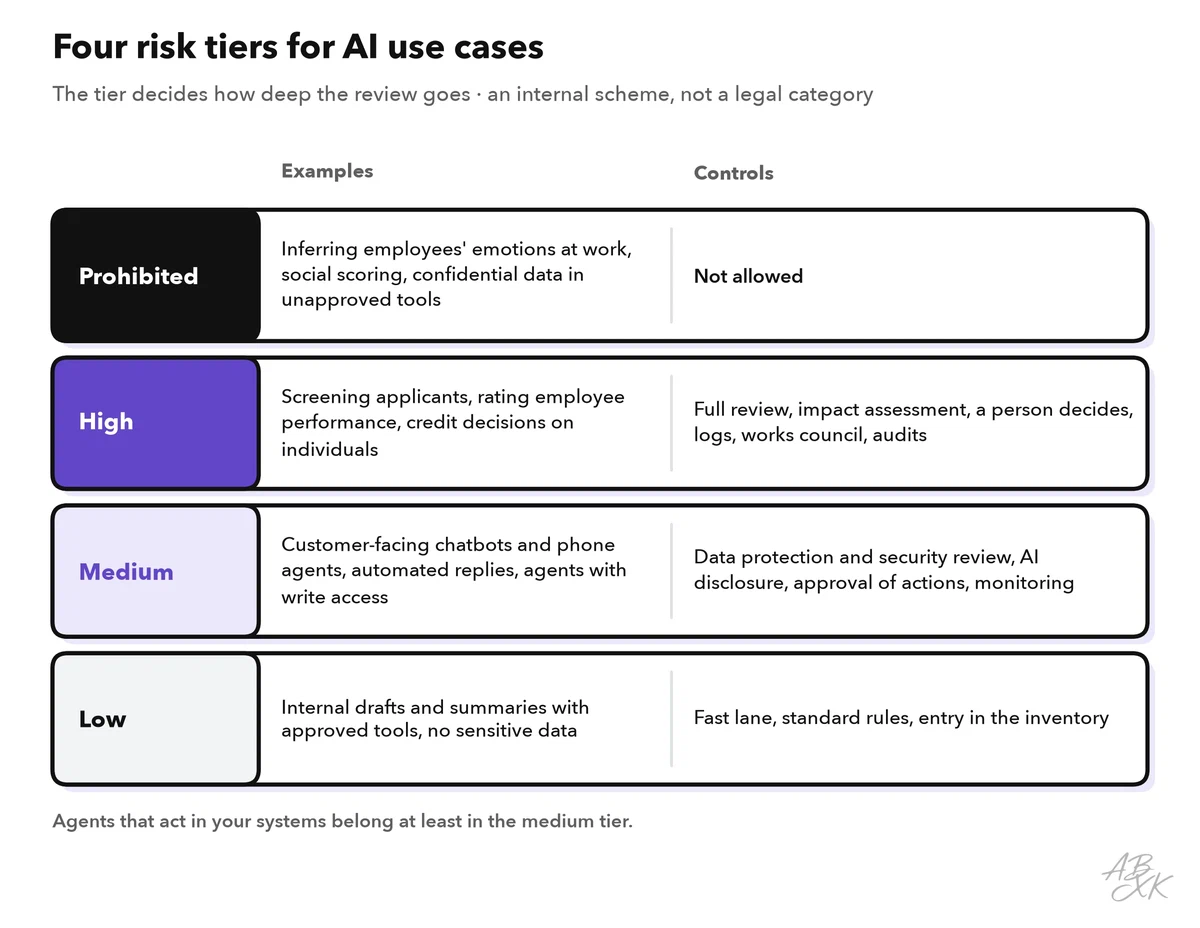
The tiers are an internal scheme. They overlap with the EU AI Act, but they are stricter in places: a support assistant that drafts replies with customer data is not a high-risk system under the law, yet it handles personal data and its output reaches customers. That is why it sits in the medium tier. AI that takes actions in your systems, such as an agent that changes orders, belongs at least in the medium tier too. Part 5 covers agentic workflows in operations, and Level 3 shows how to design the human checks in human in the loop.
The tier then sets the path through the approval process:
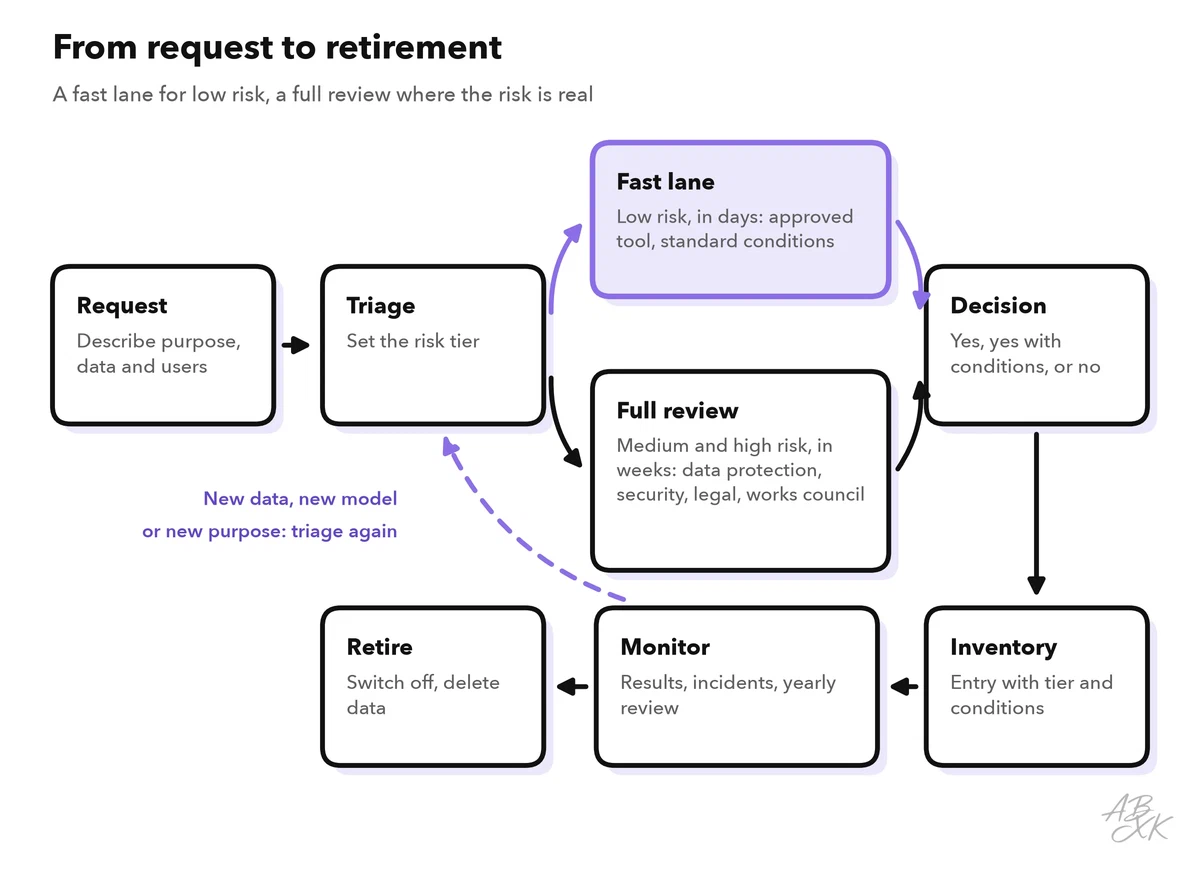
A low-risk request with an already approved tool should take days, not months. Medium- and high-risk requests go through the full review. Every approval comes with conditions, for example “only anonymized data”, “a person approves each reply” or “review after six months”. Every approved use enters the inventory. When the data, the model or the purpose changes, the use goes back to triage.
Know the basics of the EU AI Act
The EU AI Act (Regulation (EU) 2024/1689) entered into force on August 1, 2024, and applies in stages. Most business teams are deployers: they use AI systems under their own authority. Providers develop AI systems and place them on the market. These four points matter most for deployers:
| Rule | What it means for business teams | Applies from |
|---|---|---|
| AI literacy (Article 4) | Support the AI literacy of staff who work with AI systems | February 2, 2025 |
| Prohibited practices (Article 5) | For example, no AI that infers the emotions of employees at work (except for medical or safety reasons) and no social scoring | February 2, 2025 |
| Transparency (Article 50) | AI systems that talk to people must make clear that they are AI, unless this is obvious; deepfakes must be labeled | August 2, 2026 |
| High-risk uses (Annex III) | Uses such as recruitment, performance evaluation or credit scoring of individuals bring duties for deployers, such as human oversight, monitoring, keeping logs and informing workers’ representatives before use at the workplace | December 2, 2027 |
The date for high-risk uses was moved by an amendment in 2026 (Regulation (EU) 2026/1744, the “Digital Omnibus on AI”). The same amendment reworded Article 4: companies must take measures to support the AI literacy of their staff, but they do not have to guarantee a specific level for each person. Use the table for orientation, not as legal advice, and check the current state with your legal team. For data processing, the GDPR applies in addition: high-risk processing of personal data needs a data protection impact assessment (Article 35). Our AI Security section goes deeper into threats such as data leaks and manipulated inputs, and into the controls that protect against them.
Document, train and manage vendors
Three routines keep governance alive after the approval.
Documentation. For each medium- or high-risk use case, keep a short file: purpose, data, risk tier and assessment, test results, how human oversight works, instructions for users, a change log and incidents. Write it so that someone outside the team can understand in ten minutes how the system is used and controlled.
Training. Everyone who uses AI needs the basics: what the tools can and cannot do, which data may go in and how to check outputs. Owners and reviewers need more: how to assess risks, design human oversight and read test results. Repeat the training when tools or rules change.
Vendor management. When a team buys AI, the vendor becomes part of your control system. Before the contract, check the data processing agreement, the data location, whether the vendor trains models on your data, its sub-processors, retention and deletion, and certifications such as ISO/IEC 27001 or a SOC 2 report. Level 2 walks through this review step by step in choose AI tools for your team. In the contract, agree on notice of material changes, such as a new underlying model, on incident reporting, data export and exit terms. After the contract, review each vendor once a year.
Customer-facing products need extra care, because their output reaches people directly. According to the vendors, Tidio combines an AI agent with live chat and ticketing, and Vida runs AI phone agents that answer calls and schedule appointments. Uses like these typically land in the medium tier: make sure that customers learn they are dealing with an AI and can always reach a person. Platforms can support the governance work itself: according to the vendors, Airia is a platform for building and managing AI solutions securely in enterprises, and Evolve creates training courses, adapts them to each learner and measures the results.




Short descriptions from our tool comparison, based on the vendors' information — not tested by ABXK.
Measure whether governance works
Governance should show results, not only exist on paper. Five metrics tell you whether it works, and a 90-day plan gets it started:
| Metric | What it shows | Warning sign |
|---|---|---|
| Share of AI uses in the inventory | How visible AI use is | New AI found outside the inventory every month |
| Approval time per risk tier | Whether the fast lane works | Low-risk requests wait for weeks |
| Overdue reviews | Whether the routines run | Reviews postponed again and again |
| Training coverage | Whether AI literacy grows | People use approved tools without any training |
| Incidents and near misses | Whether controls catch problems | Customers find problems before your controls do |