

Before a salesperson talks to a new customer, a lot of groundwork happens. Someone has to find companies that fit, find the right person in each one, look up an email address and decide whom to contact first. AI tools now do much of this work. They search contact databases, fill gaps in your records, rank leads and draft a first message. They also deliver outdated data, guess when they lack facts and can get you into legal trouble if you handle contact data carelessly.
This is part 1 of Level 1 in our AI Work learning path. Level 0 showed which tasks AI changes in a company. Level 1 goes through the departments one by one, with first practical techniques. In this part, you will learn the five steps of AI-assisted prospecting, how lead scoring works, how to write a personal first message without invented facts and which data protection basics apply to business contacts.
Start with your ideal customer
Prospecting means searching for potential new customers. A lead is a person or company that might buy from you. It becomes a qualified lead once you have checked that it fits your offer and that a conversation makes sense.
AI tools can produce a list of thousands of leads in minutes. Without a clear target, most of them are the wrong people. So first, write down your ideal customer profile (ICP): the kind of company that benefits most from your offer. Five lines are enough:
- Industry: for example, logistics companies or dental practices
- Size: number of employees or locations
- Region: the countries or cities you can serve
- Problem: the situation in which your offer helps
- Roles: the people who decide and the people who use the product
Your best existing customers are the best guide. An AI assistant can help here: list your ten best customers with industry, size and the problem you solved, and ask what they have in common. Then check the answer against what you know about these customers.
Five steps from market to first contact
Most AI-assisted prospecting follows the same five steps. At each step, the tool does the work, and you check the result before you move on.
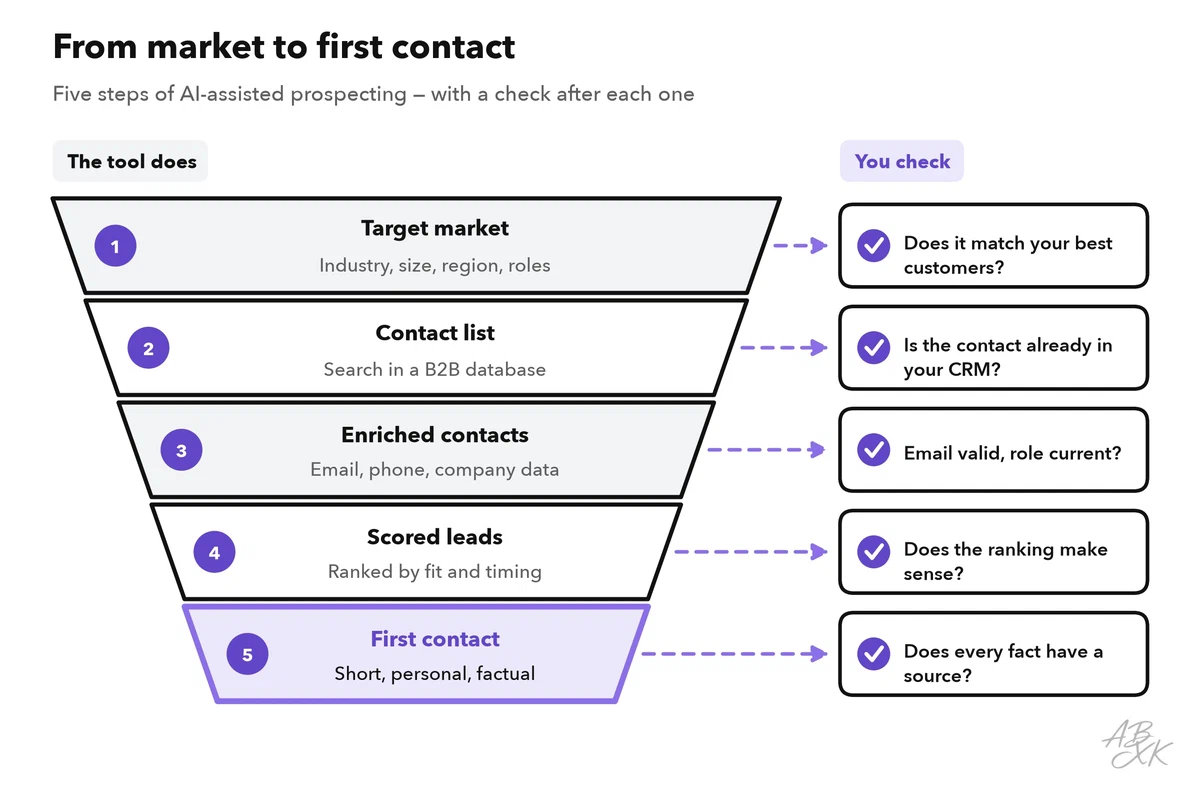
- Target market: You turn your ICP into filters: industry, size, region, roles.
- Contact list: A B2B contact database — a searchable collection of company and contact data — returns matching people.
- Enrichment: The tool fills in missing details such as an email address, a phone number or the company size. Some tools use waterfall enrichment: they ask several data providers one after another until one of them has the answer.
- Scoring: Each lead gets a score, so that you contact the most promising ones first.
- First contact: You send a short, personal message.
The table shows which kinds of tools support which step. The examples come from our comparison; the descriptions are the vendors’ own claims, not test results.
| Step | What the tool does | Examples from our comparison |
|---|---|---|
| Find contacts | Searches a B2B database by company, role and region | Lusha, Seamless.AI |
| Enrich | Adds email addresses, phone numbers and company data | FullEnrich, Lusha |
| All in one | Combines search, enrichment and outreach | Amplemarket |
| Qualify inbound leads | Answers incoming calls and chats, asks qualifying questions, books appointments | Distance |
According to the vendor, FullEnrich queries more than 20 data providers in sequence. Our comparison describes Distance as a platform for service businesses that lose leads because nobody answers the phone. Our comparison lists 9 tools in Sales & Leads; here are the five from the table:





Short descriptions from our tool comparison, based on the vendors' information — not tested by ABXK.
Lead scoring: fit and timing
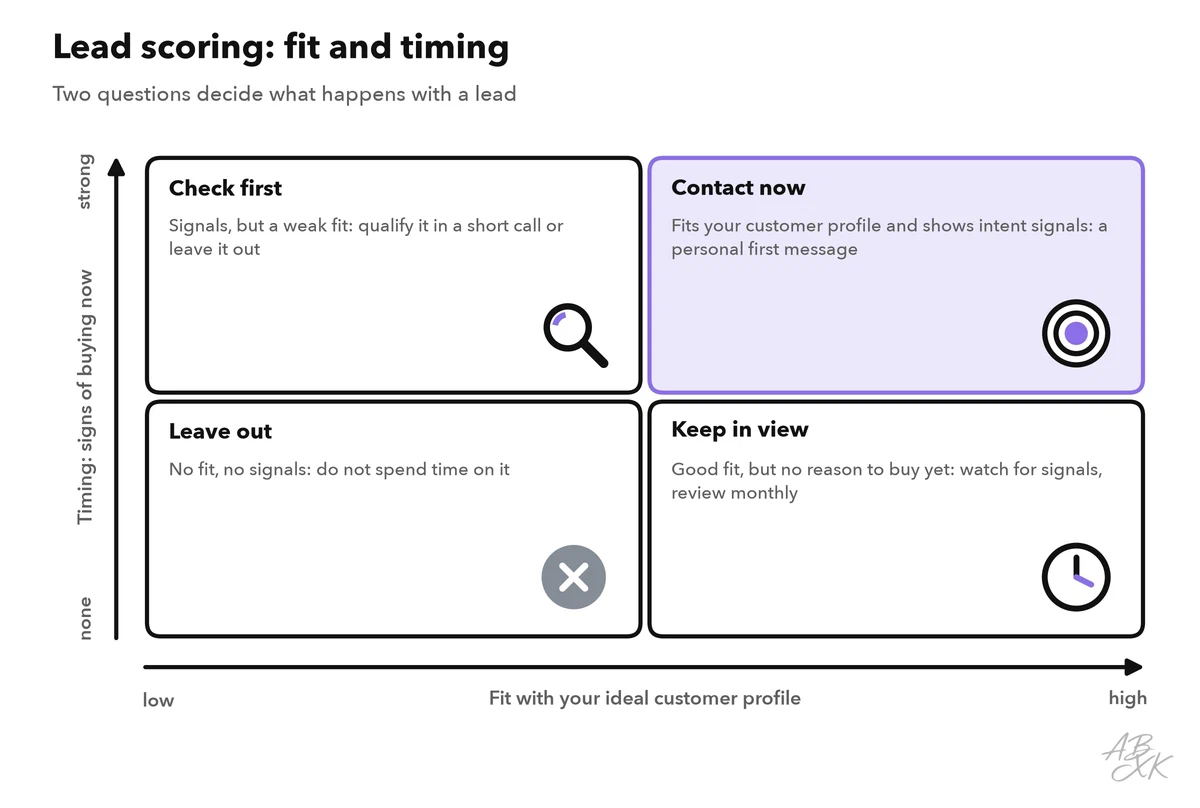
Lead scoring gives every lead a number, so your team knows whom to contact first. A good score answers two questions. Does the company fit your ICP? And is there a reason to buy now?
Signs that a company might be ready to buy are called intent signals. Typical examples are a new manager in the role that decides, a funding round, job ads for a related role, a new location or repeated visits to your pricing page. Some vendors also sell data about the topics that companies research online. Treat all of these as hints, not proof.
There are two ways to calculate the score. With rule-based scoring, you set the points yourself. With predictive scoring, an AI model learns from your past won and lost deals which leads tend to buy. Predictive scoring needs a good amount of clean history, and it repeats past patterns — including your blind spots. Many teams start with simple rules like these:
| Signal (example sheet, the points are illustrative) | Points |
|---|---|
| Industry matches your ICP | +20 |
| Company size is in your target range | +15 |
| Contact decides on the purchase or strongly influences it | +15 |
| Contact started in the role within the last three months | +10 |
| Company visited your pricing page | +10 |
| Only a generic address such as info@ is known | −10 |
| Existing customer or competitor | exclude |
After a month, check whether leads with high scores really led to more conversations. If not, adjust the points.
Personalize the first message with facts only
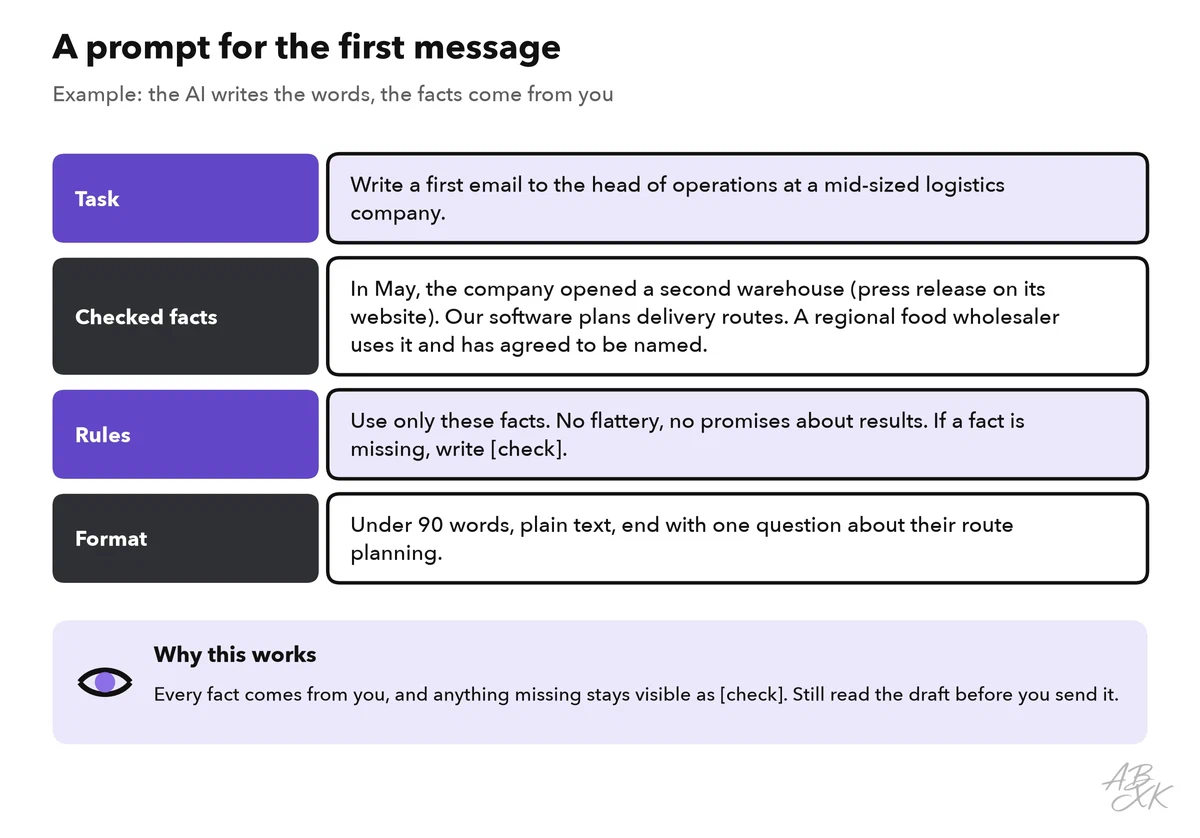
AI assistants are good at drafting a first message that refers to something real: a company announcement, the person’s role, a typical problem in their industry. Good personalization shows that you did your homework. Bad personalization invents facts or becomes too personal.
The safest method is to give the AI the facts and forbid it to add new ones:
Sending many messages, with follow-ups and good deliverability, is a topic of its own. Level 2 covers sales outreach automation without spam.
Data protection basics for business contacts
Contact data of business people is still personal data. In the EU, the GDPR (General Data Protection Regulation) applies to a name, a work email address such as jane.doe@example.com or a direct phone number. A generic address such as info@example.com is usually not personal data. Four basics matter most for prospecting:
- Legal basis: B2B prospecting often relies on legitimate interest (Article 6(1)(f) GDPR). The GDPR names direct marketing as a possible legitimate interest (Recital 47), but you must weigh it against the person’s interests and document that.
- Information: If you got the data from a database, you must tell the person where it came from and what you do with it: at the latest with your first message, and no later than one month after you got the data (Article 14).
- Objection: If someone objects to direct marketing, stop and mark the contact as “do not contact” (Article 21).
- Data minimization: Collect only what you need, and delete leads you will not contact.
The rules for email and phone calls are separate from the GDPR and differ by country. In Germany, advertising emails generally need the recipient’s prior express consent, also between businesses (Section 7 of the Act against Unfair Competition, UWG). In the US, the CAN-SPAM Act allows commercial email without prior consent. But it requires accurate sender information, honest subject lines, a clear note that the message is an ad, a valid postal address and a working opt-out that you honor within 10 business days — with no exception for business email (Source: FTC, CAN-SPAM Act: A Compliance Guide for Business, ftc.gov).
This is an overview, not legal advice. Before you buy contact data or start a campaign, ask your data protection officer, and ask the data vendor where its data comes from. The Level 0 part on ground rules for using AI at work covers the rules inside your company.
Check your leads before you reach out
Contact data gets old quickly: people change jobs, companies move, email addresses stop working. A wrong email address bounces and can harm the reputation of your email domain. A wrong fact in a first message costs trust. These checks catch most problems:
| Check | How to do it | Red flag |
|---|---|---|
| Email address | Let the tool verify it and send only to addresses marked valid | Many results marked “risky” or “unknown” |
| Role and company | Compare with the company website or a recent profile | The person left the company or changed roles |
| Duplicates | Search your CRM before you import | The lead is already a customer or talks to a colleague |
| Source | Note where each record comes from | The vendor cannot name its sources |
| Objections | Check your do-not-contact list | The contact objected before |
| Facts in the message | Open the source of every fact | A fact you cannot find anywhere |
Clean data in your CRM (customer relationship management system) pays off twice: your team trusts the lists, and AI features that build on them work better. Level 0 explains why AI needs good business data.