


Online sellers repeat the same jobs for every product: write a product page, prepare images, run ads, watch the stock and read customer reviews. With a few hundred products, that is a lot of repetition — exactly the kind of work where AI helps. The risks are just as concrete. An invented product feature leads to returns and complaints, a marketplace can block a listing that breaks its rules, and an ad budget that nobody watches can burn money.
This is part 4 of Level 1 in our AI Work learning path. You will see where AI fits into the work of an online seller, how to create listings from your own product data, which numbers to watch when an AI tool runs your marketplace ads, how stock forecasts work and how to learn from reviews without crossing a line.
Where AI fits in an online store
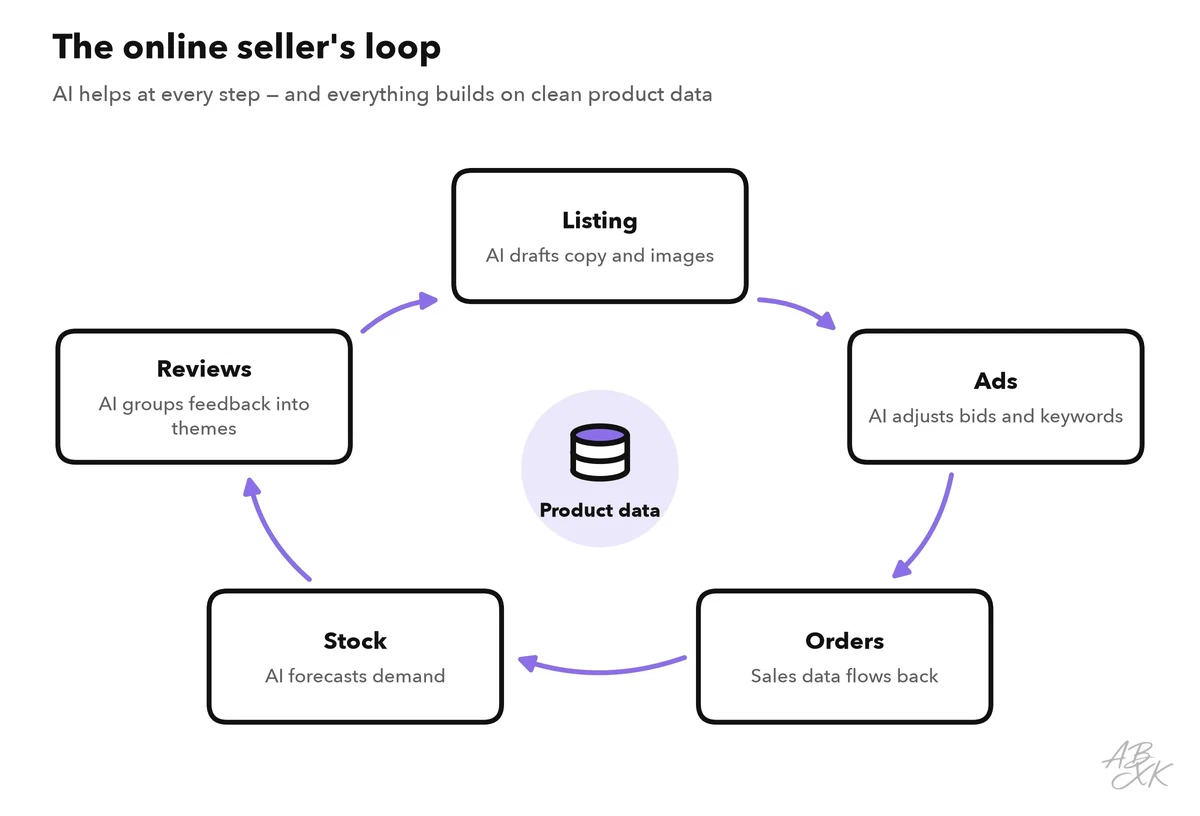
Most of a seller’s work forms a loop. The listing brings visitors, ads bring more of them, orders reduce the stock, and reviews show what to improve in the listing. At the center is your product data: the facts about each product that all the other steps build on.
| Task | What AI does | Examples from our comparison |
|---|---|---|
| Listings | Drafts titles, bullet points and descriptions | Teikametrics (according to the vendor, also listings) |
| Marketplace ads | Adjusts bids, keywords and budgets for sponsored products | Teikametrics, Quartile |
| Ads for your own store | Sets up and runs Meta and Google ads for a Shopify store | Adwisely |
| Analytics | Combines marketplace data in dashboards with daily alerts | DataHawk |
| Stock | Tracks inventory and helps plan orders | Unleashed, Teikametrics |
| Sourcing | Imports products from suppliers for dropshipping | Alidrop |
Our comparison lists 7 tools in E-Commerce & Marketplaces. The descriptions come from the vendors; they are not test results.






Short descriptions from our tool comparison, based on the vendors' information — not tested by ABXK.
Listings from your own product data
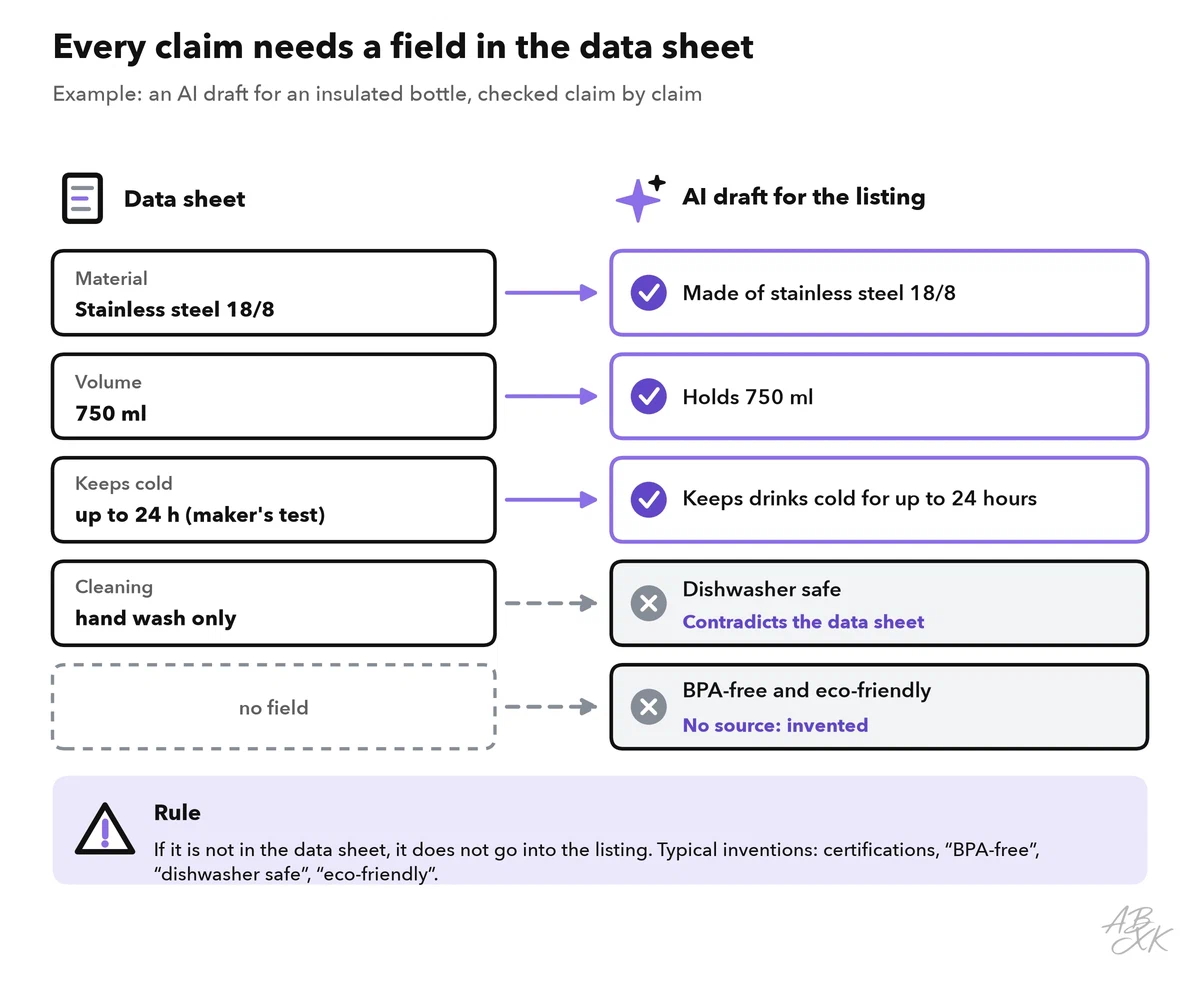
A listing is the page of a product on a marketplace or in your store: title, bullet points, description, images and attributes such as size or material. AI tools write listings quickly — if you give them the right input. The safest input is a data sheet: a structured list of everything you know about the product, from the supplier’s specifications to your own tests.
Then apply one rule: every claim in the listing must come from a field in the data sheet. AI models know which phrases are common in a product category, and they add them even when they are not true for your product.
Marketplaces also have their own rules for listings, for example for the length of titles, forbidden phrases and images. Amazon, for example, requires a pure white background for the main image. Read the style guide for each category you sell in, and add its most important rules to your prompt. AI image tools can remove backgrounds or show a product in use, but the picture must show the real product: the same color, the same size, the same parts in the box. How to keep claims honest in ads is covered in part 3, AI for marketing content.
Marketplace ads: let the tool bid within your limits
On marketplaces such as Amazon, the typical ad format is sponsored products: ads for a single product that appear in the search results. You pay when a shopper clicks on the ad. AI ad tools adjust the bid for each keyword, add new keywords, exclude weak ones and shift budget between products. They react faster than a person can. But they optimize for the target you give them, and they do not know your margins unless you tell them.
Three numbers help you judge the result. The values in the example are illustrative:
| Metric | Formula | Example |
|---|---|---|
| ACoS (advertising cost of sales) | Ad spend ÷ sales from ads | $200 ÷ $1,000 = 20% |
| ROAS (return on ad spend) | Sales from ads ÷ ad spend | $1,000 ÷ $200 = 5 |
| TACoS (total advertising cost of sales) | Ad spend ÷ all sales, with or without ads | $200 ÷ $2,500 = 8% |
The key comparison is ACoS against your margin before ad costs. If a product earns a 25% margin before advertising, an ACoS above 25% means that you lose money on every sale that comes through an ad. Set limits for the tool: a maximum daily budget, a target ACoS for each product group and a list of keywords to exclude. Then review the changes every week, and decide on large budget increases yourself.
Stock forecasts: AI estimates the demand
Running out of stock costs sales, and ads for a product that is sold out waste budget. Too much stock ties up money and can cost storage fees. Demand forecasting means estimating how many units you will sell in the coming weeks. AI tools use your sales history, seasons, planned promotions and trends for this. The ordering logic itself stays simple: you reorder when the stock falls to the reorder point.
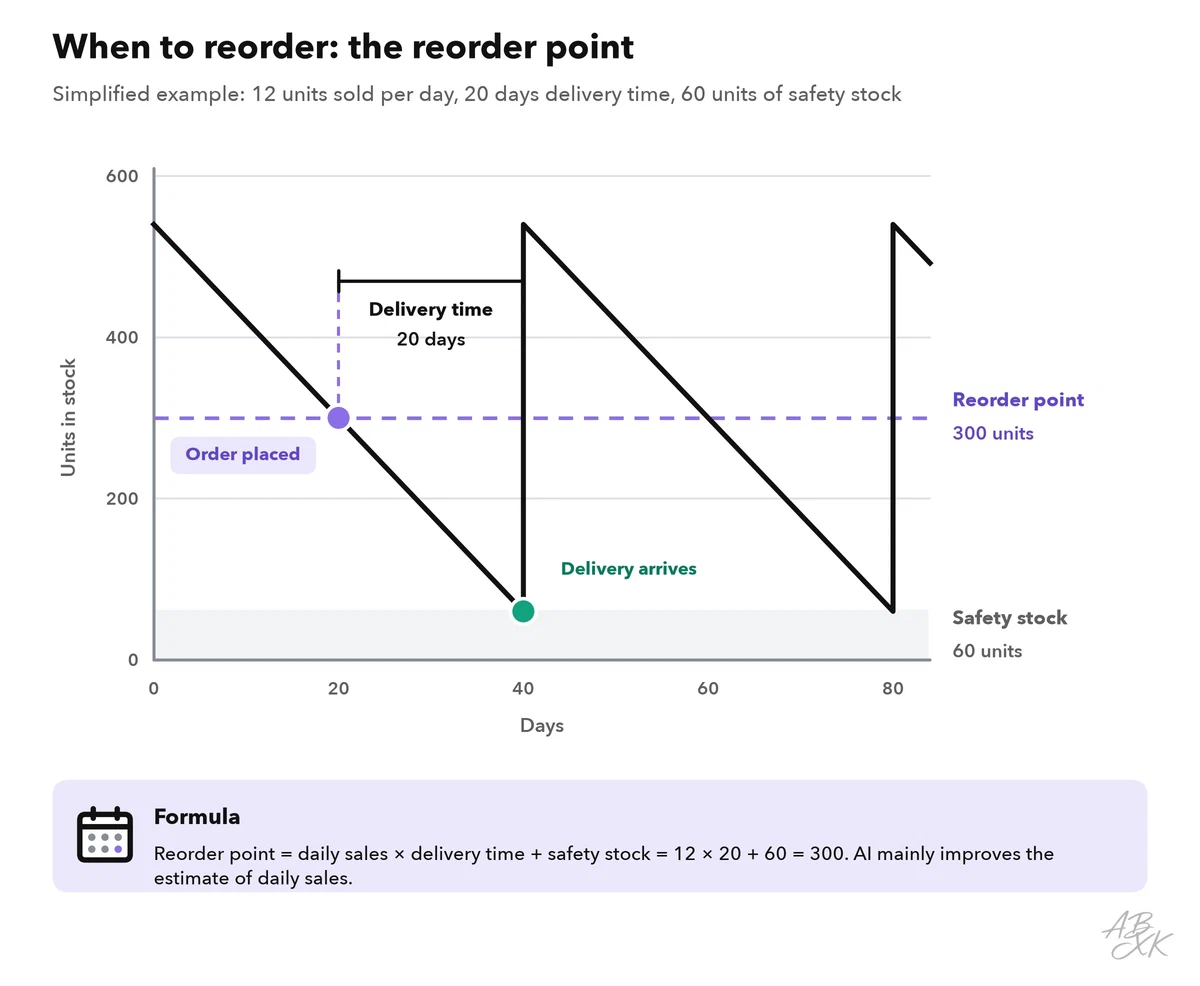
The reorder point is the expected daily sales times the delivery time in days, plus a safety stock for surprises. In the example, that is 12 × 20 + 60 = 300 units. AI improves the most uncertain part of this formula: the expected daily sales. Forecasts are least reliable for new products without sales history, for sudden spikes — for example, after a post about your product goes viral — and when a supplier has problems. Check large orders yourself.
Reviews: learn from them, never fake them
Reviews are free feedback from your customers. AI can read hundreds of them and group them into themes, with example quotes for each theme. Every theme points to an action:
| Theme in the reviews (example) | What you can do |
|---|---|
| “The lid leaks when the bottle tips over” | Check the batch with the supplier; describe the lid correctly |
| “Smaller than expected” | Add the exact dimensions and a photo next to a familiar object |
| “Arrived dented” | Improve the packaging; talk to the shipping partner |
| “Keeps drinks cold all day” | A sign that the claim in your listing holds |
Read a sample of the original reviews as well. AI summaries can overstate rare complaints or miss sarcasm.
There is one hard line: never write fake reviews, never let an AI write them and never buy them. In the US, the FTC’s rule on consumer reviews and testimonials, in force since October 2024, bans fake reviews, including reviews generated by AI. In the EU, fake consumer reviews are also banned (Directive (EU) 2019/2161). Marketplaces remove fake reviews, too, and can suspend the seller.
A weekly AI routine for sellers
AI tools save the most time when someone checks their work at a fixed rhythm. This routine takes about an hour a week:
- Ads: Compare last week’s changes by the ad tool with your limits for budget and ACoS.
- Stock: Look at the stock alerts and the forecast for the next weeks, then approve the orders.
- Reviews: Let the AI group the new reviews into themes, and pick one action.
- Listings: Improve one listing with what you learned, and check every new claim against the data sheet.
- Log: Write down what you changed, so that you can see the effect next week.
Clean product data makes every step easier; Level 0 explains why AI needs good business data. Part 5 of this level shows how to bring sales, ad and stock numbers together in reports and dashboards.