

A single campaign needs a lot of content: ads in several sizes, a landing page, a few emails and social media posts — often in several versions for different audiences. AI tools can draft all of it in minutes. That is the opportunity. The risk is content that sounds like everyone else’s, drifts away from your brand or makes claims your company cannot prove.
This is part 3 of Level 1 in our AI Work learning path. After sales and customer service, this part covers marketing. You will learn a five-step campaign workflow with AI, how to write a brief and a brand voice guide that an AI can use, how to test variants fairly and what to check before anything goes live.
A campaign workflow with AI
AI is most useful in the middle of a campaign: it turns a clear brief into many drafts and variants. The start and the end stay with people. Someone has to decide what the campaign should achieve, approve what gets published and draw the right lessons from the results.
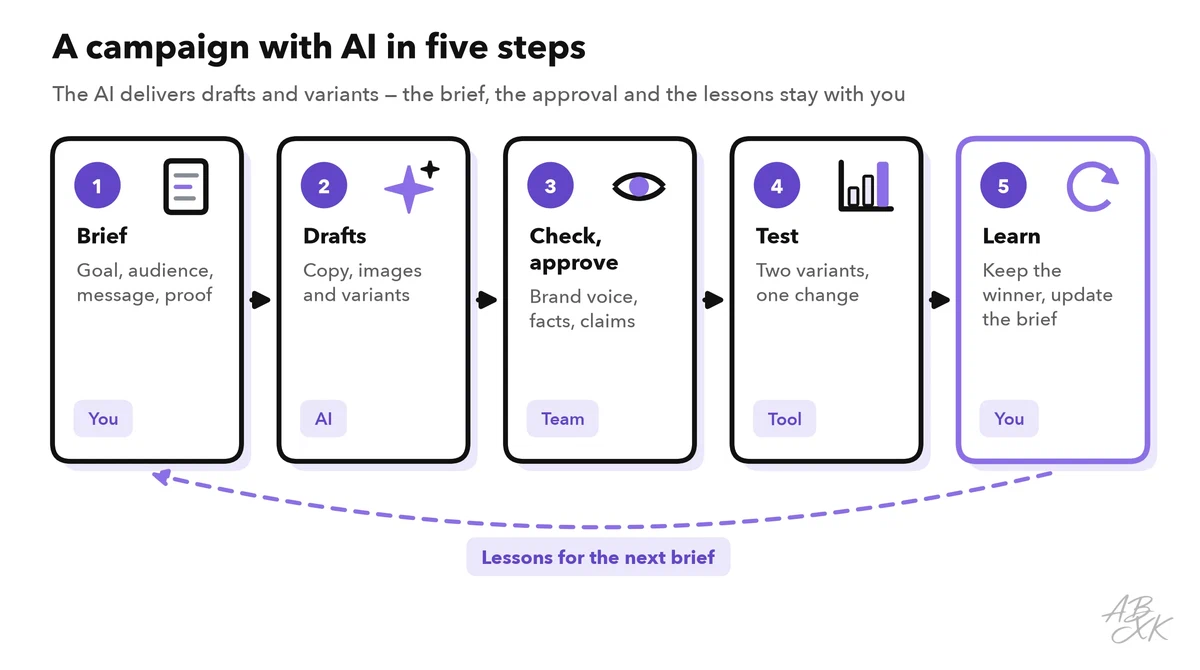
The workflow is the same for every format. Only the details you check change:
| Format | What AI drafts | What you check |
|---|---|---|
| Ads | Headlines, short texts, image variants | Claims, brand fit, the ad rules of the platform |
| Landing pages | Page copy, sections, alternative headlines | Facts, prices and conditions, a clear next step |
| Email campaigns | Subject lines, body text, follow-up emails | Consent of the recipients, the unsubscribe link, the tone |
| Social media posts | Post texts in different lengths and tones | Timing, current events, the replies you will have to handle |
Monitoring what people say about your brand on social media is a topic of its own; Level 2 covers social media and brand monitoring.
Start with a brief
A brief is a short document that describes a campaign: its goal, its audience, the key message and the facts behind it. A good brief is also the best prompt you can give an AI tool. Without one, the tool fills the gaps with generic phrases and invented details.
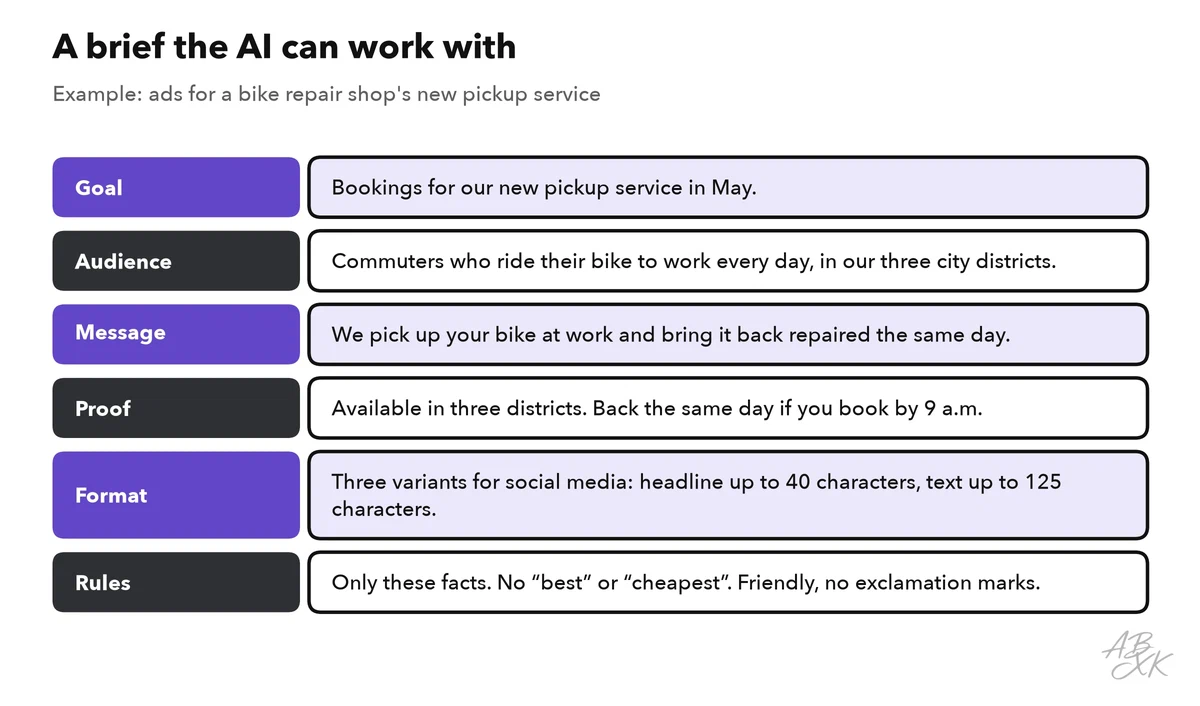
Two parts of the example deserve attention. Proof lists the facts that the ads may claim, and nothing else. Rules say what the AI must avoid. With this brief, you can ask for ten headline variants and get options that stay within your facts — instead of ten versions of “the best bike service in town”.
If you only have loose notes, let the AI help with the brief itself. Paste your notes, ask it to sort them under the six headings and to list what is missing as questions. Answer the questions yourself; do not let the tool fill the gaps.
Write a brand voice guide
Your brand voice is how your company sounds: formal or casual, playful or plain. AI tools write in an average voice unless you tell them otherwise. A one-page brand voice guide fixes that. You can paste it into a prompt or save it in the settings of your tool; some tools have a place for it, often called a brand kit.
| Trait | We write | We avoid |
|---|---|---|
| Clear | “Your bike is back by 6 p.m.” | “Seamless mobility solutions” |
| Friendly | “We’ll take care of it.” | “Dear valued customer” |
| Honest | “Back the same day if you book by 9 a.m.” | “Always lightning fast!” |
| Local | “In our three city districts” | “The world’s leader in bike care” |
Add a few rules about form, too: how you spell your product names, which words you never use, whether emojis are allowed. Then test the guide. Give an AI assistant the guide and a brief, and put the result next to texts your team wrote. If you can tell them apart at first glance, the guide needs more examples.
Create variants and test them fairly
AI makes variants cheap: ten headlines or five image styles take minutes. That is useful, because it is hard to predict which version will work better. An A/B test answers this question. Two versions run at the same time for comparable audiences, and you compare one metric.
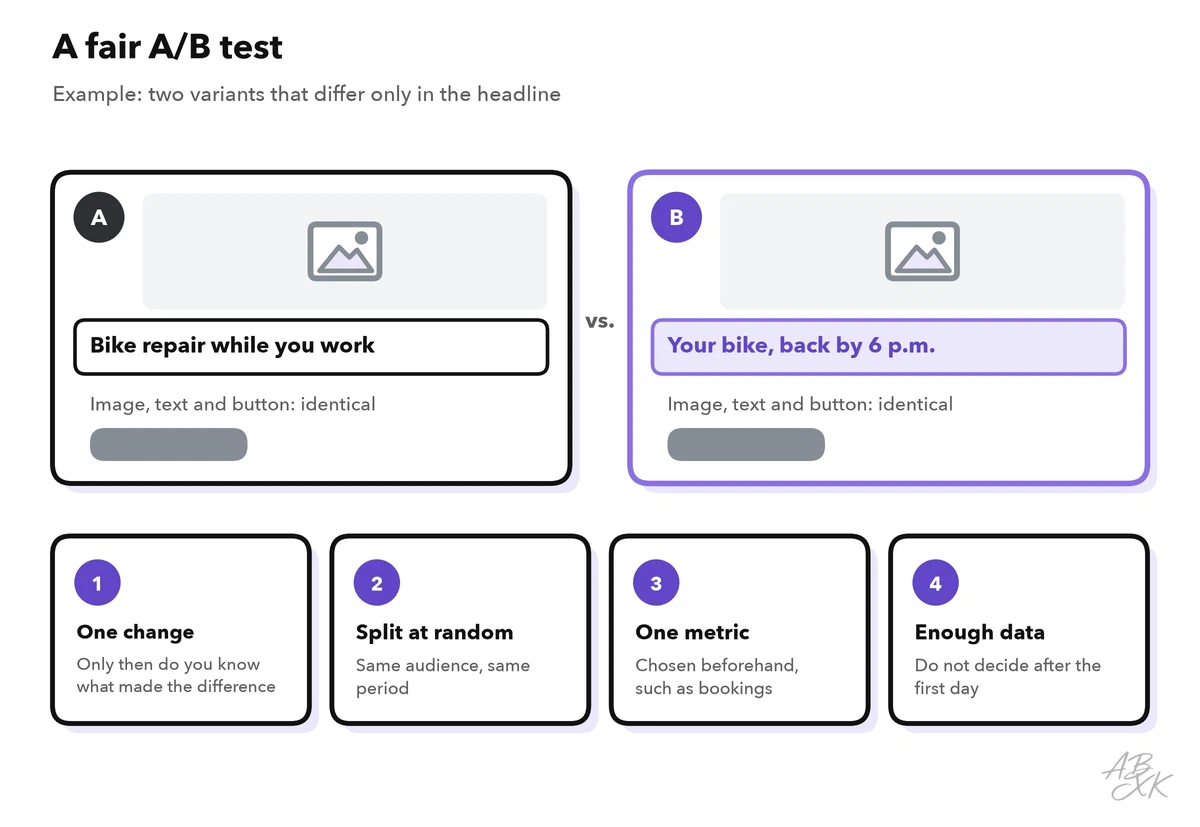
The more variants you test at once, the more likely it is that one of them wins by chance. So start with two or three, and change only one element per test. Many ad platforms and email tools have a built-in test feature. Use it instead of comparing two campaigns from different weeks.
Choose the metric that is closest to your goal. A catchy headline can win on clicks and still lose on bookings, because it attracts people who were only curious. In the bike example, the goal is bookings, so bookings decide the test.
Specialized tools support different parts of this work. According to the vendors, AdCreative.ai generates ad images, videos and copy; Atria combines ad research, creation and analytics; Motion shows which ad creatives perform; Unbounce builds and tests landing pages; and GetResponse covers email campaigns with automation. Our comparison lists 12 tools in Marketing & Advertising. For general image generation, see our ABXK Ranking of text-to-image generators in the AI Productivity section.





Short descriptions from our tool comparison, based on the vendors' information — not tested by ABXK.
Approvals, claims and disclosure
Before anything goes live, someone who did not write it should check it. Decide in advance who approves what: the marketing lead checks tone and brand fit, the product owner checks the facts, and someone from legal checks sensitive claims. Keep a short record of each campaign: the brief, the approved version and who approved it. If a claim is questioned later, you can show where it came from.
AI tools often write superlatives and confident promises, because such phrases are common in the advertising texts they learned from. Every claim needs proof:
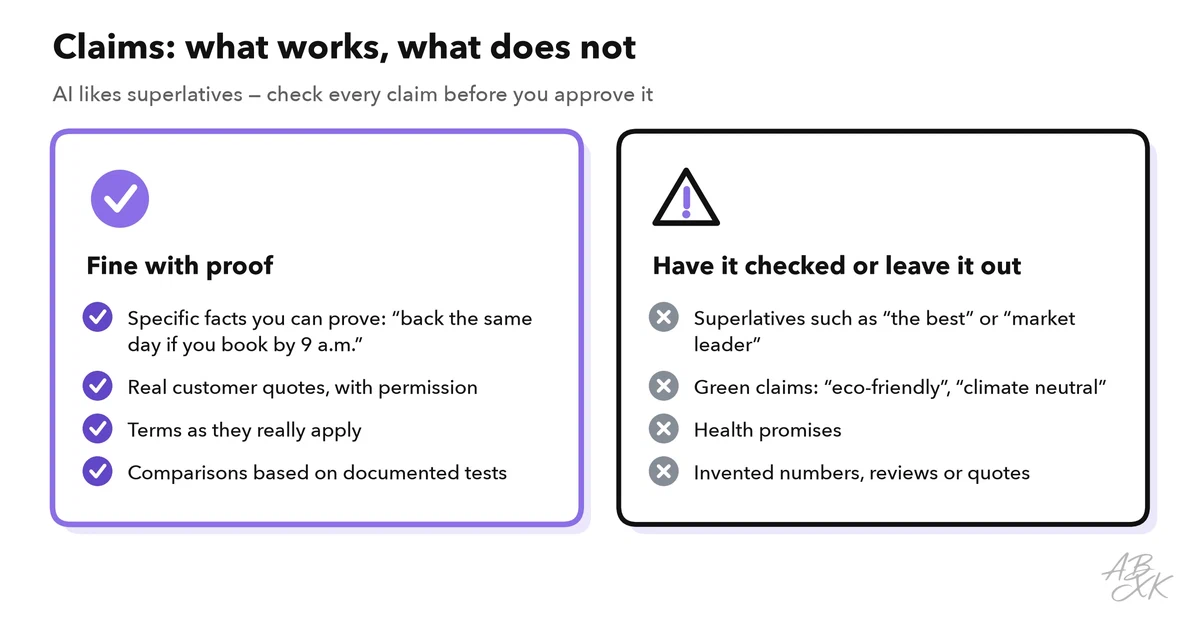
- Proof for claims: In the US, the FTC expects advertisers to have evidence for objective claims before they make them (Source: FTC Policy Statement Regarding Advertising Substantiation, ftc.gov). In the EU, the Unfair Commercial Practices Directive bans misleading advertising.
- Green claims: Since September 27, 2026, EU member states must apply stricter rules against greenwashing (Directive (EU) 2024/825). Under these rules, generic environmental claims such as “eco-friendly” are allowed only if the company can show recognized excellent environmental performance.
- Rights: In the US, the Copyright Office has said that material generated purely by AI, without enough human creative control, is not protected by copyright (Source: U.S. Copyright Office, Copyright and Artificial Intelligence, Part 2: Copyrightability, 2025, copyright.gov). Also check whether the terms of your AI tool allow commercial use.
- Disclosure: The EU AI Act requires a label for deepfakes — realistic AI-generated or manipulated images, audio or video that could be mistaken for real (Article 50). Several social platforms also ask you to label realistic AI content. Customer reviews and quotes must always be real.
Your company’s general rules for AI apply here, too. Level 0 covers ground rules for using AI at work, and part 5 of this level shows how to track campaign results in reports and dashboards.
A checklist before you publish
| Check | Question | Who |
|---|---|---|
| Facts | Is every number, date and feature in the brief or in another source? | Product owner |
| Claims | Are there superlatives, green or health claims? Is there proof for each? | Marketing lead, legal if needed |
| Brand voice | Does it sound like us and not like a generic ad? | Marketing lead |
| Rights | May we use the images, music and quotes commercially? | Marketing lead |
| Labels | Does realistic AI content need a label on this platform? | The person who publishes |
| Test plan | Which variants, which metric, how long? | Campaign owner |