

Picture a company that buys AI licenses for every employee. Three months later, a third of the staff use the assistant every week, mostly for small tasks, and the business case is far out of reach. The tool works. The adoption does not. Buying a tool changes nothing by itself: people have to change how they work.
This is part 4 of Level 4 in our AI Work learning path. Part 2 showed that the benefit of AI depends on how much freed time turns into value (measure the ROI of AI at work). This part covers the human side: why AI tools fail without adoption, how new tools spread through a team, champions, training formats, communication, fears, adoption metrics and incentives.
Buying a tool is not adoption
Adoption means that people use a new tool regularly, for the tasks where it helps, in a way that changes results. Access is not adoption, and neither is one enthusiastic try. A representative US survey shows the gap. As of late 2024, nearly 40 percent of adults aged 18 to 64 used generative AI, but only 9 percent of employed people used it every workday (Source: Bick, Blandin and Deming, “The Rapid Adoption of Generative AI”, NBER Working Paper 32966, 2024, revised 2025, nber.org).
The funnel shows five stages from license to impact. At each stage, people drop out for typical reasons:
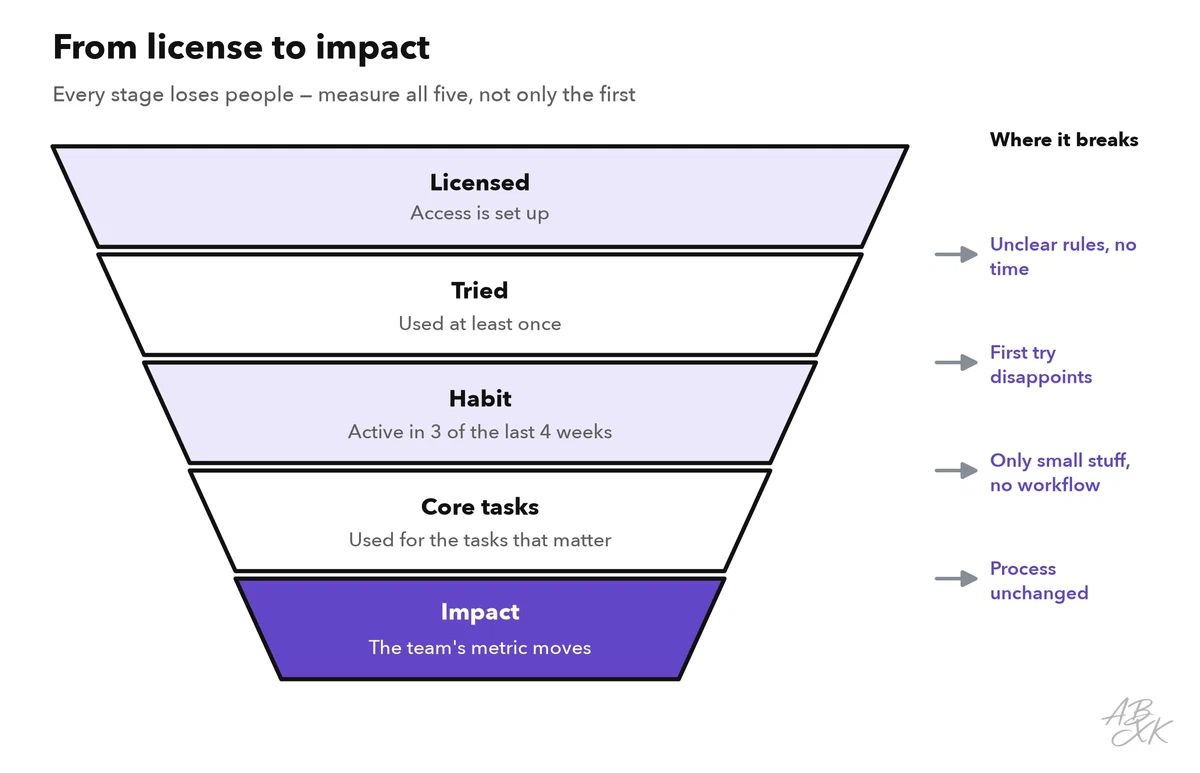
- Unclear rules and no time. People do not know what they may enter into the tool, and nobody gave them time to learn it.
- A disappointing first try. AI does well on some tasks and fails on others that look similar. Whoever starts with the wrong task gives up early. Level 0 explains this uneven border in what AI changes at work.
- Only small tasks. People rewrite an email now and then, but the tool never reaches the tasks that matter.
- An unchanged process. The team uses AI on top of the old workflow. Steps, roles and targets stay the same, so the saved minutes disappear.
- A mandate without guidance. “Use AI for everything” pushes people toward quick, low-effort output. Researchers at BetterUp Labs and the Stanford Social Media Lab link such top-down mandates to workslop: AI output that looks finished but has to be fixed by someone else (Source: reported by Fortune, September 2025). Say where AI helps and where it does not, and make clear that people stay responsible for what they pass on.
How new tools spread through a team
New tools do not spread evenly. The sociologist Everett Rogers described five groups of adopters in his book Diffusion of Innovations, first published in 1962: innovators, early adopters, early majority, late majority and laggards. Their shares follow a bell curve, and the share of people who use the innovation grows along an S-curve.
Geoffrey Moore added an important point in his book Crossing the Chasm (1991). Between the early adopters and the early majority lies a gap, the chasm. Early adopters try new things because they are new. The early majority wants proof that the tool works for people like them, ready-made examples and help when they get stuck.
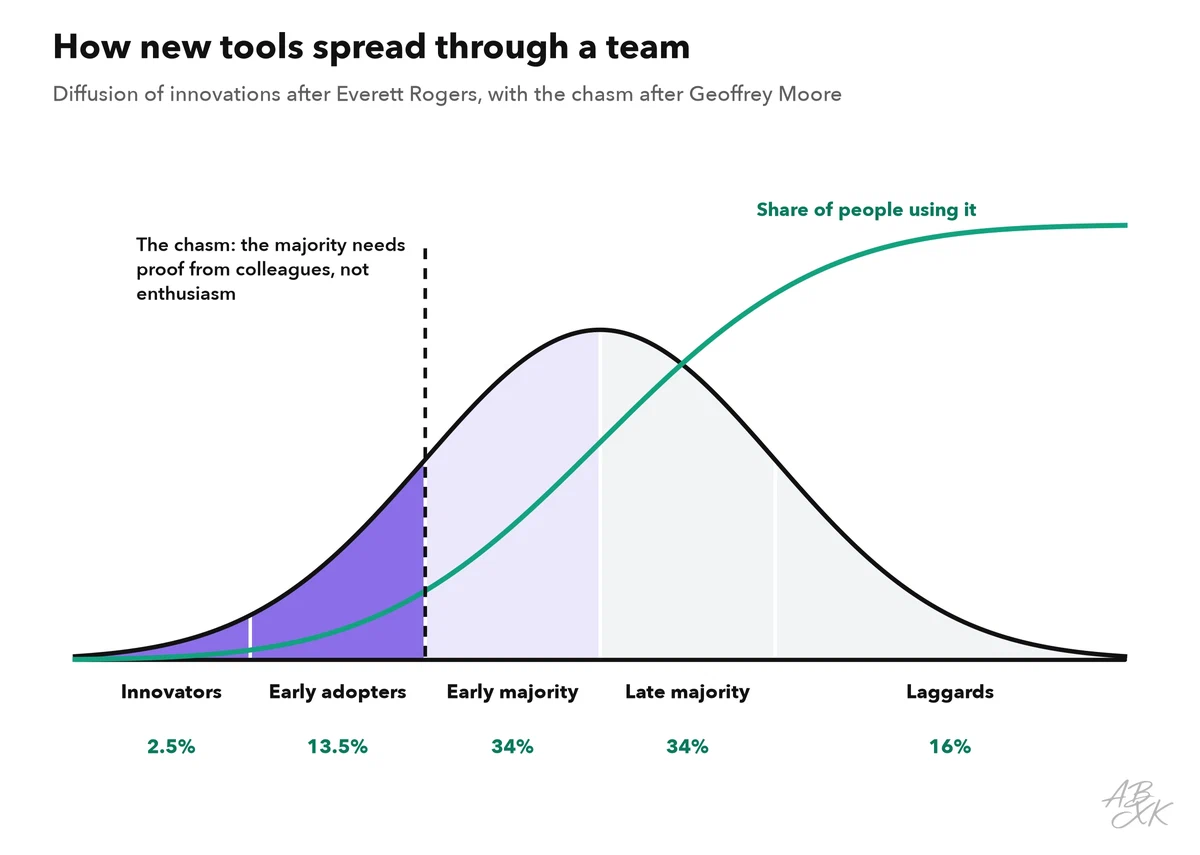
For AI at work, this means that the enthusiasm of the first users does not carry the rollout. You win the majority with results from colleagues in the same role, with examples from their own tasks and with time to learn. The model is a description, not a law, and the groups in your team may be larger or smaller. But the lesson holds: the majority follows proof, not novelty.
Build a network of champions
Champions are employees in each team who use AI early, find good use cases, share examples and help their colleagues. They are not part of the central AI team. They work in sales, service or finance and know the work there. A champion network connects two directions: the AI team supplies rules, templates and updates, and the champions send back examples, problems and requests.
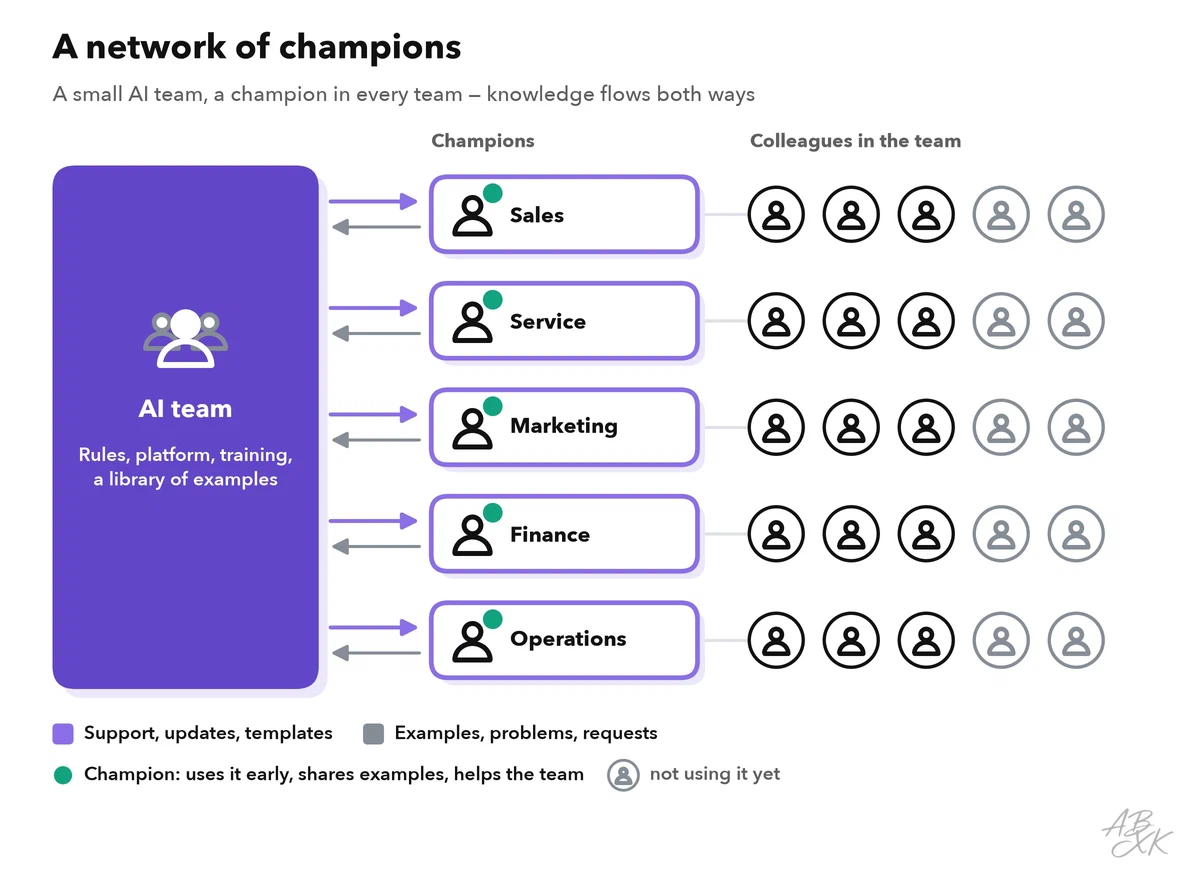
Champions need four things:
- Time: a few hours a week, agreed with their manager and written into their goals.
- Early access to new tools and features, and a direct line to the AI team.
- A stage: short demos in team meetings, a channel for questions and a shared library of good examples.
- Recognition: visible thanks from management and credit in performance reviews.
Choose champions for respect, not only for enthusiasm. A respected colleague who says “this saved me an hour on the monthly report” convinces the early majority more than any vendor demo.
Train in formats that fit the work
No single format builds a habit. Combine several, and match each to its purpose:
| Format | Good for | Limits |
|---|---|---|
| Short online course | Basics for everyone: what AI can do, rules, data, checking outputs | Builds knowledge, not habits |
| Hands-on workshop | Practice on the team’s own tasks, led by a champion | Needs preparation and real examples |
| Office hours | Questions from daily work, fast help when someone is stuck | Only helps people who come |
| Peer demos in team meetings | Proof from colleagues, new ideas | Tend to show only highlights |
| Library of examples and prompts | Reusing what works, a faster start | Gets outdated without an owner |
| Deep dive by role | Owners, reviewers and power users | Small groups only |
Two principles make training work. First, train on real tasks from the team’s own work, not on generic examples. Second, show where the tool fails, not only where it shines. People who know the weak spots trust the tool for the right things. In the EU, the AI Act also asks companies to support the AI literacy of staff who use AI systems (Article 4). Part 3 of this level places this duty in AI governance for business teams.
Software can deliver the basics and show the adoption metrics described below. According to the vendors, Evolve creates training courses, adapts them to each learner and measures the results, and Databox combines dashboards, automated reports and goals:


Short descriptions from our tool comparison, based on the vendors' information — not tested by ABXK.
Communicate honestly and answer fears
Good communication answers five questions before people ask them: Why are we doing this? What changes for me? What stays the same? What are the rules? Where do I get help? Managers matter more than any announcement. When a manager uses the tool openly and shares a real example, the team follows.
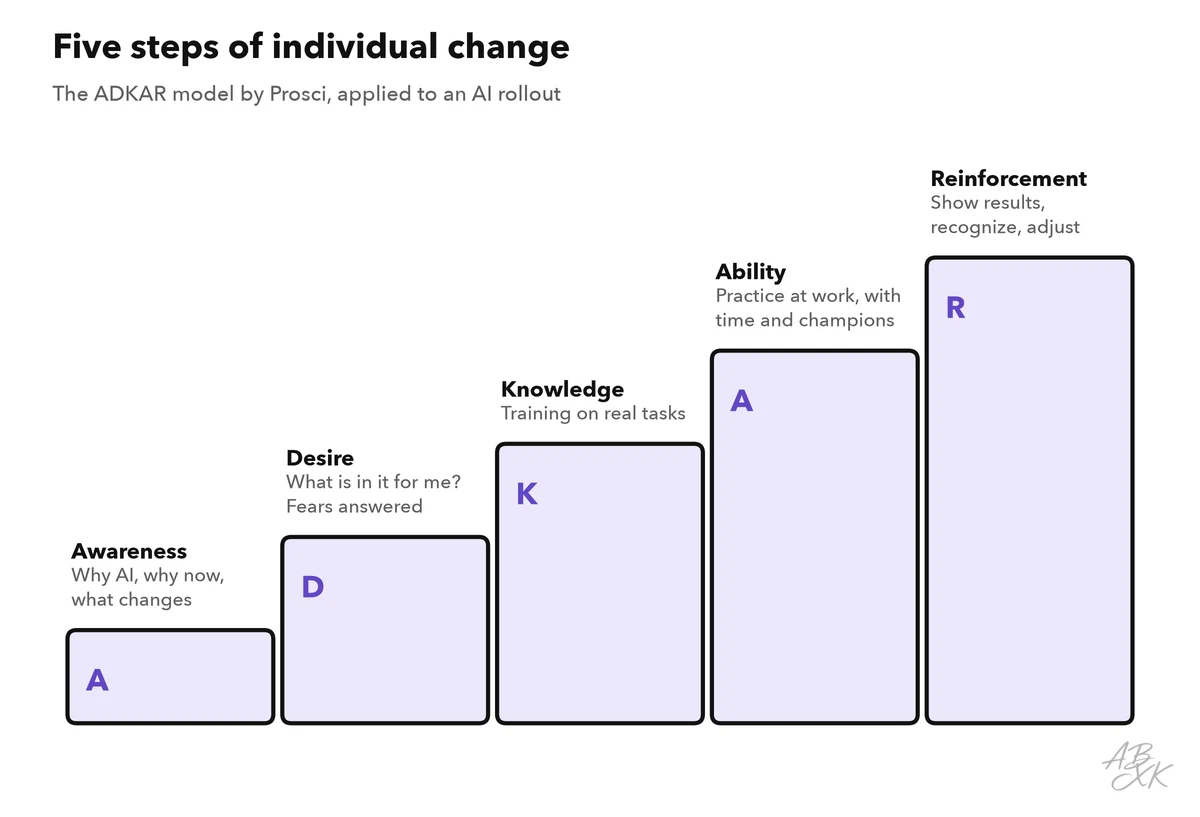
Change happens person by person. The ADKAR model by the change management firm Prosci describes five steps that each person goes through: awareness, desire, knowledge, ability and reinforcement. Communication covers the first two steps, training and practice the next two, and recognition and results the last one.
Fears need direct answers. Avoid promises you cannot keep, such as “no job will change”. Say what you know:
| Fear | What is behind it | What helps |
|---|---|---|
| “AI will take my job.” | Uncertainty about the future of the role | Be honest about plans, show which tasks change, say how freed time will be used |
| “I will look incompetent.” | New skills, visible mistakes | Safe practice time, no evaluation of individuals by usage data |
| “I might break a rule.” | Unclear limits for data and use | Clear rules with examples of allowed and forbidden inputs |
| “I am liable for AI errors.” | Unclear responsibility | Review rules, clear accountability, a way to escalate |
| “This is a way to monitor us.” | Usage data can show who did what | Measure at team level, agree on rules with the works council |
Research supports honesty on the first point. The ILO found that generative AI is more likely to change parts of jobs than to replace whole jobs (Source: ILO, Generative AI and Jobs, Working Paper 96, 2023, ilo.org). That does not mean that nothing changes. It means you can tell people which tasks change and how.
Measure adoption without monitoring people
Researchers at Google proposed the HEART framework to measure how people use software: Happiness, Engagement, Adoption, Retention and Task success (Source: Rodden, Hutchinson and Fu, “Measuring the User Experience on a Large Scale”, CHI 2010, research.google). It works well for AI tools at work:
| Dimension | Example metric for an AI tool | Watch out |
|---|---|---|
| Happiness | Share of users who would keep the tool, from a short survey | Early enthusiasm fades, so ask again after two months |
| Engagement | Tasks done with AI per active user and week | More use is not always better |
| Adoption | Share of licensed users who used it in the last 30 days | Counts tries, not habits |
| Retention | Share of users still active after eight weeks | The best early warning |
| Task success | Share of AI results used after light edits | Needs regular sample checks |
Report these metrics per team, not per person. Ranking individuals by AI use invites fake activity and damages trust. In Germany, the works council also has a say in systems that can monitor performance. And watch out for Goodhart’s law: when a measure becomes a target, it stops being a good measure. A target such as “50 prompts a week” produces 50 prompts, not better work.
Incentives help when they reward results and learning, not clicks:
- Time: protected time to learn, especially in the first weeks.
- Recognition: good examples shown in team meetings, with the names of the people behind them.
- Career: AI skills in role profiles and development goals.
- Shared gains: an open decision on how freed time is used — less overtime, more time with customers, new tasks — so that employees benefit too.
Avoid usage quotas and leaderboards. They measure activity, not value.
Plan the rollout in four phases
Each phase has its own goal and a clear signal for moving on. The pilot phase follows the same logic as Level 3’s guide to running an AI pilot project:
| Phase | Goal | Actions | Move on when |
|---|---|---|---|
| Prepare (weeks 1–4) | Ready to start | Rules, two or three use cases per team, champions named, baseline measured | Champions trained, use cases tested |
| Pilot with champions (weeks 5–10) | Proof in daily work | Champions use AI on real tasks, collect examples, fix problems | Clear results on at least one use case |
| Roll out team by team (months 3–6) | Habits in the majority | Workshops on team tasks, office hours, example library, demos by managers | Retention is stable, task success is known |
| Embed (months 6–12) | The new normal | AI in process descriptions, onboarding and role profiles, old steps removed | The use case metric has moved, reviews run regularly |