

A teacher wonders whether an essay came from ChatGPT. A newsroom receives a video that looks almost too good. A company gets a voice message from “the CEO”. All of them want the same thing: a tool that says “real” or “AI”. Such tools exist, but their answers are less certain than they look, and careless use can hurt innocent people.
This guide is part 5 of Level 0 in our AI Security learning path. You will learn the two ways to recognize AI-made content, what detectors look for in text, images, audio and video, why they make mistakes and how to use them fairly.
Two ways to answer the question
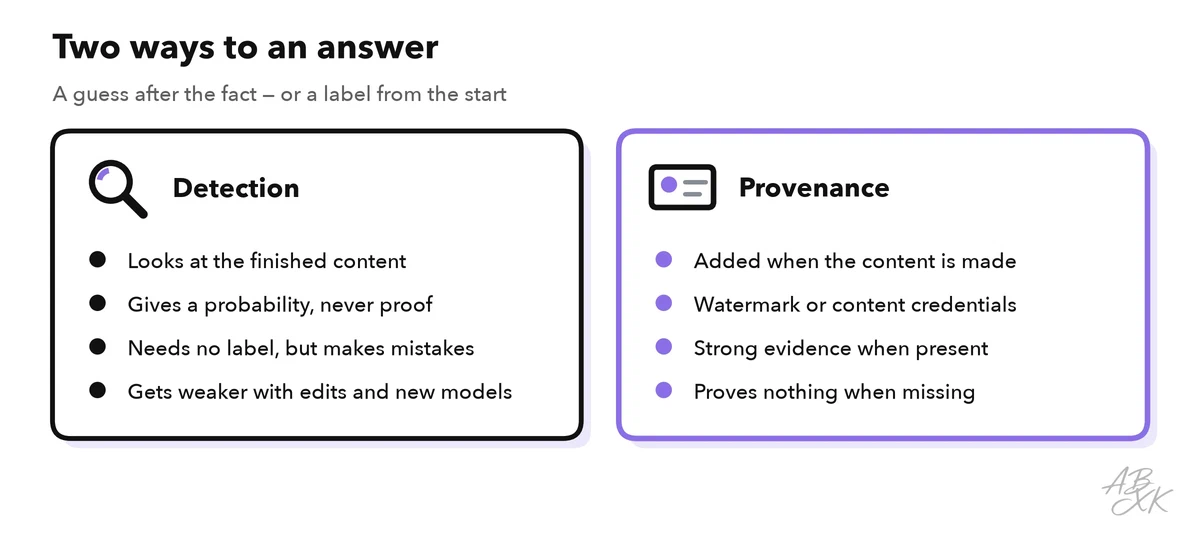
There are two very different approaches, and it helps to keep them apart:
- Detection looks at the content after the fact and searches for patterns that are typical of AI. The result is a probability, never proof.
- Provenance means information about the origin of a file that is added when the file is made. A generator can embed a watermark, a hidden signal in the content itself. Or the file carries content credentials, signed information about who or what created and edited it.
What detectors look for
Detectors work differently for each type of media. For text, many look at perplexity: how predictable each next word is for a language model. AI text tends to be smooth and predictable, with sentences of similar length and typical phrases. Some detectors measure such statistics directly; others are trained models that have seen large amounts of human and AI text.
Our own AI text detector uses nine statistical signals and runs entirely in your browser. Our article on how the detector works explains each signal in simple terms.
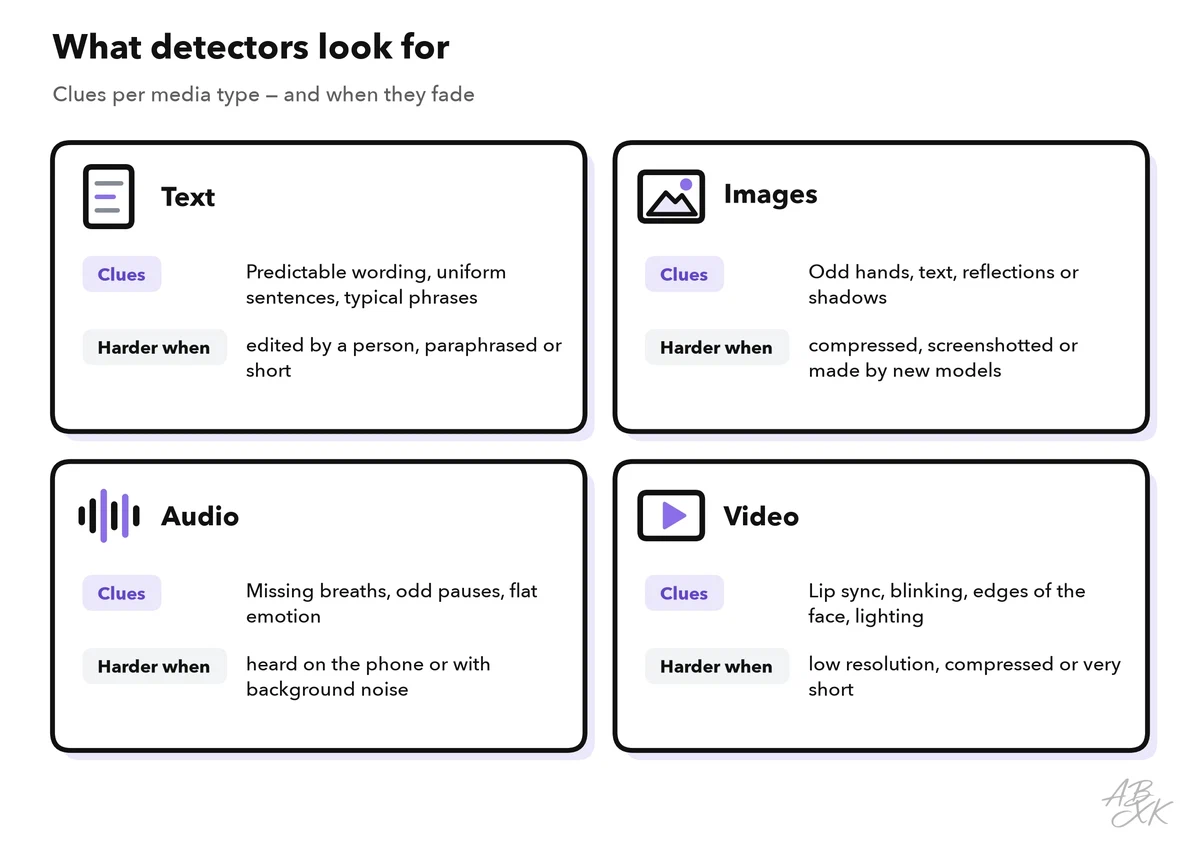
| Media | Clues detectors use | What makes detection harder |
|---|---|---|
| Text | Predictable wording, uniform sentences, typical phrases | Human editing, paraphrasing tools, short texts |
| Images | Odd hands, text, reflections or shadows; pixel patterns | Compression, screenshots, newer models |
| Audio | Missing breaths, odd pauses, flat emotion | Phone quality, background noise |
| Video | Lip sync, blinking, edges of the face, lighting | Low resolution, compression, short clips |
Audio is the hardest case for people. In a study at University College London, 529 participants listened to real and AI-generated speech in English and Mandarin. They identified the fakes only 73% of the time, and training helped only a little, although the fake voices were made with older technology (Source: Mai et al., “Warning: Humans cannot reliably detect speech deepfakes”, PLOS ONE, 2023). For phone calls, this means: do not try to judge the voice. Check the request instead.
Our guide How to Spot a Deepfake Video or Image goes deeper into the visual clues and the technology behind automated detection.
Why detectors make mistakes
A detector can fail in two directions. A false positive is a human text or real photo that the detector flags as AI. A false negative is AI content that slips through. Both happen, and the numbers can be sobering.
OpenAI launched its own text classifier in early 2023. In OpenAI’s tests, it correctly labeled 26% of AI-written texts as “likely AI-written” and wrongly labeled human texts as AI 9% of the time. OpenAI took the tool offline in July 2023 because of its low accuracy (Source: OpenAI, 2023, openai.com).
Detectors can also be unfair. Researchers at Stanford tested seven detectors on essays by non-native English speakers written for the TOEFL exam. On average, the detectors flagged 61% of these human-written essays as AI-generated, while they judged essays by US eighth-graders almost perfectly. The authors suspect that simpler vocabulary looks “predictable” to the detectors (Source: Liang et al., “GPT detectors are biased against non-native English writers”, Patterns, 2023).
Detectors also age. They learn the patterns of the AI models that existed when they were trained. When a new generator appears, its output can look different, and detection gets worse until the detector is updated. Light editing has a similar effect: rewriting a few sentences can lower a text score considerably.
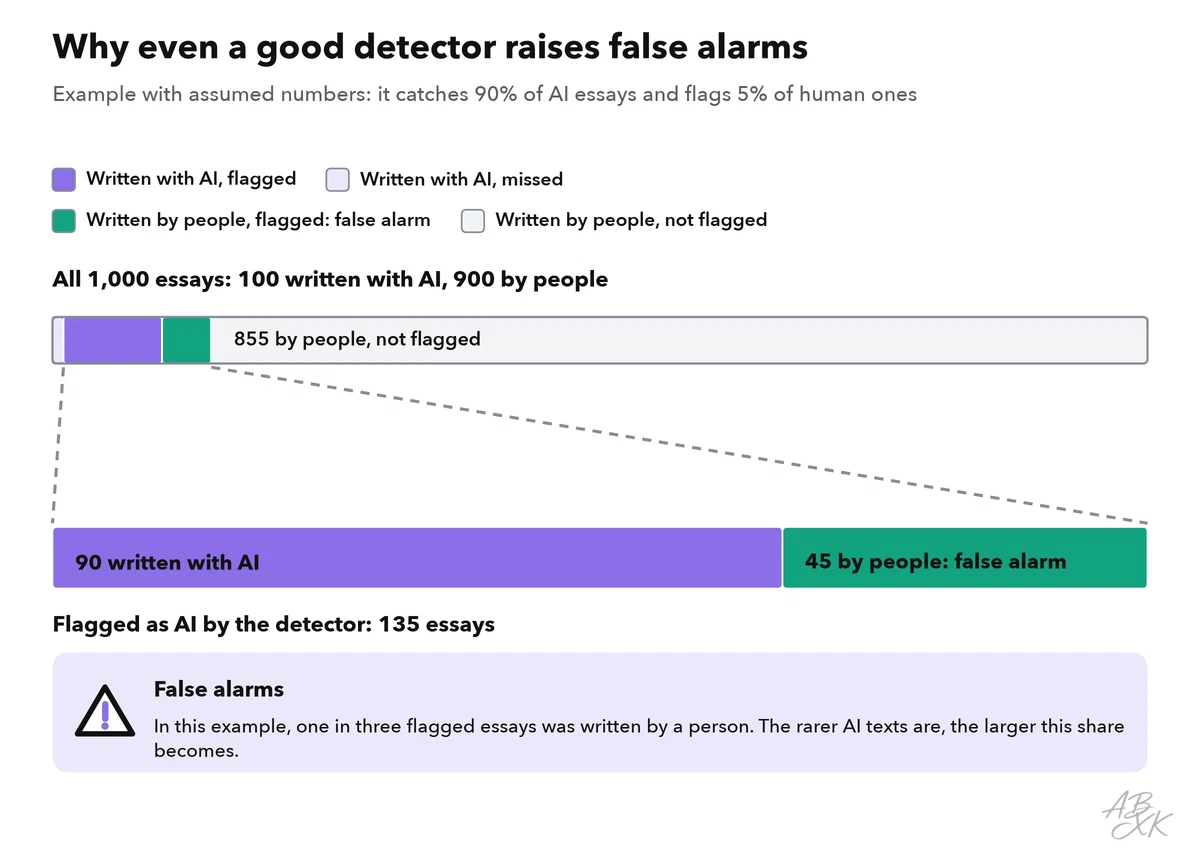
There is one more, less obvious problem: even a good detector produces many false alarms when most texts are human. The example below uses assumed numbers to show the effect.
Watermarks and content credentials
Provenance avoids guessing, but only if the generator takes part:
- Watermarks. Google DeepMind’s SynthID embeds an invisible watermark in content from Google’s AI models. Google says that images generated with its Gemini image models carry it, and that you can upload an image to the Gemini app to ask whether Google AI made it (Source: Google, 2025, blog.google).
- Content credentials. They follow the open C2PA standard, short for Coalition for Content Provenance and Authenticity. Adobe applies them automatically to images fully generated with Firefly (Source: Adobe Help Center, helpx.adobe.com). OpenAI adds C2PA metadata to the images it generates in ChatGPT (Source: OpenAI, 2025).
Both have limits. A watermark only says something about tools that use it, and heavy edits can weaken it. Content credentials are stored as metadata, which is easy to lose. OpenAI itself notes that most social media platforms remove metadata from uploaded images, and that a simple screenshot can remove it too (Source: OpenAI Help Center, help.openai.com). The rule of thumb: a watermark or a credential that you find is strong evidence. A missing one proves nothing.
The image generators below mark their output, according to the vendors. We have not tested these claims.



Short descriptions from our tool comparison, based on the vendors' information — not tested by ABXK.
How to use detectors fairly
A detector score can open a question. It should never close one. Five rules help:
- Treat the score as a clue, not as proof. Never accuse, grade or reject a person based on a detector alone.
- Check that the text suits the tool. Short texts and languages the tool does not support give unreliable results. OpenAI said its classifier was unreliable below 1,000 characters.
- Be careful with non-native writers and with formal, technical or heavily edited text.
- Collect other evidence. Drafts, version history, sources and a conversation about the content say more than any score.
- Prefer provenance for images and video. Look for content credentials, check the original source and the date, and see whether trusted outlets report the same.
Our detector caps its score between 5% and 95% because it never claims certainty. Pangram Labs offers a detector for educators, publishers and companies, according to the vendor; we have not tested it. Level 2 compares detection methods in depth in how AI detectors work and where they fail.

Short descriptions from our tool comparison, based on the vendors' information — not tested by ABXK.
Practice: what a detector adds, and what else you need
Detection is one tool among several. The table shows what it can and cannot do in five common situations:
| Situation | What a detector can add | What you need as well |
|---|---|---|
| A teacher suspects that an essay was written with AI | A first clue for longer texts | Drafts, version history and a conversation with the student |
| A hiring manager doubts a cover letter | Very little: many people polish letters with AI | The content itself and an interview |
| A newsroom receives a video of an event | Signs of manipulation; content credentials, if present | Original source, date, place and a second, independent source |
| An image goes viral after a disaster | A watermark or credential, if present | A reverse image search and reports from trusted outlets |
| A family gets a voice message asking for money | Almost nothing in real time | The callback rule and the family code word from part 2 |