

The phone rings. Your daughter is crying: she has had an accident and needs money right now. The voice is hers, or at least it sounds exactly like hers. Calls like this are one of the oldest tricks of fraudsters. With AI, they have become much more convincing.
This guide is part 2 of Level 0 in our AI Security learning path. Part 1 introduced the three sides of AI security. This part covers the first side: attacks that use AI against people. You will learn five common AI scams, the warning signs they share and three habits that protect you from them.
What AI changes about scams
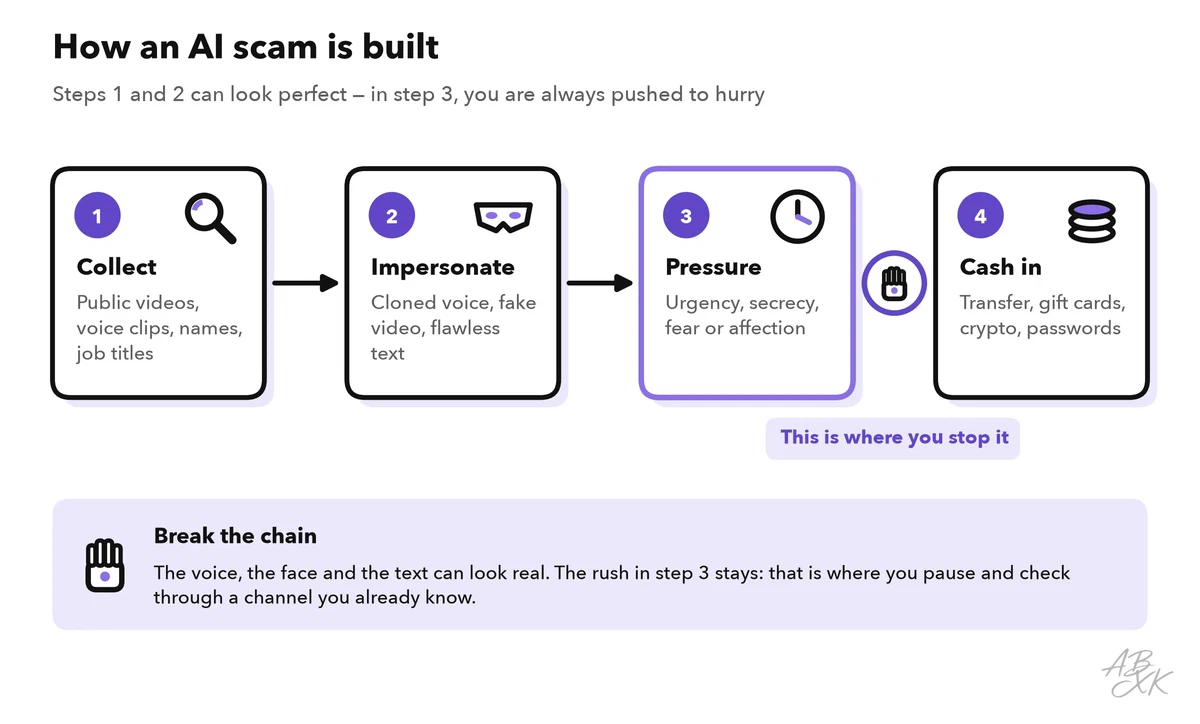
The scripts behind most AI scams are old: the emergency call from a relative, the urgent order from the boss, the message from “your bank”. What AI changes is how real they look and sound, and how many people a scammer can reach.
- Real voices and faces. A voice clone is a synthetic copy of a real person’s voice. The FTC, the US consumer protection agency, warns that a scammer needs only a short audio clip, for example from a video posted online (Source: FTC consumer alert, March 2023, consumer.ftc.gov). A deepfake puts a familiar face into a video or even a live call.
- Flawless language. Spelling mistakes used to give scammers away. According to the FBI, criminals now use AI to write and translate their messages without errors (Source: FBI Internet Crime Complaint Center, alert I-120324-PSA, December 2024, ic3.gov).
- Scale. AI writes a thousand personal messages in the time a person writes one, each with your name, your employer or your last order.
The pattern of the scam, however, stays the same, and that is your advantage. Almost every scam needs you to act fast, before you have time to check.
Five common AI scams
The fake emergency call
A relative calls in panic: an accident, an arrest, a hospital bill. The voice may be cloned from a video they posted. The caller wants money fast and asks you to keep quiet. Payment by wire transfer, cryptocurrency or gift cards is a typical sign of a scam, the FTC warns.
The fake boss
In 2019, the head of a British energy company transferred €220,000 after a phone call with what he believed was his boss at the German parent company. He even recognized the slight German accent. The voice had been generated with AI software (Source: The Wall Street Journal, 2019, citing the insurer Euler Hermes). Security experts call this CEO fraud. In 2024, the Arup case from part 1 took the same trick to video: a whole video call full of deepfakes.
AI-written phishing
Phishing means messages that pretend to come from a bank, a shop or a colleague in order to steal passwords, money or data. AI makes them flawless and personal. The FBI also reports fake websites with AI chatbots that steer visitors toward malicious links. Level 1 covers phishing in the AI era in depth.
Deepfake videos and video calls
Fake videos show celebrities who praise an investment or a product. In live calls, a deepfake can pose as a manager, an online partner or a job applicant. The FBI has warned that criminals use deepfakes and stolen identities to apply for remote jobs. In some cases, background checks showed that the applicant’s personal data belonged to someone else (Source: FBI Internet Crime Complaint Center, alert I-062822-PSA, June 2022). Our guide How to Spot a Deepfake Video or Image explains the visual clues.
Fake reviews
AI can write hundreds of believable product reviews in minutes. They push you toward a shop, an app or an investment that does not deserve your trust. In the US, an FTC rule has banned fake reviews since October 2024, and the FTC names AI-generated reviews as one example (Source: FTC, Rule on the Use of Consumer Reviews and Testimonials, 2024, ftc.gov).
The table puts the five scams side by side:
| Scam | How AI helps the scammer | Typical warning sign | What protects you |
|---|---|---|---|
| Fake emergency call | Clones a relative’s voice from a short clip | Panic, secrecy, payment by gift cards or crypto | Call back on the known number; family code word |
| Fake boss | Imitates the voice or face of a manager | Urgent transfer to a new account, “tell no one” | Callback rule; two people approve payments |
| AI-written phishing | Flawless, personal messages at scale | A link to log in, a short deadline | Type the address yourself; two-factor login |
| Deepfake videos and calls | Fake faces in videos and live calls | “Celebrity” investment tips, camera “problems” | Check through a second channel; ask something only the real person knows |
| Fake reviews | Many believable reviews in little time | Lots of similar five-star reviews within days | Compare several independent sources |
Warning signs that still work
AI makes the voice and the text perfect. It does not change what the scammer wants from you. That is why the classic warning signs still work, even when the message itself looks flawless.
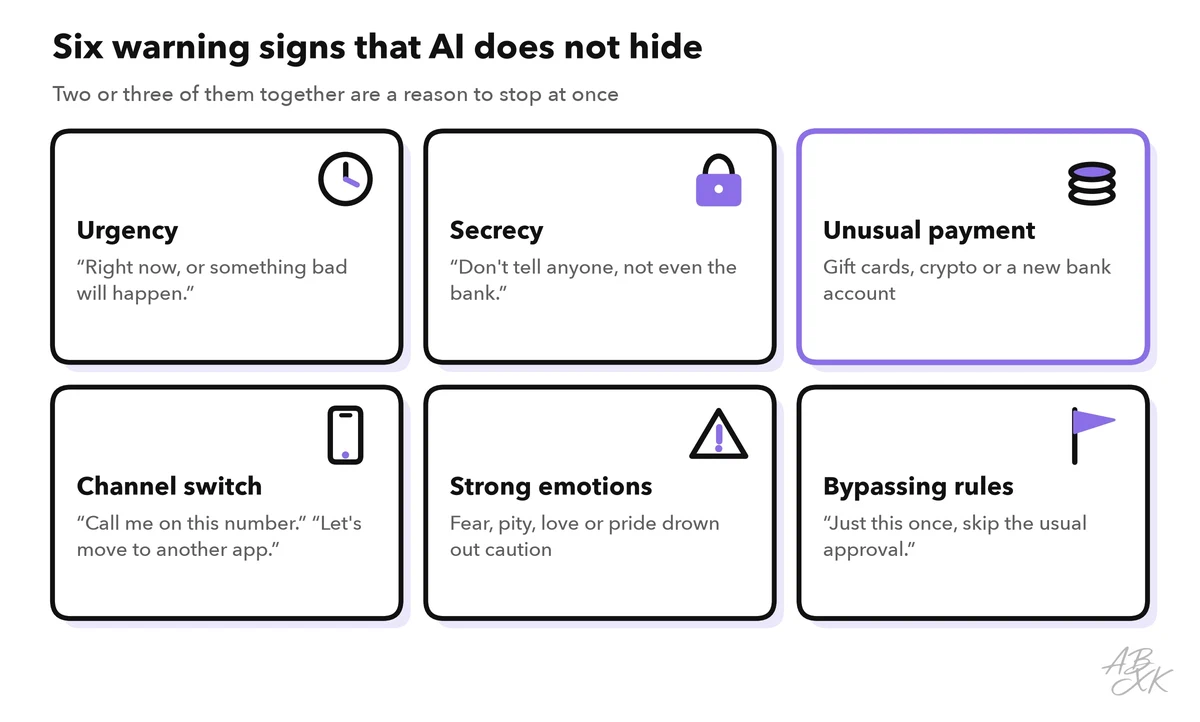
One warning sign alone can be harmless. Your boss may really be in a hurry. But two or three together, such as urgency plus secrecy plus a new bank account, should stop you. Technical glitches can be clues as well: a delay in a video call, a mouth that does not match the words, a voice without breathing. Newer fakes show fewer of them, though. Do not count on spotting the fake. Count on checking the request.
Three habits that protect you from AI scams
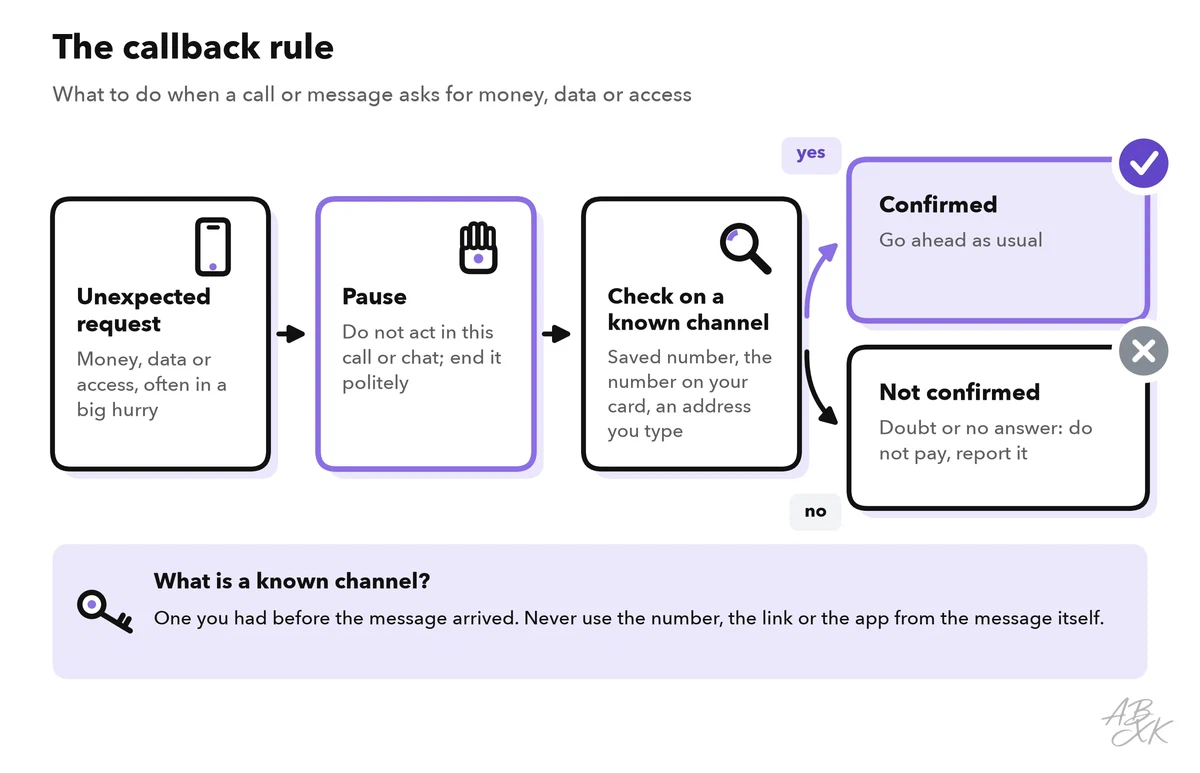
1. Hang up and call back. If a call or message asks for money, data or access, end the conversation politely. Then contact the person through a channel you already know: the number saved in your phone, the number on your bank card or a website address you type yourself. Never use the number or link from the suspicious message. The FBI and the FTC both recommend this check.
2. Agree on a family code word. The FBI recommends a secret word or phrase that only your family knows. Agree on it in person, never share it online, and ask for it in any emergency call. This is especially useful for older relatives, whom fake emergency calls often target.
3. Pause before money or data move. No payment and no password in the first contact, no matter how urgent it sounds. In companies, this pause becomes a rule: two people approve payments, and a change of bank details is only accepted after a callback on a known number.
Make yourself harder to copy
Scammers can only clone what they can find. A few habits reduce the material:
- Share less voice and video in public. The FBI advises limiting public photos and voice recordings and keeping social media accounts private.
- Accept only people you know. Fake profiles collect information about you and your family.
- Watch what you post about plans. Travel dates, a new job or a family member abroad give a scammer the story for the next call.
- Set firm rules at work. Fixed approval steps for payments protect you even when a fake is perfect. For remote hiring, identity and background checks are one safeguard; services such as Checkr offer them, according to the vendor.
Security software helps against part of the problem. It can block known phishing sites, dangerous attachments and malware, according to the vendors of the tools below. It cannot stop a convincing phone call; your habits do that. The short descriptions come from the vendors, and we have not tested the tools. More tools are in our AI Security tool comparison.



Short descriptions from our tool comparison, based on the vendors' information — not tested by ABXK.
If you have already paid or shared data
Scams fool careful, smart people every day. If it happened to you, act quickly and without shame:
- Call your bank’s fraud line at once. If you act fast, a transfer can sometimes still be stopped or recalled. Ask the bank to block cards you shared.
- Secure your accounts. If you gave away a password or a code, change the password, sign out of all devices and turn on two-factor login.
- Keep the evidence. Save phone numbers, messages, screenshots and the details of every payment.
- Report the scam. Contact your local police. In the US, report it to the FTC at ReportFraud.ftc.gov and to the FBI at ic3.gov.
- Warn the people around you. Scammers often try the same story on your family or your colleagues next.