

ChatGPT, Gemini, Claude, Grok: behind each of these assistants sits a large language model, or LLM for short. You do not need to understand the math to use one well. But a basic picture of how an LLM works explains a lot: why it writes so fluently, why it sometimes invents facts, and why the same question can get different answers.
This is part 3 of Level 0. You need no technical background. You will learn what happens when you type a request, what tokens and the context window are, how training differs from using a model, and who builds these models.
An LLM predicts the next word, again and again
A large language model is a computer program that has learned from a huge amount of text how language usually continues. Give it the start of a sentence, and it predicts what comes next. “Large” refers to the amount of training text and to the size of the model itself. Modern LLMs contain billions of internal numbers, called parameters, that store what the model has learned.
When you ask a question, the model does not look up a finished answer. It writes the answer piece by piece. For every next piece, it estimates how likely each possible continuation is, picks one of the likely ones, adds it to the text and starts again.
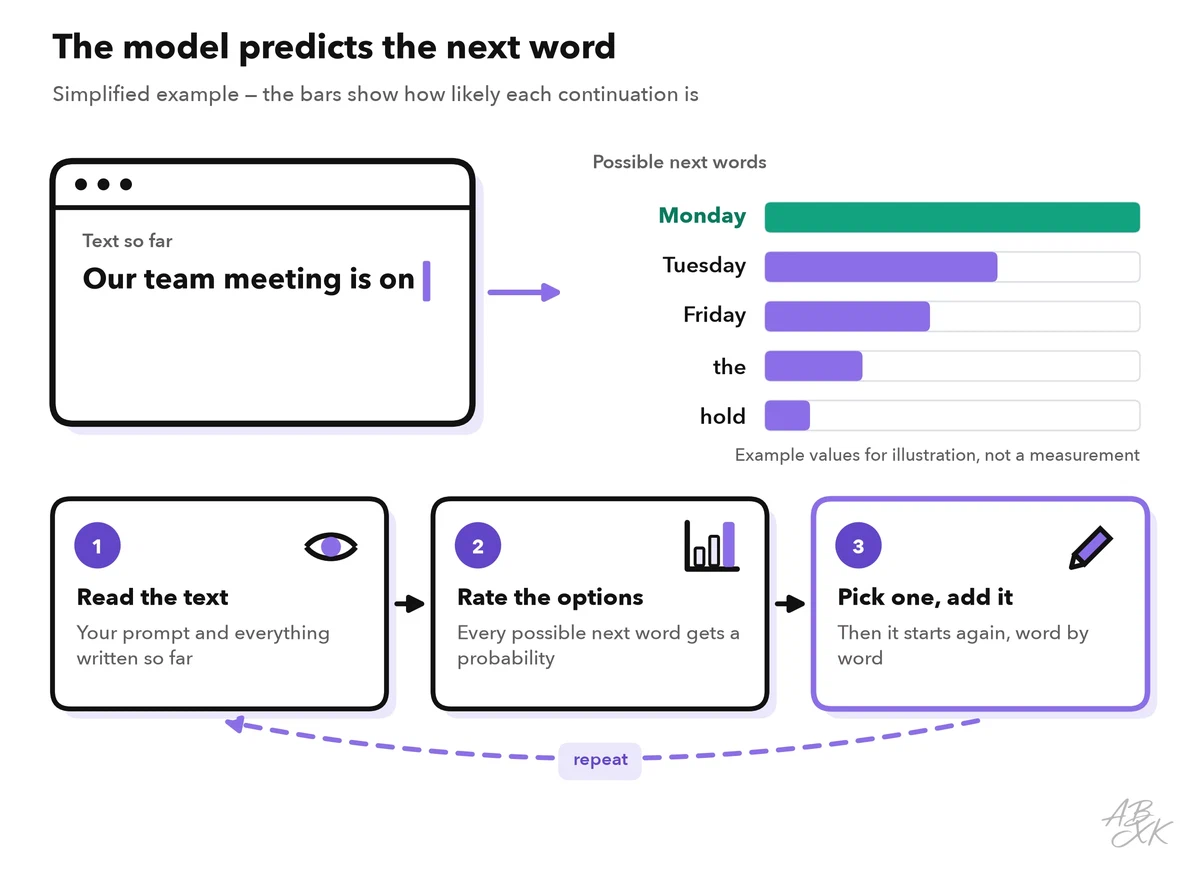
Most chat tools add a little randomness to this choice. That is why the same question can give you a slightly different answer each time — and why you can simply ask again if you do not like the first result.
Tokens: the pieces an LLM really works with
Strictly speaking, an LLM does not read whole words. It reads tokens: small pieces of text. A common short word is often one token. A long or rare word is split into several pieces. Every model has its own way of splitting text.
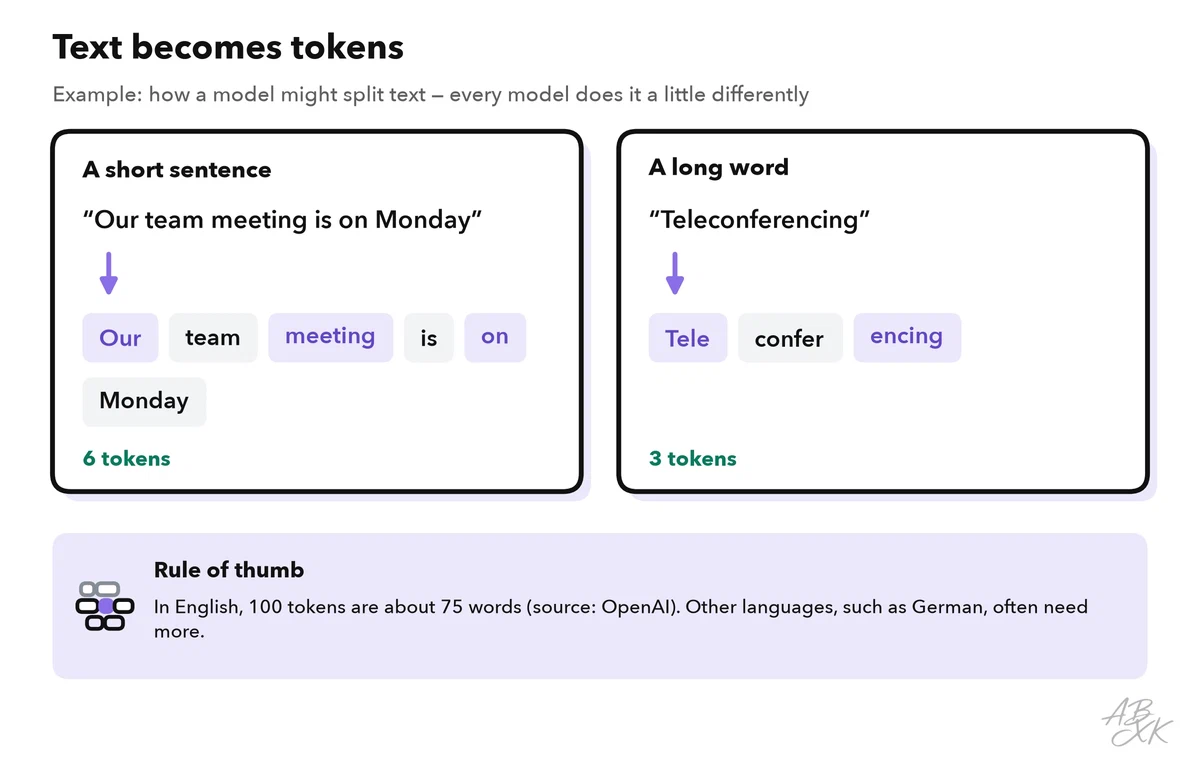
As a rough guide, OpenAI says that in English, 100 tokens are about 75 words (Source: OpenAI Help Center, help.openai.com). Other languages, such as German, often need more tokens for the same content. You will meet tokens again and again. The limit on how much text a model can handle is counted in tokens. So is the usage that developers pay for when they connect to a model directly.
Training and use: two separate phases
An LLM goes through two very different phases.
Training happens at the company that builds the model, before anyone uses it. The model reads enormous amounts of text — for example books, websites and program code — and adjusts its parameters step by step until its predictions get better. For large models, this takes weeks or months on thousands of specialized computer chips. Afterward, the model is trained further to follow instructions and to answer in a helpful way.
Use, also called inference, is what happens when you type a prompt. The finished model predicts an answer in seconds. It does not learn from your chat in that moment: its parameters stay the same, no matter what you tell it.
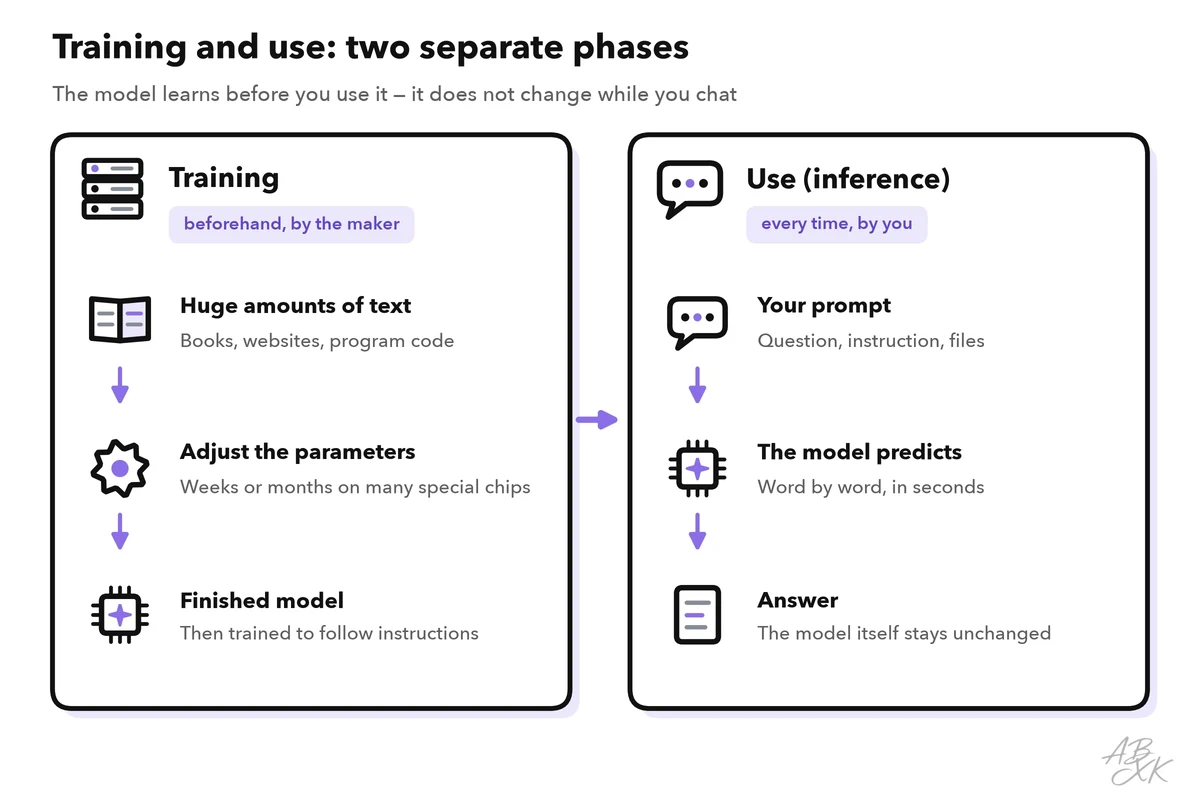
Two practical consequences follow. First, every model has a knowledge cutoff: the date when its training data ends. Without a web search, it does not know what happened after that date. Second, the privacy question is not about the model learning from you live. It is about what the provider stores and whether it uses your chats to train future models. That depends on the provider and your settings, so check them before you share anything sensitive.
Why fluent answers can still be wrong
An LLM is built to produce text that sounds right. It is not built to know when it is wrong. If the model has not learned a fact well, it still produces a likely-sounding answer: a wrong date, a mixed-up name, a source that does not exist. This is called a hallucination, and it sounds just as confident as a correct answer.
Some tools reduce this risk. They first search the web or your own documents and then answer with references — the answer engines from part 2 work this way. Even then, the model can misread a source. Level 2 explains how to check AI output step by step.
The context window: what the model can see at once
The model itself does not remember you from one chat to the next; some tools save notes about you separately. Within one conversation, the model works with what fits into its context window: the amount of text, measured in tokens, that it can take in at once. Everything counts toward this limit — the tool’s own instructions, your files, the chat history and your new question.
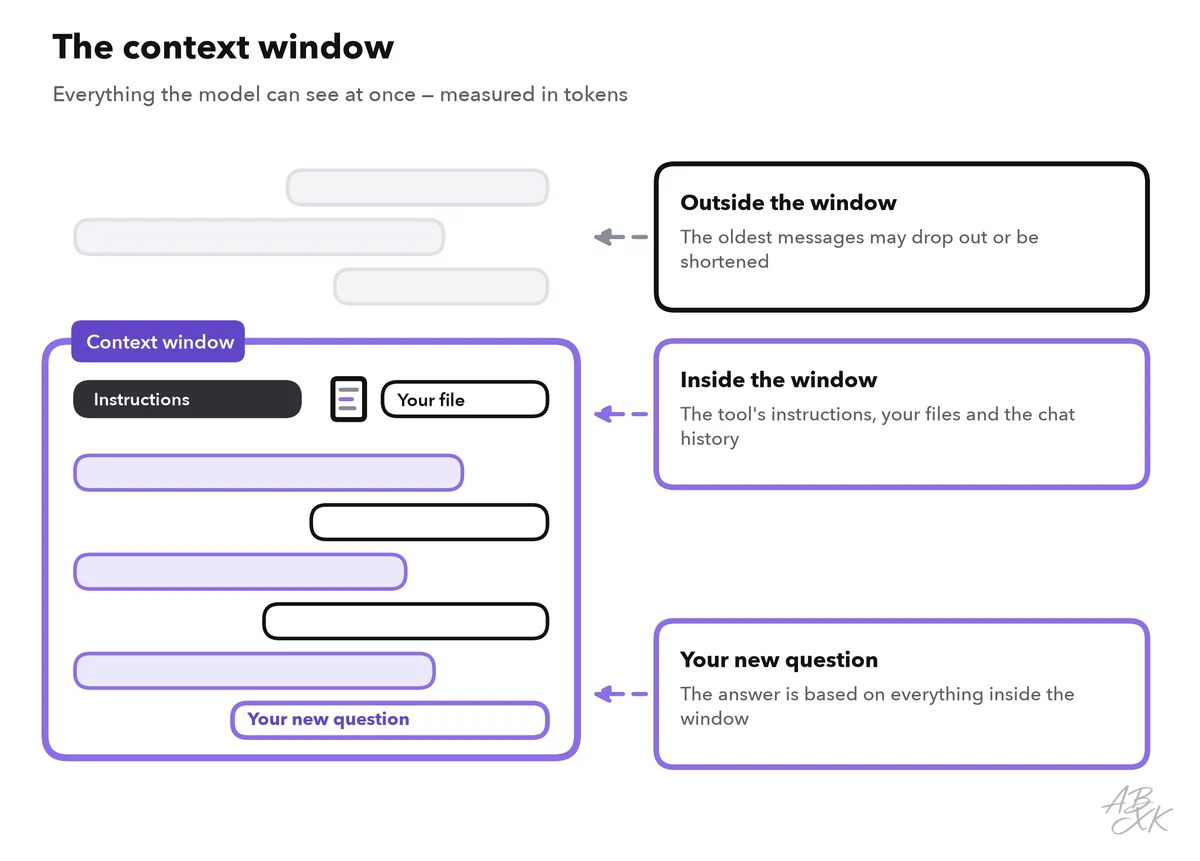
Today’s models have large context windows, but they are not unlimited. In a very long chat, a tool may drop or shorten the oldest messages, and the model can lose track of details from early on. Two simple habits help: start a new chat for a new topic, and repeat the key facts when a conversation gets long. Level 4 goes deeper into working with long documents.
Why models differ, and who builds them
All LLMs predict tokens, but they are not all the same. They differ in the data they learned from, in their size, in how they were trained to follow instructions, in speed and in the size of their context window. Some are stronger at writing, others at math or code.
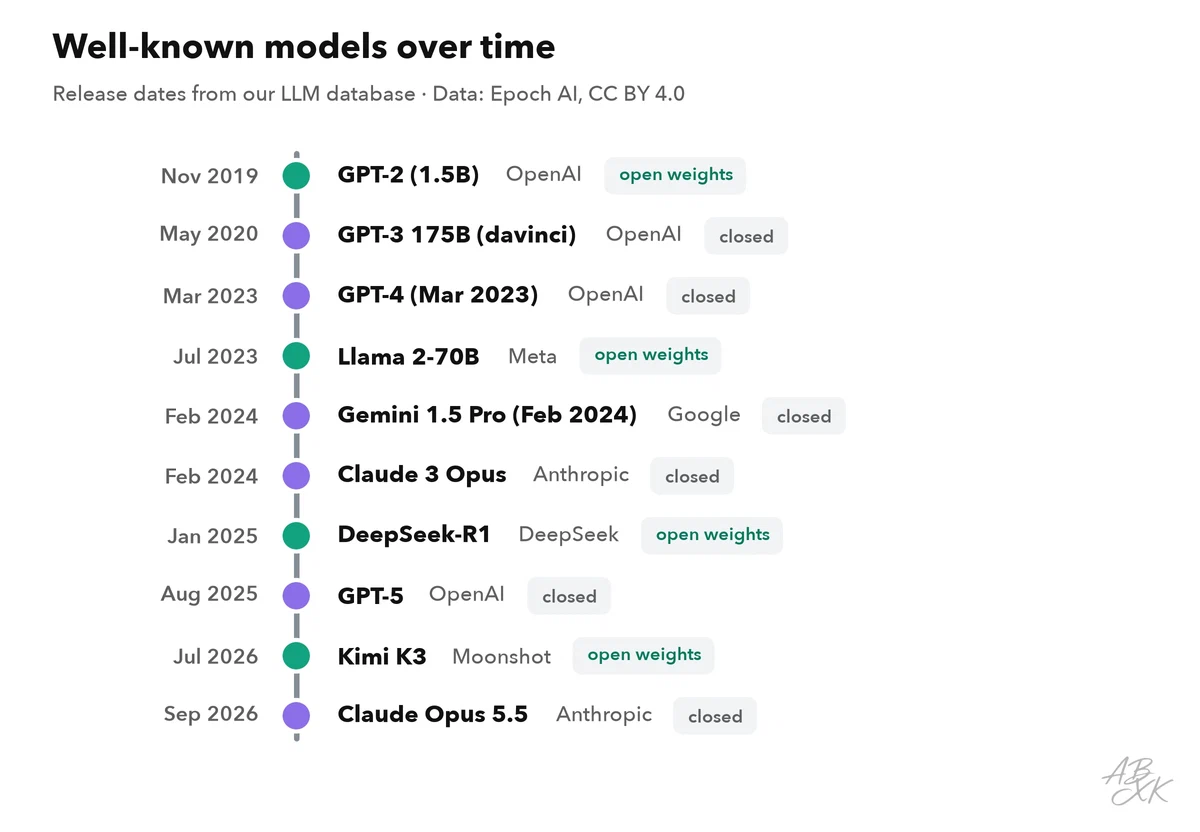
Another important difference is access. A model with open weights can be downloaded and run on your own computers, because its maker has published the trained parameters. A closed model can only be used through its maker’s apps or interfaces.
Most well-known models come from a small group of companies: OpenAI (GPT), Anthropic (Claude), Google DeepMind (Gemini), Meta (Llama), xAI (Grok), and companies in China such as Alibaba (Qwen), DeepSeek and Moonshot (Kimi). Our LLM database tracks 343 models from GPT-2 to today; 172 of them have open weights.
The table shows six current models from our database. For each one, you see the release date, open or closed weights and the overall score in the Epoch Capabilities Index (ECI), which combines many benchmark tests:
| Model | Released | Weights | ECI | Rank |
|---|---|---|---|---|
| Claude Opus 5.5 Anthropic | Sep 22, 2026 | closed | 166.8 | 1 |
| GPT-6 Astra OpenAI | Sep 3, 2026 | closed | 166.4 | 2 |
| Gemini 3.7 Flash Google DeepMind | Aug 13, 2026 | closed | 157.2 | 18 |
| Grok 4.6 xAI | Aug 12, 2026 | closed | 156.3 | 27 |
| DeepSeek V4 Pro 0813 DeepSeek | Aug 13, 2026 | open | 155.3 | 32 |
| Kimi K3 Moonshot | Jul 16, 2026 | open | 157.4 | 17 |






ECI = Epoch Capabilities Index, one overall score across many benchmarks; rank among all models with an ECI. Data: Epoch AI, retrieved on October 17, 2026, licensed CC BY 4.0. All models: LLM database.
A higher overall score does not mean a model is the best choice for your task. Level 3 shows how to choose the right LLM for a task by testing two or three models on your own work.
Four small experiments to see it yourself
You can observe all of this in a few minutes with any chat assistant. Try these four experiments and note what you see:
| Experiment | What to type | What to look for |
|---|---|---|
| Prediction | “Continue this sentence in five different ways: Our team meeting is on …” | Several plausible endings: the model weighs options |
| Chance | The same question in two new chats | Same meaning, different wording |
| Knowledge cutoff | A question about last week’s news, in a tool without web search | The model may say it does not know — or it may guess |
| Hallucination | “Name three studies about [a topic from your field], with authors and year.” | Search for each study: does it really exist? |
The last experiment is the most important one. If you find a study that does not exist, you have seen the main limit of LLMs with your own eyes. Remember that example the next time an answer sounds perfect.