

AI tools can find, read and summarize information faster than any person. They can also give you a confident answer that rests on a source that does not exist. Research with AI works when you treat every answer as a lead, not as a fact.
This is part 3 of Level 1 in our AI Productivity learning path. You will learn how chat assistants and answer engines differ, what a citation proves, how to check a claim in three moves, and a five-step routine for everyday research questions.
Three ways AI tools find answers
Not every AI tool gets its answers from the same place. That decides how far you can trust them.
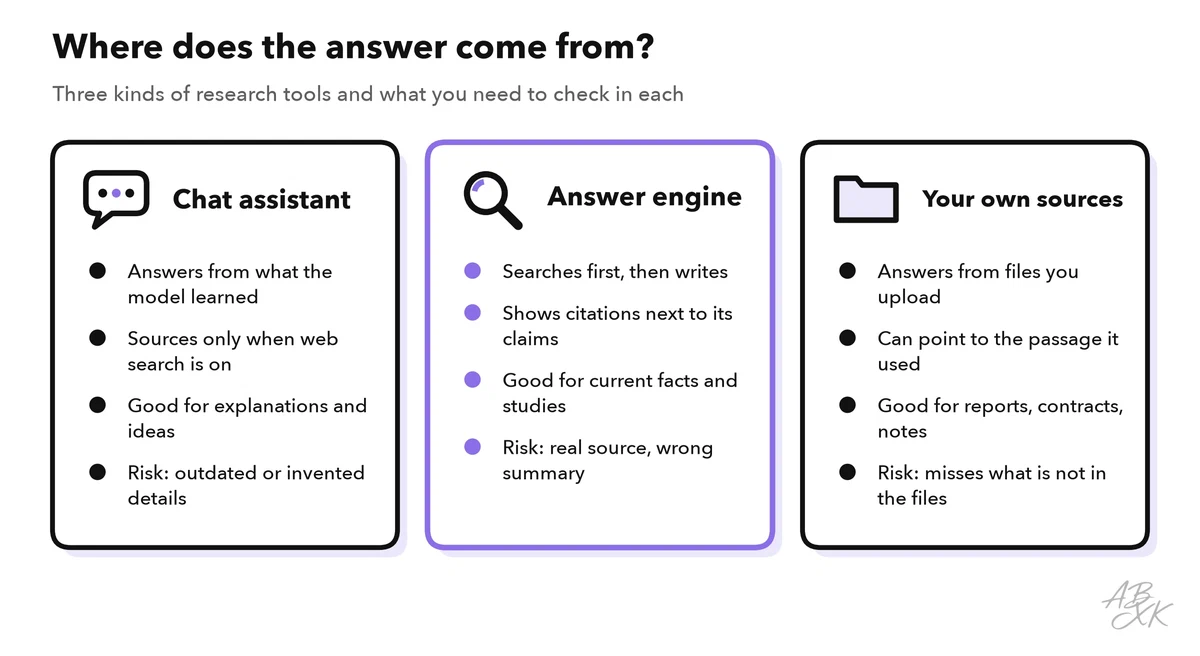
- A chat assistant answers from what its model learned during training. This knowledge stops at a certain date, and the assistant shows no sources unless a web search is switched on.
- An answer engine searches first and then writes an answer with citations: links or numbered references that point to the sources it used. Many chat assistants work this way when their web search is on.
- A source-based assistant answers from documents you upload, such as reports, contracts or meeting notes. Level 4 shows how to work this way with long documents.
Our comparison lists specialized tools for the last two types under writing and research. Consensus is an AI search engine for academic research. Nouswise grounds its answers in the sources you upload. Both descriptions come from the vendors.


Short descriptions from our tool comparison, based on the vendors' information — not tested by ABXK.
What a citation proves, and what it does not
A citation shows that a source exists. It does not prove that the source says what the answer claims. When you check citations, you will meet the same problems again and again:
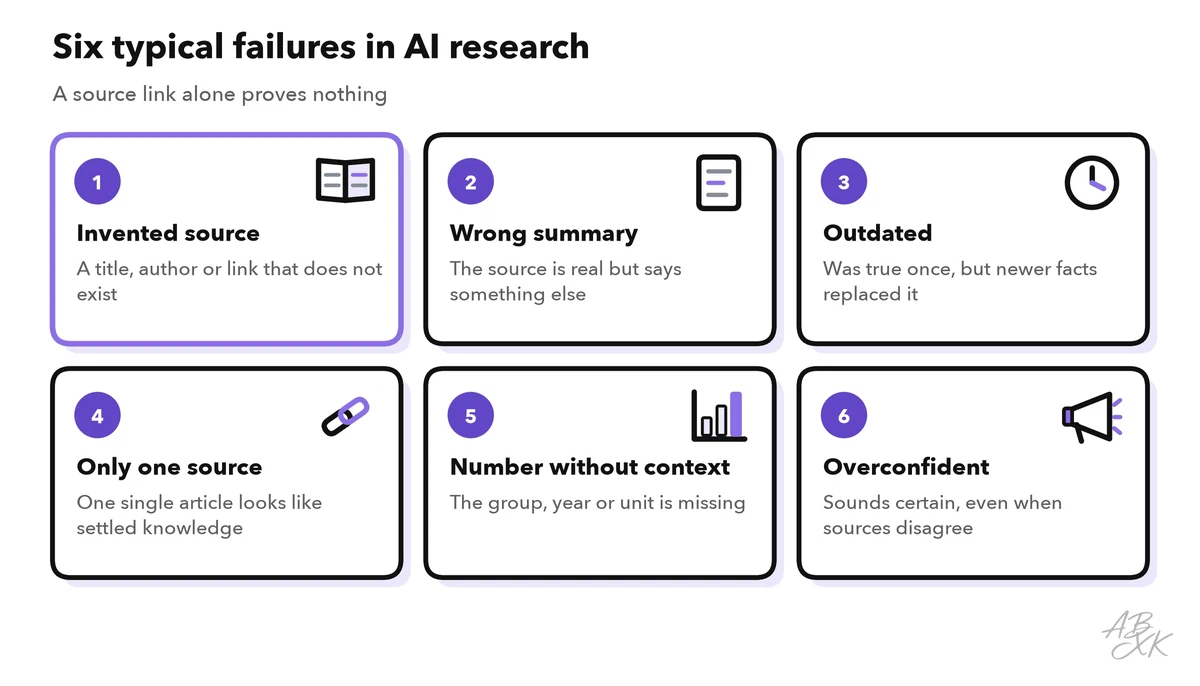
The most serious problem is the invented source: a study, an article or a court decision that looks real but does not exist. This has happened in real cases. In 2023, a US federal court sanctioned two lawyers and their law firm. They had submitted a court filing that cited decisions ChatGPT had made up (Source: Mata v. Avianca, Inc., U.S. District Court for the Southern District of New York, 2023). The lawyers had not verified the cases before they filed the document.
The wrong summary is more common and harder to spot. The source is real, but it says something weaker (“may help” instead of “helps”), it gives a different number, or it describes a different group of people or a different year.
Check a claim in three moves
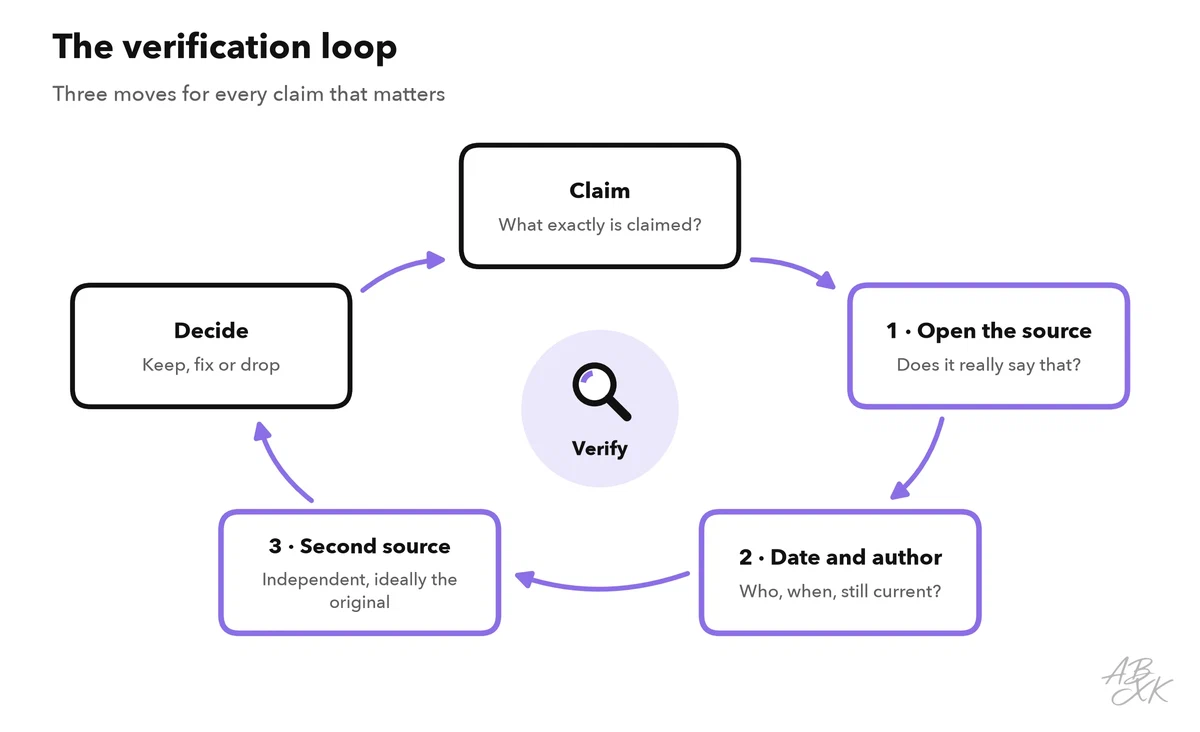
You do not need to check every sentence. Check the claims that matter: numbers, dates, names, quotes and anything you will repeat to others. For each one, make three moves:
- Open the source. Find the exact passage. Does it say the same thing, with the same number?
- Check the date and the author. Who published it, and when? Is it still current? Is it the original or a copy of a copy?
- Compare with a second source. Look for an independent source, ideally the primary source: the study itself, the law or the official statistic, not an article about it.
Then decide: keep the claim, correct it or drop it.
How reliable are AI answers on facts?
Researchers measure this with benchmarks: standard tests that every model takes in the same way. SimpleQA Verified asks short factual questions that have exactly one correct answer, and the models answer without a web search. The table shows the current leaders from our LLM data:
| # | Model | Released | Result |
|---|---|---|---|
| 1 | Gemini 4 Argon (high) Google DeepMind | Sep 30, 2026 | 76.0% |
| 2 | GPT-6 Astra (max) OpenAI | Sep 3, 2026 | 75.6% |
| 3 | GPT-6.1 Sol (max) OpenAI | Sep 29, 2026 | 73.9% |
| 4 | Gemini 3.1 Pro Preview Google DeepMind | Feb 19, 2026 | 73.5% |
| 5 | Claude Opus 5.5 (max) Anthropic | Sep 22, 2026 | 72.2% |



Short factual questions with exactly one correct answer, answered without tools. It shows how much a model really knows and how often it invents an answer instead of admitting that it does not know. Data: Epoch AI, retrieved on October 17, 2026, licensed CC BY 4.0. All models: LLM database.
Even the best models are still clearly below a perfect score. The chart shows how the best result has developed:
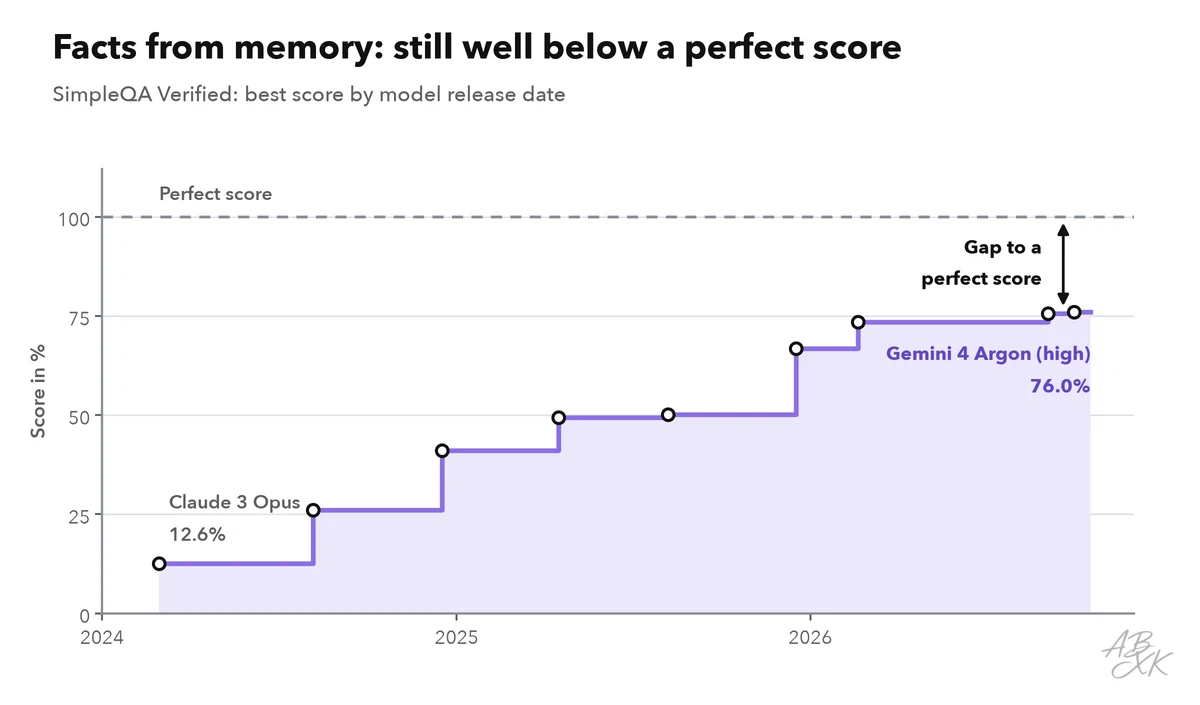
Two lessons follow. First, models are getting better at facts, but not good enough to skip the checks. Second, the test measures answers from memory. Tools that search and cite sources can do better on such questions, but they bring the citation problems described above. You can compare all models in our LLM database, and Level 2 shows a complete routine to check AI output for errors.
Academic questions: search the papers
For scientific questions, such as “Does a four-day week change productivity?”, use a tool that searches research papers, not the general web. Then look at the evidence behind the answer:
- Type of study: A meta-analysis combines the results of many studies. It usually carries more weight than one small study.
- Size and setting: How many people took part, in which country and in which industry? Does that match your situation?
- Date: Is there newer research that changes the picture?
- Your own reading: Read at least the abstract of the two or three most important papers yourself.
A five-step research routine
Use this routine for everyday research questions. It takes a few minutes longer than trusting the first answer, and it keeps you from passing on errors.
| Step | What you do | Tip |
|---|---|---|
| 1. Frame | Write one precise question and note what you need the answer for. | Add a time frame and a region. |
| 2. Search | Use an answer engine or academic search and ask for sources. | Ask for links to the exact pages. |
| 3. Read | Open the two or three most important sources yourself. | Read the passage, not just the summary. |
| 4. Cross-check | Compare the key claims with a second, independent source. | Prefer primary sources. |
| 5. Record | Write down each fact with its source and date. | Mark what you could not confirm. |