

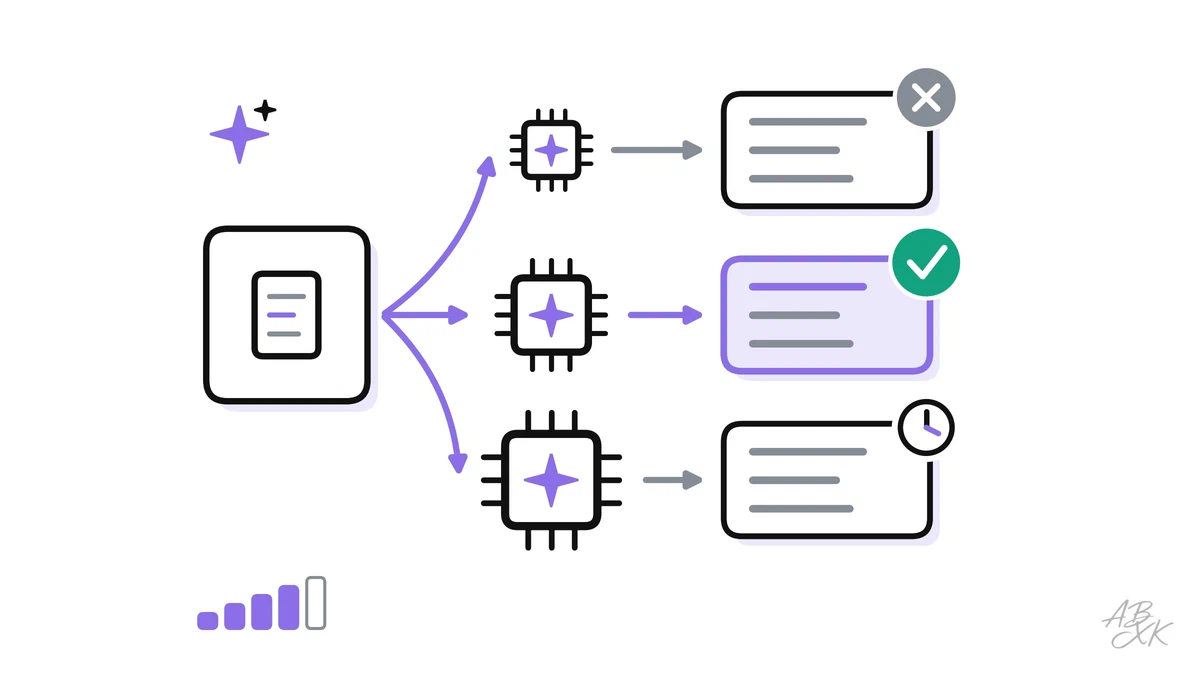
Most people use one AI assistant with its default model for everything: emails, research, spreadsheet formulas, long reports. That works well enough until a task needs more. A model that is excellent at hard analysis can be slow for a quick reply. A fast model can stumble over a tricky calculation. And the model at the top of a ranking may be one that your company does not allow you to use.
This is part 1 of Level 3 in our AI Productivity learning path. Level 3 is about building AI into your work and measuring the results. Here you learn the six ways in which language models differ and how to read our LLM database and its ranking. Then you match tasks to model strengths and test two or three models on your own work. If you want to refresh the basics first, Level 0 explains what a large language model is.
Six ways language models differ
All large language models (LLMs) do the same basic thing: they predict text, piece by piece. Still, they differ in ways that matter for your work. Six differences decide most choices.
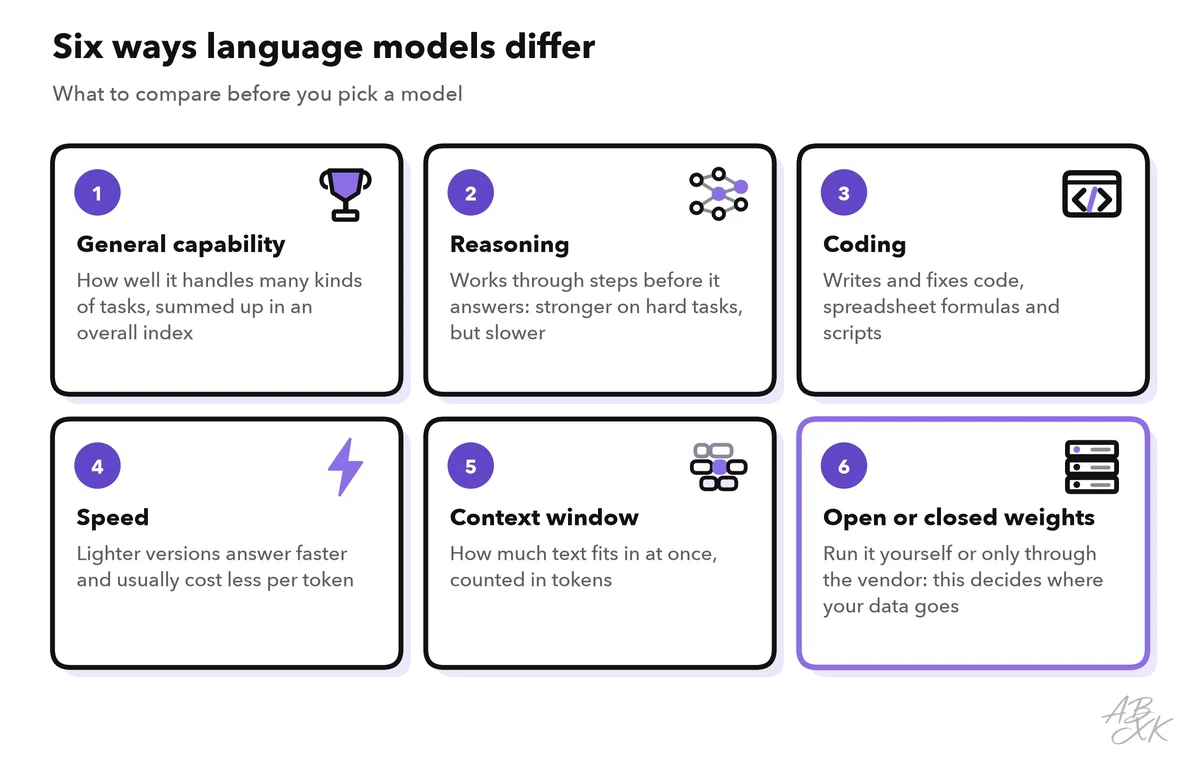
- General capability. How well a model handles many different kinds of tasks. An overall index sums this up in one number — more on that below.
- Reasoning. Many current models can reason before they answer. They first work through intermediate steps, often hidden from you, and then write the answer. This takes longer and uses more tokens, but it helps with analysis, planning, math and code. Many assistants let you switch on such a “thinking” mode.
- Coding. Some models are much better than others at writing and fixing code, spreadsheet formulas and scripts.
- Speed. Large models are often slower. Many vendors offer a large model plus lighter, faster versions; names like Flash, Mini or Haiku usually mark the lighter ones. If you connect to a model through an API (an interface for software), you pay per token. Lighter versions usually cost less per token.
- Context window. The amount of text a model can take in at once, counted in tokens — small pieces of words. It decides whether a long report fits in one go. Level 4 shows how to work with long documents.
- Open or closed weights. A model with open weights can be downloaded and run on your own servers. A closed model can only be used through its maker’s apps or interfaces. This decides where your data goes.
The skill is not to find the one “best” model. It is to know which of these six matter for your task — and to accept a weaker score where it does not matter.
How to read our LLM database and ranking
Our LLM database lists 343 language models, from GPT-2 to today’s models. Each row shows who built the model, when it came out and whether its weights are open. It also shows the overall index, the model’s rank and the number of benchmarks with results. You can filter by organization, year and access and sort by date or index. Tick two to four models to see all their results side by side. From the start page, two more views are one click away. The ranking puts all models with an index on one scale. The benchmark page shows the record results of each test over time.
The overall index is the Epoch Capabilities Index (ECI). It comes from Epoch AI, the research organization whose data our LLM pages use. The ECI combines many benchmark results into one number per model. These eight models lead it right now:
| # | Model | Released | Result |
|---|---|---|---|
| 1 | Claude Opus 5.5 Anthropic | Sep 22, 2026 | 166.8 |
| 2 | GPT-6 Astra OpenAI | Sep 3, 2026 | 166.4 |
| 3 | GPT-6.1 Sol OpenAI | Sep 29, 2026 | 166.3 |
| 4 | Claude Fable 5.1 Anthropic | Sep 1, 2026 | 164.7 |
| 5 | Gemini 4 Argon Google DeepMind | Sep 30, 2026 | 164.6 |
| 6 | Claude Sonnet 5.5 Anthropic | Sep 28, 2026 | 164.4 |
| 7 | Claude Opus 5 Anthropic | Jul 24, 2026 | 162.6 |
| 8 | GPT-6 Sol OpenAI | Sep 22, 2026 | 162.6 |



Combines the results of more than 50 benchmarks into one number per model, so that models can be compared even if they were never tested on the same benchmarks. It is an index, not a percentage: Epoch AI scales it so that Claude 3.5 Sonnet stands at 130 and GPT-5 at 150. Data: Epoch AI, retrieved on October 17, 2026, licensed CC BY 4.0. All models: LLM database.
Read such a list with three questions. How big is the gap? The index is an estimate with a margin of error. Our ranking notes that differences of one or two points are within that margin. When was the model released? A very new model may not have results on every test yet. Can you use it? A top model does not help if your company has not approved it or if it is too slow for your task.
The columns of the database tell you more than the rank:
| Column | What it tells you | Watch out for |
|---|---|---|
| Released | When the model came out | Very new models may still lack results on some tests |
| Access | Open weights or closed (API or app) | Open weights can come with license limits |
| ECI and rank | Overall capability on one scale | Gaps of one or two points are within the margin of error |
| Benchmarks | On how many of our tests the model has results | A low count means less evidence, not a weaker model |
| Side-by-side comparison | All results of two to four models | Compare scores only within the same benchmark |
Match the task to the model’s strengths
The overall index is a good first filter, but it is an average. For a specific task, look at the test that comes closest to it. The table maps common office tasks to what matters most and to the place in our data where you can check it.
| Your task | What matters most | Where to look in our data | A good place to start |
|---|---|---|---|
| Emails, summaries, rewrites | Speed, tone, your language | No test fits well — your own test decides | A fast, light model |
| Analysis, planning, tricky questions | Reasoning | GPQA Diamond, Humanity’s Last Exam | A large model or a thinking mode |
| Facts and research | Correct facts, real sources | SimpleQA Verified (answered without web search) | An assistant with web search that shows its sources |
| Formulas, scripts, code | Coding | SWE-bench Verified, Aider Polyglot | A model that does well on these tests |
| Calculations | Multi-step math | FrontierMath, MATH Level 5 | A thinking mode — then check the numbers |
| Long documents | Context window | Not in our data — see the vendor’s documentation | A model with a large window |
| Long tasks with many steps | Working on its own | METR Time Horizon | A top model, with close supervision |
For hard expert questions, GPQA Diamond is a good guide. These five models lead it:
| # | Model | Released | Result |
|---|---|---|---|
| 1 | Gemini 4 Argon (high) Google DeepMind | Sep 30, 2026 | 96.4% |
| 2 | GPT-6 Astra (max) OpenAI | Sep 3, 2026 | 95.8% |
| 3 | Claude Sonnet 5.5 (max) Anthropic | Sep 28, 2026 | 95.6% |
| 4 | Gemini 3.8 Flash (high) Google DeepMind | Sep 2, 2026 | 95.4% |
| 5 | GPT-6.1 Sol (max) OpenAI | Sep 29, 2026 | 95.4% |
198 multiple-choice questions in biology, physics and chemistry at graduate level, written so that non-experts fail even with web access. Guessing gives 25%. Data: Epoch AI, retrieved on October 17, 2026, licensed CC BY 4.0. All models: LLM database.
Compare this list with the overall index above: the order is not the same. Labels such as “(high)” or “(max)” after a name mark the setting of the test run — usually more thinking time. So check which setting you will actually use: a result with maximum thinking time says little about the same model in a quick mode. The figure shows the leaders of six of our tests side by side.
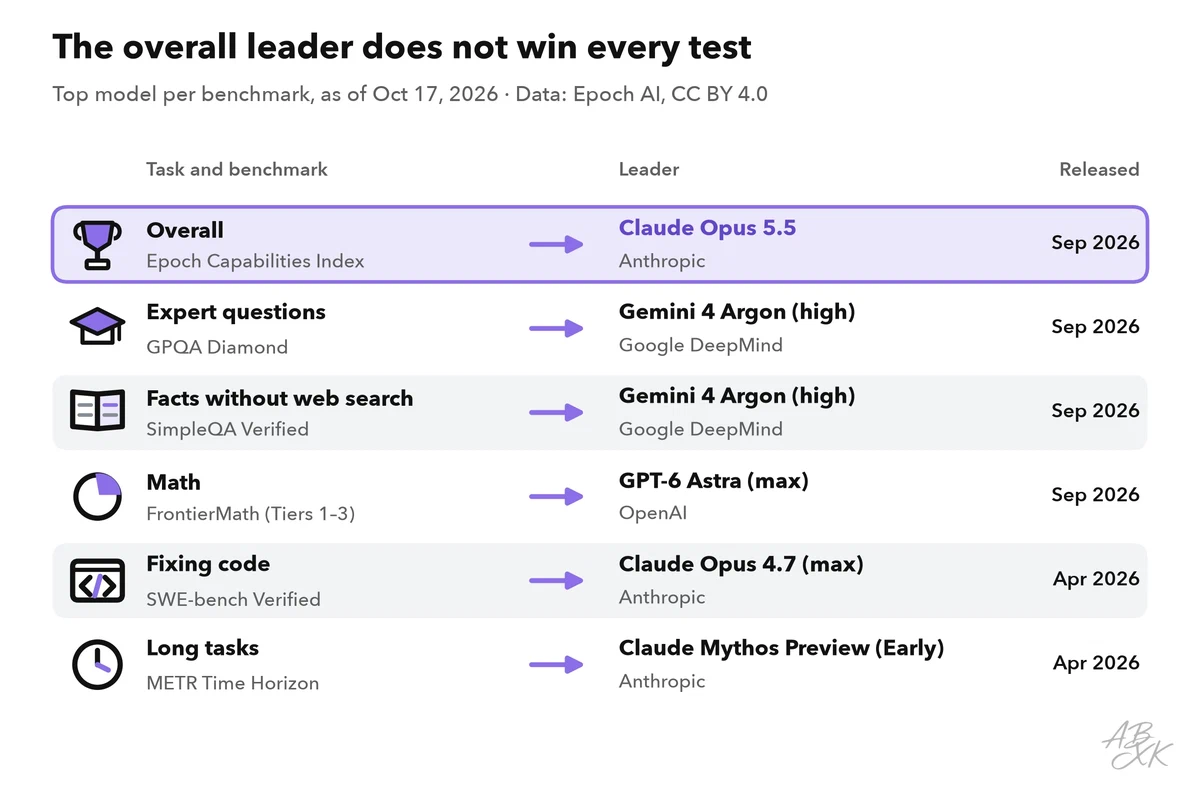
The model at the top of the overall index does not win every test. Some leaders may be older models. That does not always mean the newer ones are weaker. They may simply not have results on that test yet. The Level 4 part on reading benchmarks like an expert explains this and other traps in detail.
Open or closed weights: where your data goes
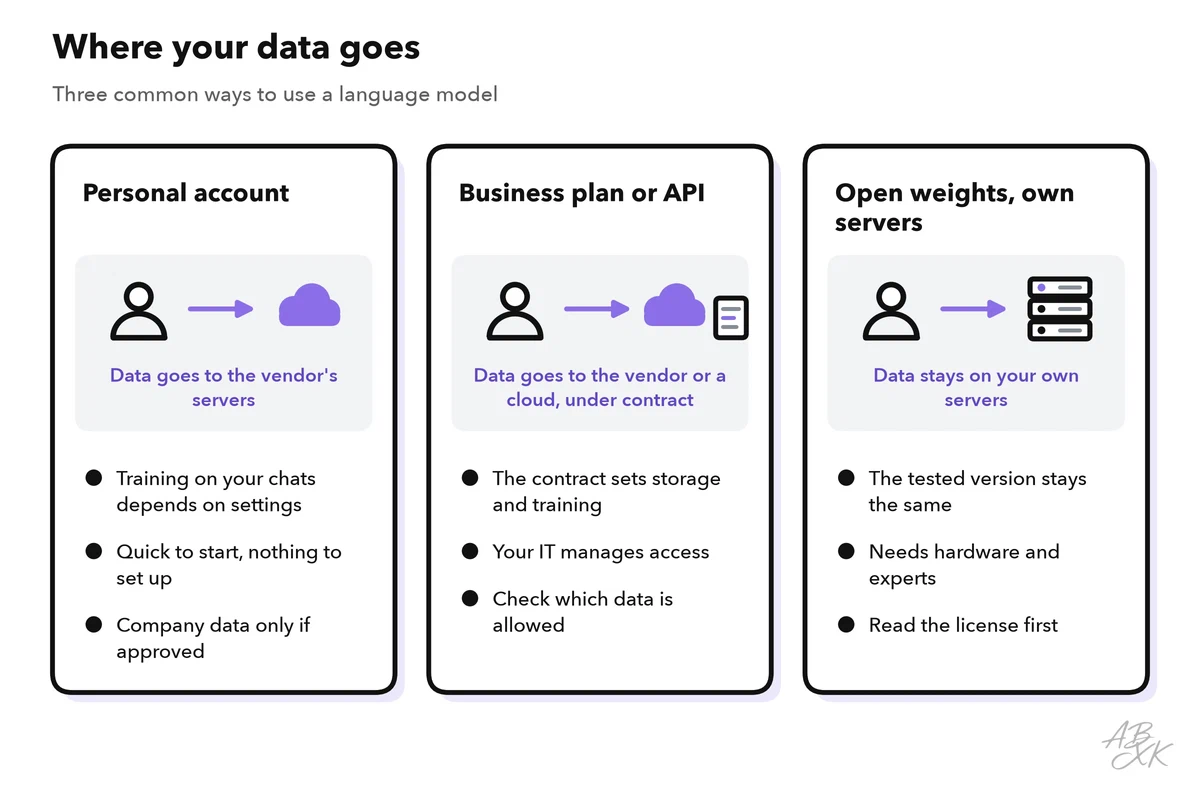
With a closed model, your prompts and files go to servers run by the vendor or by a cloud provider that offers the model. With an open-weights model, you decide where it runs: on your own servers or with a hosting provider you choose. That is why “open or closed?” is often a question about data protection, not only about quality.
In our database, 172 models have open weights and 160 are closed; for the rest, the access is unknown. The left chart shows how many models of each kind came out per year. The right chart shows the overall index of the strongest open and the strongest closed model of each year.
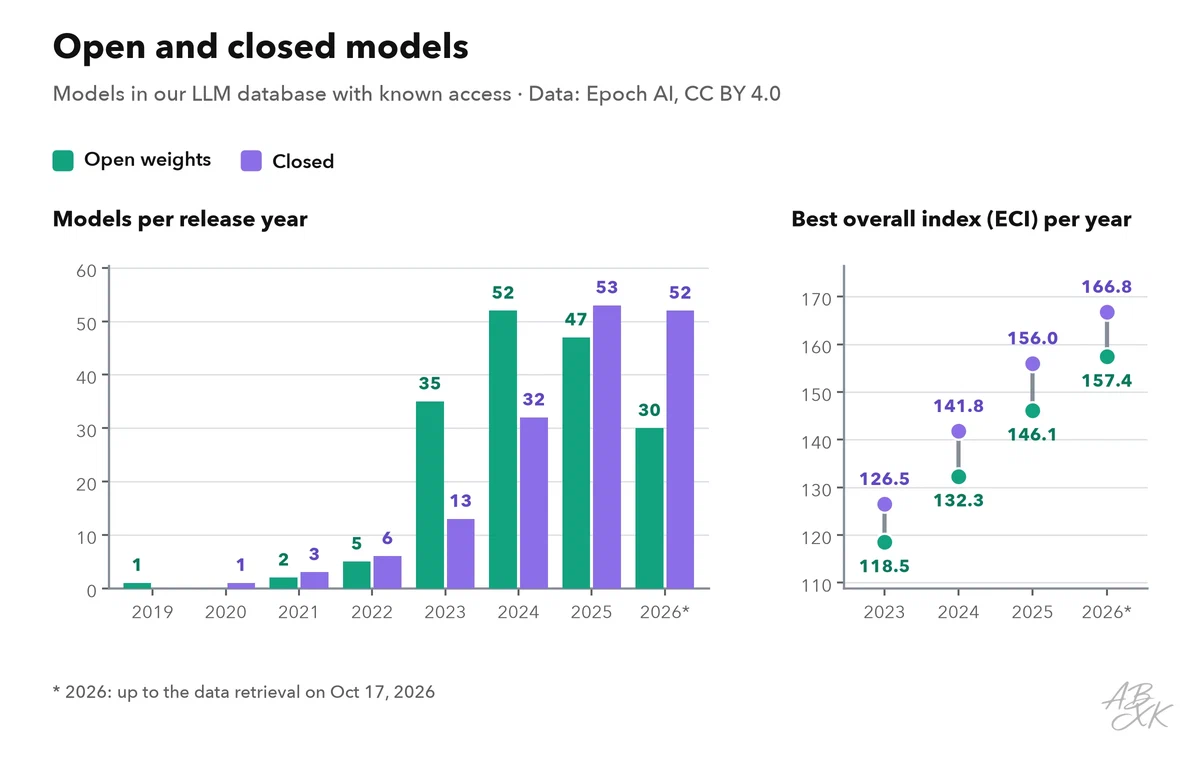
The gap between the two points of a year shows roughly how much overall capability you give up when you need open weights. Keep in mind that the database only lists models with benchmark results, so it is not a full count of all models. Here are two closed models from the top of the index next to two strong open-weights models:
| Model | Released | Weights | ECI | Rank |
|---|---|---|---|---|
| Claude Opus 5.5 Anthropic | Sep 22, 2026 | closed | 166.8 | 1 |
| GPT-6 Astra OpenAI | Sep 3, 2026 | closed | 166.4 | 2 |
| Kimi K3 Moonshot | Jul 16, 2026 | open | 157.4 | 17 |
| DeepSeek V4 Pro 0813 DeepSeek | Aug 13, 2026 | open | 155.3 | 32 |


ECI = Epoch Capabilities Index, one overall score across many benchmarks; rank among all models with an ECI. Data: Epoch AI, retrieved on October 17, 2026, licensed CC BY 4.0. All models: LLM database.
Open weights bring more than privacy. The copy you run stays the same: the vendor cannot change or retire it. You can also adapt it to your own data. The costs are real, too: you need suitable hardware, people who can run the model and time for updates. And open weights do not always mean free use: some licenses forbid commercial use or set other limits. Read the license before you build on a model.
Where a model runs also decides who can see your data. In practice, you will meet three ways to use a model:
Test two or three models on your own task
Benchmarks narrow the field; your own test decides. You do not need a lab for that. An afternoon and a shared document are enough.
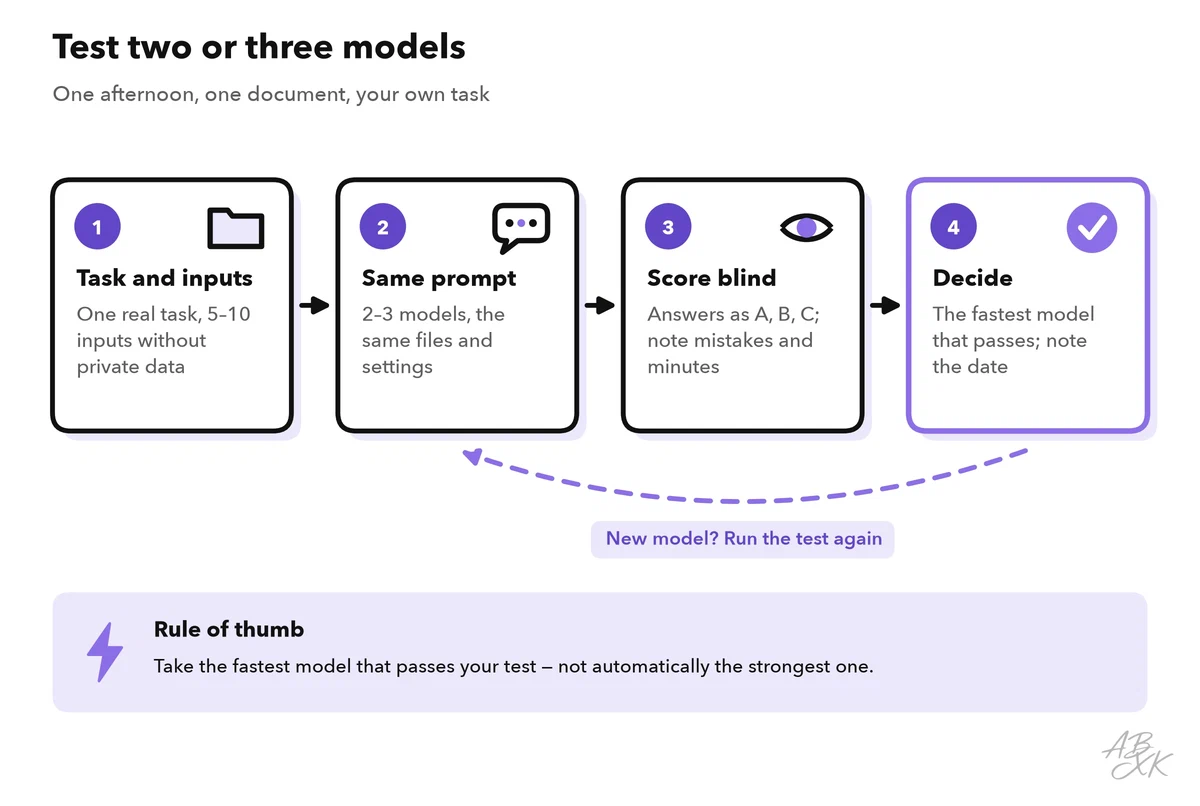
- Pick one real task and five to ten inputs. Choose a task that comes back every week, such as answering one type of customer email. Remove names, numbers and anything confidential from the inputs.
- Run the same prompt on two or three models. Keep everything else equal: the same files, the same instructions, the same mode — all with or all without thinking.
- Score blind. Copy the answers into a document, label them A, B and C in random order, and judge them before you check which model wrote which. Note the mistakes, the minutes you needed to fix each answer and how long you waited.
- Decide and note the date. Vendors update and retire models. When your model changes, run the same test again.
One rule makes the decision easier: take the fastest model that passes your test, not automatically the strongest one. You can run a first test in assistants you may already use. Each runs on its maker’s own models, but each also adds its own instructions and tools, such as web search. So you compare products, not only models.



Short descriptions from our tool comparison, based on the vendors' information — not tested by ABXK.
Level 4 turns this into a full method with a test set, a scoring rubric and repeat tests after every change: test and evaluate your prompts.
Common mistakes when choosing a model
| Mistake | Why it hurts | Better |
|---|---|---|
| Using the top model of the ranking for everything | Slower, often more expensive and more energy-hungry than needed for simple tasks | Start with a fast model; move up only if it fails your test |
| Choosing by a single benchmark | Each test measures one skill | Look at the test closest to your task, and at several |
| Testing with one example | One good answer can be luck | Use five to ten real inputs |
| Knowing which model wrote which answer | You favor the name you expect to win | Score blind, then reveal |
| Checking data rules last | The best model is useless if you may not use it | Check approval and hosting first |
| Never testing again | Vendors update and retire models | Repeat your test when the model changes |
Keep your test inputs, the prompt and your scores in one place. When the next model comes out, you can repeat the test in an hour instead of starting from scratch.
A smaller model that passes your test is also the better choice for the environment: it needs less computing power for every answer. Level 0 shows how large the energy and water footprint of AI has become: what AI can do for your everyday work.