

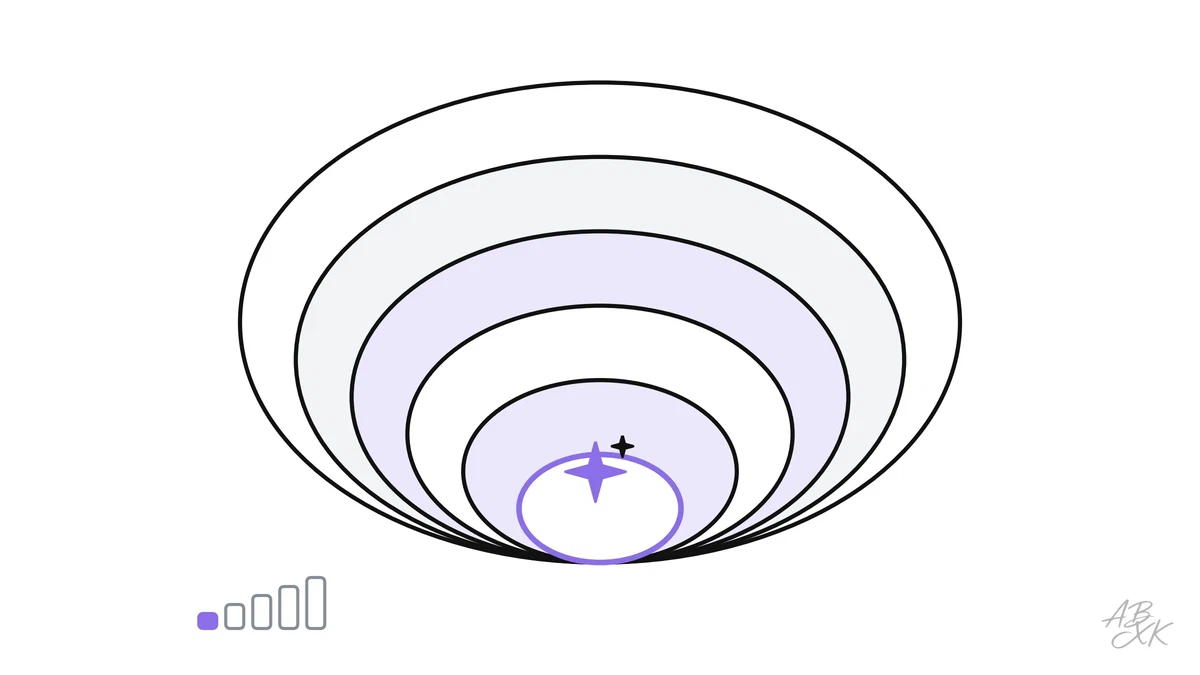
Artificial intelligence, machine learning, deep learning, generative AI, agents: the words are often used as if they meant the same thing. They do not. They are rings of one map, each one inside the next, like the layers of an onion. Once you know the map, you can place any AI system you read about, from a spam filter to a robot, and you know which questions to ask about it.
This is part 1 of Level 0 in our learning path AI Fundamentals. You will learn the six rings of the AI universe, what each one adds, which milestones mark them and what the data on more than a thousand notable AI models shows about where the field has moved. You do not need math or code for this part.
Six rings, one map
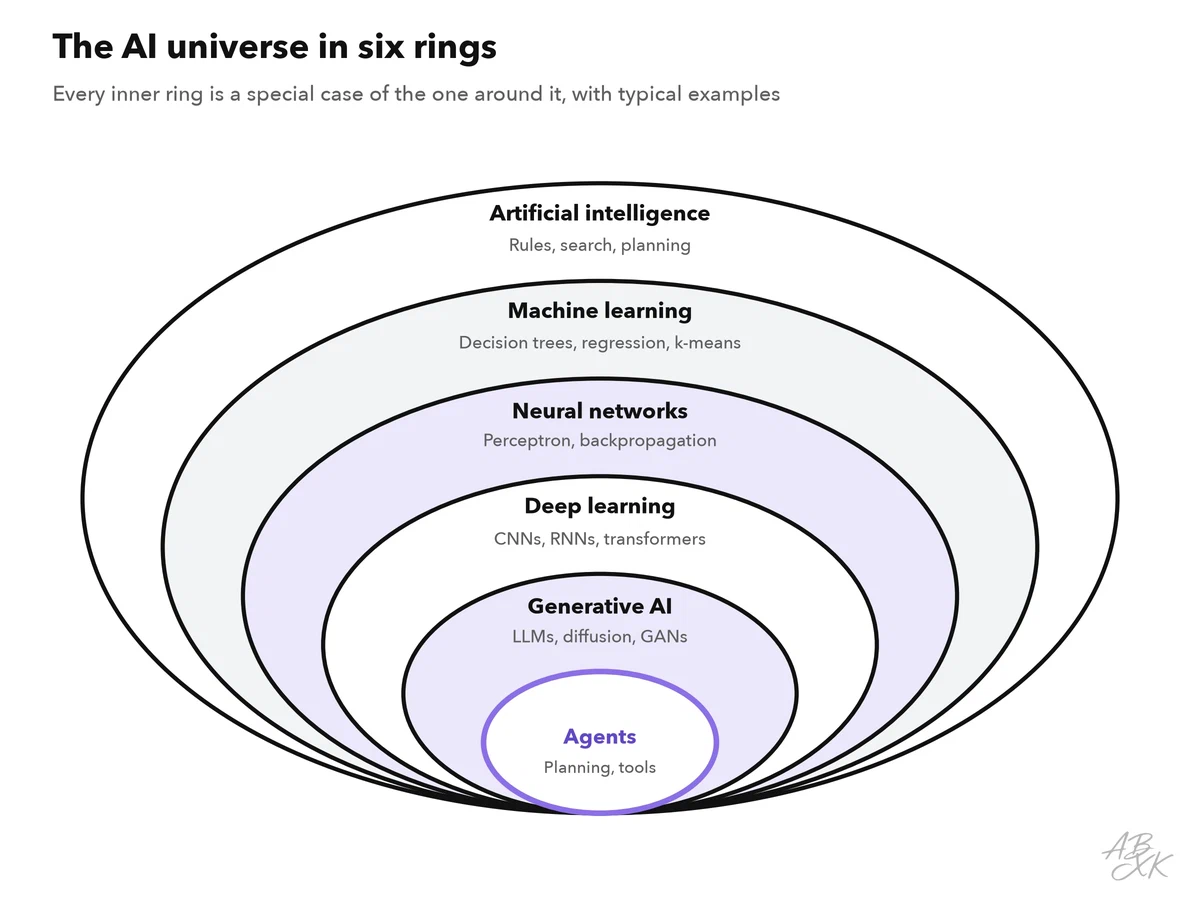
Artificial intelligence (AI) is the whole field: any method that makes a machine act in ways we would call intelligent, such as planning a route, playing chess, recognizing a face or answering a question. Early AI did this with rules and search that people wrote down, and some systems still do.
Machine learning (ML) is the part of AI where the machine learns its rules from data instead of being told them. You show it examples, it finds the pattern. Classic methods such as decision trees, linear and logistic regression or k-means clustering belong here.
Neural networks are one family of machine learning models, loosely inspired by the brain: many simple artificial neurons, connected in layers, each passing on a weighted sum of its inputs. The first one was built as a machine in the 1950s.
Deep learning means neural networks with many layers. The extra layers let a network learn its own features, for example edges, then shapes, then faces, instead of relying on features an engineer designed. Convolutional networks for images, recurrent networks for sequences and transformers for language belong here.
Generative AI uses deep learning to create new content: text, images, audio, video or code. Large language models (LLMs), diffusion models for images and generative adversarial networks (GANs) are its best-known types.
Agents are the newest ring: generative AI models that do not just answer but plan several steps, use tools such as a web search or a code interpreter and act on the result. An agent that books a meeting room or fixes a bug in a codebase works this way.
| Ring | What it adds | Examples | Where this path covers it |
|---|---|---|---|
| Artificial intelligence | Machines that act intelligently | Route planning, chess programs, expert systems | Level 0 |
| Machine learning | Rules learned from data | Spam filter, price prediction, customer groups | Level 1 |
| Neural networks | Layers of artificial neurons | Handwriting recognition | Level 2 |
| Deep learning | Many layers that learn their own features | Image recognition, speech recognition, translation | Level 3 |
| Generative AI | Models that create new content | LLMs, image generators | Level 4 |
| Agents | Models that plan and use tools | Coding agents, research agents | Level 4 |
The milestones, in data
Epoch AI, a research institute that tracks the development of AI, records 1,078 notable AI models from 1,950 until today: models that set a record, were widely cited or changed the field. The table shows milestones from this data. Notice two numbers: the parameters, the adjustable values a model learns, and the training compute, the number of calculations its training took. Both grew by many orders of magnitude.
| Year | Model | What it showed | Parameters | Training compute (FLOP) |
|---|---|---|---|---|
| 1950 | Theseus Bell Laboratories | A robot mouse learns its way through a maze | 40 | 4.0 × 101 |
| 1957 | Perceptron Mark I Cornell Aeronautical Laboratory | The first neural network built as a machine, recognizes simple images | 1,000 | 6.9 × 10⁵ |
| 1959 | Samuel Neural Checkers IBM | A checkers program that plays against itself and improves | 16 | 4.3 × 10⁸ |
| 1997 | LSTM Technical University of Munich | A neural network with a memory for sequences | 10,504 | 3.2 × 10¹³ |
| 1998 | LeNet-5 AT&T | Reads handwritten digits, for example on bank checks | 60,000 | 2.8 × 10¹² |
| 2012 | AlexNet University of Toronto | Wins the ImageNet image recognition contest by a wide margin and starts the deep learning boom | 60 million | 4.7 × 10¹⁷ |
| 2013 | DQN DeepMind | Learns Atari games from the screen pixels alone | 836,096 | 2.8 × 10¹⁵ |
| 2014 | GANs University of Montreal / Université de Montréal | Two competing networks generate realistic images | – | 5.1 × 10¹⁷ |
| 2017 | Transformer Google Research | Attention instead of recurrence: the design of today's language models | 213 million | 7.4 × 10¹⁸ |
| 2018 | BERT-Large Google | Pretrained on large amounts of text, then adapted to many tasks | 340 million | 2.8 × 10²⁰ |
| 2020 | GPT-3 175B (davinci) OpenAI | A very large language model solves new tasks from a few examples in the prompt | 174.6 billion | 3.2 × 10²³ |
| 2021 | DALL-E OpenAI | Generates images from text descriptions | 12.0 billion | 4.7 × 10²² |
| 2023 | GPT-4 (Mar 2023) OpenAI | Multimodal: understands text and images | 1.8 trillion | 2.1 × 1025 |
Data: Epoch AI, Data on AI models (1078 notable models), retrieved on October 18, 2026, licensed CC BY 4.0; our analysis.
A robot mouse with a few dozen learned settings and a language model with an estimated trillion-plus parameters are both AI. The difference is not the idea of learning, which is old, but the amount of data and computing power behind it. Part 4 of this level looks at that growth in detail.
Where the field has moved
The rings did not grow evenly. For decades, most notable models worked on images, reading digits or recognizing objects, alongside famous game players for checkers, chess and Go. Since the transformer appeared in 2017, language has taken over: 71.6% of the notable models published since 2023 work with language, alone or together with images and sound.
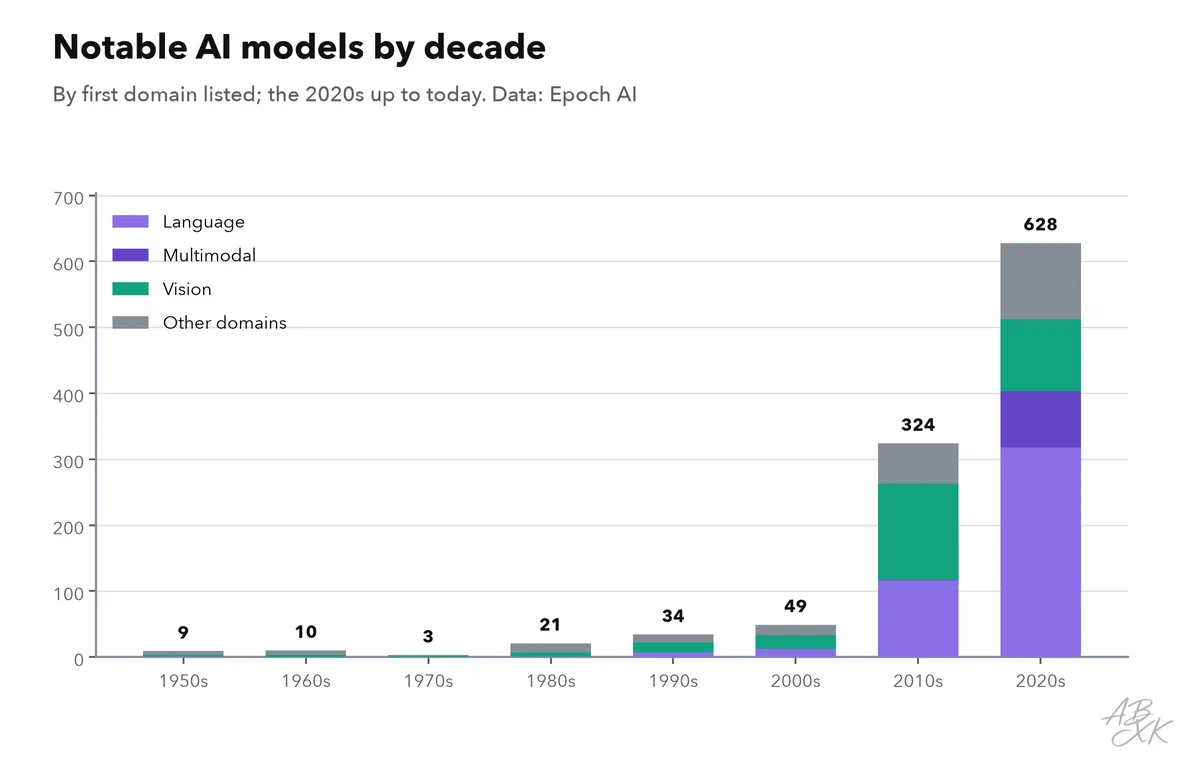
This shift explains why AI and language models are so often treated as the same thing today. But the outer rings did not disappear: classic machine learning still runs many fraud checks, recommendations and forecasts, because it is cheaper, faster and easier to check than a large model.
Which ring do you need?
When you plan an AI project, start from the problem and pick the smallest ring that solves it:
- Rules and search are enough when the task is fully known, such as route planning or scheduling.
- Classic machine learning fits tables of data: predicting churn, scoring leads, spotting fraud.
- Deep learning fits images, sound and other raw signals: inspecting parts, transcribing speech.
- Generative AI fits language and creative work: writing, summarizing, answering questions about documents.
- Agents fit tasks with several steps and tools, as long as a person checks the result.
The next part of this level shows how machines learn from data, with an experiment you can repeat yourself.