
Why Deepfake Detection Confidence Is Structurally Fragile
Deepfake detection systems report high confidence. That confidence reflects model familiarity — not structural reliability.
In production environments, detection systems encounter synthetic media produced by generation methods the model has never trained against. The system reports a number. Decision-makers interpret that number as certainty.
This is where governance fails.
The Core Problem
Detection models train on known generation techniques: face-swapping artifacts, GAN fingerprints, inconsistent lighting, temporal discontinuities.
Generation systems evolve. Detection systems retrain on lag.
Detection confidence reflects training-set similarity. It does not measure ground-truth authenticity.
When a model encounters synthetic media from an unfamiliar generator, it may still report high confidence — because confidence measures internal pattern matching, not external validity.
How Detection Systems Work
Most deepfake detection systems analyze:
Facial Artifact Detection
Unnatural blending at hairlines, ears, or neck boundaries.
Temporal Inconsistencies
Frame-to-frame anomalies in blinking, breathing, or micro-expressions.
Compression Artifacts
Distortion patterns from re-encoding that differ between real and synthetic sources.
Spectral Analysis
Frequency-domain patterns that distinguish GAN-generated from camera-captured imagery.
These methods work — under conditions matching training assumptions.
Real-world media arrives compressed, cropped, color-corrected, and format-converted. Each transformation degrades detection accuracy while potentially preserving detector confidence.
What High Confidence Actually Indicates
A detection system reporting 92% confidence does not mean there is a 92% probability the media is synthetic.
It means the model’s internal representation of the input maps strongly to learned synthetic patterns.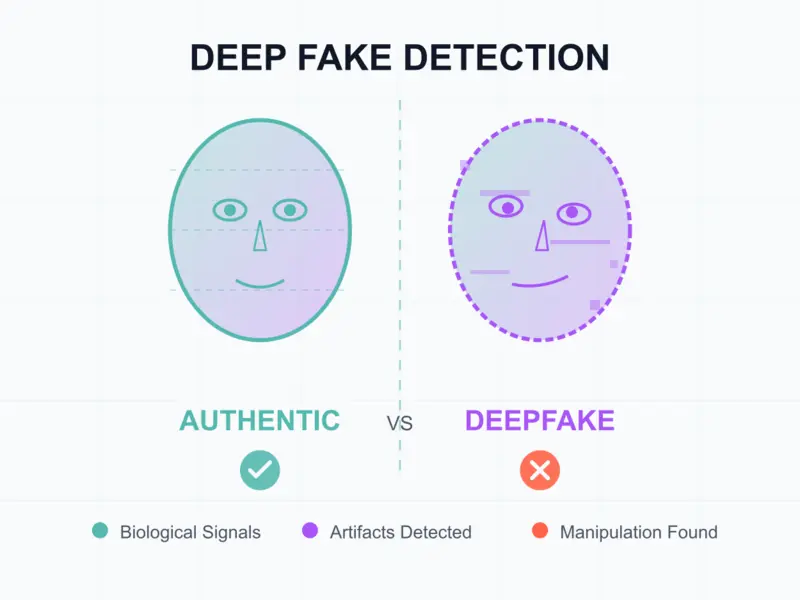
This distinction matters operationally because:
- Novel generation methods may produce outputs the model misclassifies as authentic
- Legitimate media may contain artifacts the model flags as synthetic
- Compression and noise may push authentic media across detection thresholds
Where Detection Fails
Detection systems exhibit systematic weaknesses:
- Generalization failure: Performance degrades on synthetic media from generators not in training data
- Adversarial robustness: Small perturbations can shift classification without visible change
- Format sensitivity: Results vary across resolution, codec, and compression level
- Domain shift: Models trained on one face category may fail on demographically different subjects
Benchmark accuracy does not predict production accuracy.
The Governance Gap
Organizations deploying detection systems commonly fail to define:
Critical governance questions for deepfake detection:
- Who reviews inconclusive results?
- What secondary verification applies when confidence is marginal?
- Who has authority to escalate disputed classifications?
- What risk tolerance defines the threshold for action?
- Who is accountable when detection fails?
Without these answers, detection scores become disconnected from operational decisions.
Practical Implications
If your organization relies on deepfake detection:
Treat detection confidence as one signal, not final judgment. Require human review for high-stakes classifications. Define escalation criteria for boundary cases. Monitor detection performance on new synthetic media regularly. Document handling procedures for inconclusive results.
Multi-Modal Verification
Reliable synthetic media assessment increasingly requires layered analysis:
- Audio-visual alignment: Does lip movement match speech waveform?
- Contextual verification: Does metadata support claimed source?
- Chain-of-custody review: What transformation history is documented?
- Secondary sourcing: Is corroborating material available from independent sources?
Single-model detection is necessary but insufficient.
Detection confidence without defined handling is a metric without operational value.
The Structural Reality
Deepfake detection is useful. It is not deterministic.
Detection systems measure pattern similarity to training data. They do not measure truth.
High confidence may indicate training-set familiarity. Low confidence may indicate novel generation — or legitimate media with unusual characteristics.
Governance must define how organizations handle uncertainty, not only how they interpret certainty.
Related: What Text Detection Confidence Actually Means · Why Most AI Data Protection Strategies Fail