
The Cost Illusion in Applied AI Systems
AI system cost discussions often focus on compute pricing, cloud usage, or model training budgets. These are visible costs. They are rarely the dominant risk.
The true cost of applied AI systems emerges at the decision layer — not the infrastructure layer.
This briefing examines why organizations consistently misprice AI initiatives and where structural cost exposure actually accumulates.
Visible Costs vs. Structural Costs
Most AI budget reviews examine:
- Cloud compute usage
- GPU hours
- Storage consumption
- Data processing pipelines
- Engineering headcount
These are measurable. They are also manageable.
Structural cost drivers are harder to quantify:
- Misaligned experimentation
- Undefined success criteria
- Over-engineered architectures
- Repeated hypothesis cycles
- Uncontrolled scope expansion
The illusion arises when visible spending is mistaken for primary risk.
The Experimentation Multiplier
Applied AI projects frequently operate under uncertain hypotheses. Without defined evaluation discipline:
- Teams iterate without stop criteria
- Experiments run without measurable thresholds
- Resources compound across low-probability ideas
The largest cost driver is not a single expensive training run. It is months of incremental iteration without decision clarity.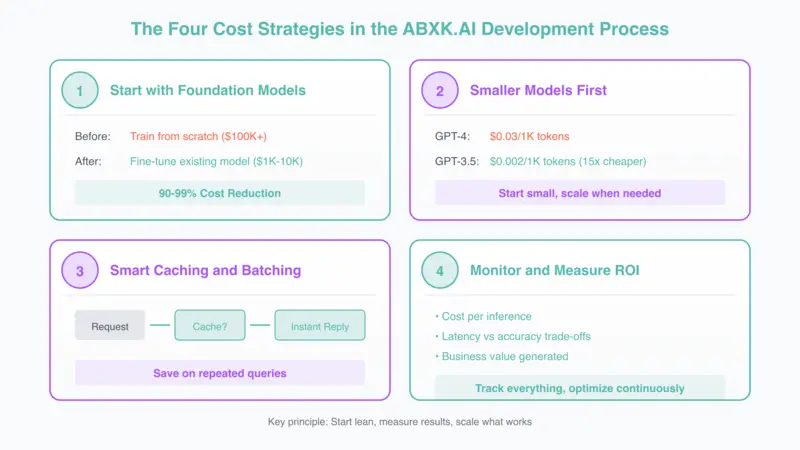
Over-Engineering Before Validation
A recurring structural pattern: organizations deploy complex architectures before proving necessity.
Architecture Premature Scaling
Multi-model ensembles without validated performance gains. Custom training pipelines without demonstrated ROI.
Complexity Costs
Higher maintenance overhead, increased operational fragility, longer debugging cycles, expanded security surface.
When architecture precedes validated need, cost compounds silently.
Model Selection Mispricing
Training custom models from scratch is often framed as strategic investment. In many applied environments, it represents unnecessary capital expenditure.
Foundation models, fine-tuning strategies, or simpler statistical approaches frequently achieve comparable results at a fraction of total cost.
The miscalculation is not technical. It is structural: organizations equate sophistication with value.
The Feedback Loop Problem
The most expensive AI systems are not those with high infrastructure bills. They are those with extended feedback cycles.
Slow iteration produces:
- Delayed failure detection
- Prolonged resource commitment
- Escalating sunk cost bias
- Increased organizational lock-in
Speed reduces infrastructure waste.
Judgment reduces structural waste.
Both are required.
The Hidden Cost of Governance Absence
Financial exposure expands when:
- Ownership of AI budgets is diffuse
- Stop criteria are undefined
- ROI measurement is inconsistent
- Production deployment occurs without cost forecasting
- Data pipeline inefficiencies remain unmeasured
Cloud bills are auditable. Decision drift is not.
Yet decision drift often drives larger long-term expenditure than compute scaling.
The Sunk Cost Trap
As AI initiatives mature, teams often escalate commitment to underperforming systems due to:
- Prior investment
- Internal visibility
- Executive sponsorship
- Perceived strategic necessity
This converts experimentation into obligation. The inability to terminate projects is frequently the largest hidden cost in applied AI.
Operational Implications
If managing AI initiatives in production environments:
- Define evaluation metrics before allocating scale budgets
- Separate experimental funding from production funding
- Implement staged investment gates with clear thresholds
- Conduct periodic ROI audits independent of project sponsors
- Establish formal termination authority before initial investment
Financial discipline in AI systems begins with governance architecture.
AI system costs are rarely miscalculated at the infrastructure layer. They are miscalculated at the decision layer.
Compute expenditure is visible. Structural drift is not.
In applied AI environments, cost control is not a tooling problem. It is a governance problem.
Related: Speed vs Judgment in Experimental AI Systems · Why Most AI Data Protection Strategies Fail