
How To Protect Personal Data Using AI Tools
Using AI tools has become essential for modern workflows, but these powerful systems create new risks for personal data exposure. Every time you interact with ChatGPT, upload documents to an AI assistant, or use automated analysis tools, you could be sharing sensitive information that might be stored, processed, or even leaked. Understanding how to protect personal data while using AI requires both technical knowledge and careful practices.
At ABXK.AI, we share our experiences with AI usage and explain practical ways to stay safe. Our AI Security projects focus on helping you understand and detect AI-generated content. In this article, we explore how to protect your personal data when working with AI tools.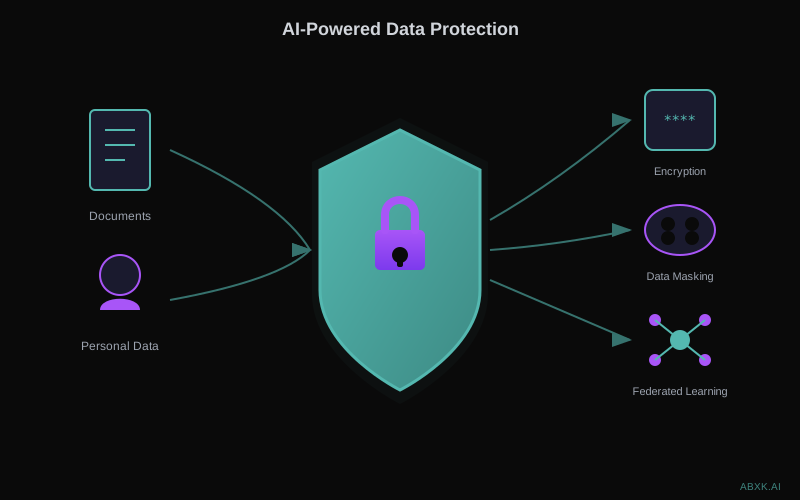
Understanding The Privacy Risks
What Happens To Your Data
When you use commercial AI services, your inputs typically get sent to remote servers. These servers may use your data to train models, improve systems, or store it in databases. Many AI companies state in their terms that user conversations may be reviewed by human trainers or used to improve future models. This creates several risks: your confidential business information could accidentally train models that competitors can access, personal health details might get added to public datasets, or sensitive code could appear in AI suggestions for other users.
The situation becomes more complex with large language models that can memorize specific training examples. If personal data enters the training process, these models might reproduce that exact information when others ask questions. Recent research shows that AI systems can leak personally identifiable information through various attack methods. These include membership inference attacks that determine whether specific data was used in training.
Creating Ethical AI Usage Guidelines
Building Clear Policies
Organizations need formal guidelines that define acceptable AI tool usage before employees start experimenting. These policies should clearly group data types: public information that’s safe to share, internal data requiring approval, and confidential data that must never enter external AI systems. The guidelines should address specific questions - can employees paste customer emails into ChatGPT for summarization? Is it acceptable to upload financial spreadsheets to AI analysis tools? Which document types need data cleaning before AI processing?
Good policies balance innovation with protection by creating different access levels. Entry-level employees might only access AI tools for public data, while data protection officers could approve specific uses involving cleaned internal data. This approach prevents both too much restriction that stops productivity and too much freedom that creates breaches.
Training And Awareness
Technical protections fail without user understanding. Regular training sessions should show real breach examples - demonstrating how a single uploaded document containing customer addresses could spread through AI systems. Employees need to recognize what counts as personal data: not just obvious identifiers like social security numbers, but also IP addresses, device fingerprints, location data, and even writing patterns that could identify individuals.
Never Use Confidential Data Directly
Identifying Sensitive Information
Personal data includes any information relating to identified or identifiable individuals. This covers names, email addresses, phone numbers, identification numbers, biometric data, health records, financial information, and even indirect identifiers like job titles combined with company names. Genetic data, religious beliefs, sexual orientation, and political opinions receive special protection under most regulations. You should never put this data into AI systems without clear consent and security measures.
The challenge lies in recognizing hidden personal data. A seemingly innocent customer service transcript might contain order numbers that link to personally identifiable information. Log files may include IP addresses and timestamps that uniquely identify users. Even combined datasets can sometimes be de-anonymized through advanced analysis techniques.
Setting Up Access Controls
Limit which employees can access AI tools that process any data beyond purely public information. Use role-based access control where data scientists working with customer information have different AI tool permissions than marketing teams. Set up authentication systems that log who uses which AI services, when, and with what data types. This audit trail becomes critical for following regulations like GDPR that require organizations to show proper data handling.
Data Masking And Pseudonymization
What These Techniques Do
Data masking replaces sensitive information with realistic but fictional substitutes. Instead of “John Smith from Acme Corp bought product X,” the masked version shows “Customer_ID_1847 from Company_ID_293 bought product X.” Pseudonymization goes further by using consistent replacement values - the same person always gets the same fake name, keeping relationships in the data while removing direct identifiers.
These techniques let you use AI analysis on data structure and patterns without exposing actual individuals. You can train sentiment analysis models on customer feedback, detect fraud patterns in transaction data, or optimize logistics using delivery information - all while protecting privacy.
How To Implement
Modern data masking tools use various techniques depending on data type. For names, they might use format-preserving encryption that keeps the name structure (first name, last name) while completely changing the values. For numeric identifiers like credit card numbers, they keep the first and last digits (which indicate card type and pass validation) while randomizing middle digits.
Character-level masking replaces specific patterns using regular expressions. You can automatically detect and replace email addresses, phone numbers, or ID numbers before data enters AI systems. More advanced approaches use AI itself - named entity recognition models identify personal data in text, then replacement algorithms substitute appropriate alternatives. For example, “Dr. Sarah Johnson treated patient Michael Lee for diabetes” becomes “Dr. [NAME_1] treated patient [NAME_2] for [CONDITION_1].”
Pseudonymization requires maintaining secure mapping tables that link real identities to fake names. These tables must be stored separately from the pseudonymized data, encrypted, and accessible only to authorized personnel. If someone compromises the pseudonymized dataset alone, they cannot reverse the fake names without also accessing the mapping table.
Advanced Privacy-Preserving Technologies
Differential Privacy
Differential privacy provides mathematical guarantees that individual data points cannot be identified in analysis results. The technique works by adding carefully measured random noise to query results or model outputs. When you ask “how many customers are aged 30-40?”, the system might return 1,247 instead of the true value 1,250 - this noise makes it mathematically impossible to determine whether any specific individual’s data was included.
The technology operates through a privacy budget parameter called epsilon. Lower epsilon values provide stronger privacy but reduce accuracy. A typical setup might use epsilon values between 0.1 and 10, balancing protection against usefulness. The key insight is that even if attackers have perfect knowledge of all database records except one, they still cannot determine whether that final record was included in the analysis.
For AI model training, differential privacy gets applied during gradient computation. Instead of using exact gradients calculated from training data, the system clips gradient values to limit sensitivity, then adds Gaussian or Laplacian noise based on the privacy budget. This ensures the trained model doesn’t memorize individual training examples. Companies like Apple and Google have deployed this technique at scale to collect user analytics while protecting privacy.
Federated Learning
Federated learning trains AI models without centralizing data. Instead of uploading your data to cloud servers, the AI model comes to your device or local server. It trains locally on your data, then sends only the model updates (the learned parameters) back to a central coordinator. This coordinator combines updates from many participants to create an improved global model, which gets sent back for the next training round.
This architecture solves fundamental privacy problems. Your raw data never leaves your control. A hospital can participate in training a medical diagnosis AI without sharing patient records. A bank can contribute to fraud detection models without revealing transaction details. Multiple organizations with sensitive data can work together on AI development while keeping confidentiality.
The process uses the FedAvg algorithm as its foundation. Each participant downloads the current global model, trains it locally for several rounds, then uploads the parameter changes. The central server receives these changes from all participants and computes a weighted average based on how much data each contributed. This averaged update improves the global model, completing one federation round. Advanced setups run 50-200 rounds to achieve good results.
Federated learning combines powerfully with differential privacy. Before uploading model updates, each participant adds measured noise to their changes. This protects against attacks where dishonest coordinators try to reverse-engineer training data from model updates. The combination provides both architectural privacy (data never centralized) and cryptographic privacy (updates themselves reveal minimal information).
Homomorphic Encryption
Homomorphic encryption allows computations on encrypted data without decryption. You encrypt your sensitive dataset, send it to an AI service, which processes the encrypted data and returns encrypted results - all without ever seeing the actual information. When you decrypt the results locally, they’re identical to what would’ve been produced on unencrypted data.
The technology works through special mathematical properties. Traditional encryption schemes scramble data so thoroughly that any computation produces garbage. Homomorphic schemes carefully structure the encryption so mathematical operations on ciphertext correspond to operations on plaintext. For example, multiplying two encrypted numbers produces an encrypted result that decrypts to the product of the original numbers.
Two types exist: partially homomorphic encryption supports limited operations (addition or multiplication, but not both), while fully homomorphic encryption handles any computations. Modern AI applications primarily use fully homomorphic encryption despite its significant computational overhead - operations on encrypted data run 1000-10000 times slower than on plaintext. This makes it practical for small-scale sensitive operations like encrypted medical diagnosis or confidential financial analysis, but challenging for training large neural networks.
Synthetic Data Generation
Synthetic data generation creates artificial datasets that keep statistical properties of real data without containing actual personal information. AI models learn the patterns, distributions, and relationships in authentic data, then generate completely new records that look realistic but represent no real individuals.
The process typically uses generative adversarial networks or variational autoencoders. These models train on real data to understand its structure - how age correlates with income, how purchase patterns cluster, what text patterns appear in customer feedback. After training, the generator produces new synthetic samples by sampling from learned distributions. A synthetic customer database might contain 100,000 records that show the same demographic distributions, purchasing behaviors, and seasonal patterns as real customers, but where every single record is invented.
This approach works excellently for development and testing environments. Developers can build AI applications using synthetic data that mirrors production characteristics without touching actual customer information. It also enables safe data sharing - researchers can receive synthetic datasets for analysis without privacy concerns. The limitation is that synthetic data may miss rare edge cases present in real data and can accidentally include biases from the original dataset.
Common Critical Mistakes
Exposing API Keys And Credentials
One of the most frequent and dangerous mistakes involves accidentally uploading API keys, passwords, or access tokens to public repositories. Developers commonly hard-code credentials directly in source files during testing, then push that code to GitHub or GitLab without realizing the secrets are included. Automated scanners constantly search public repositories for exposed credentials - compromised keys often get exploited within minutes of exposure.
The solution requires multiple defensive layers. First, never hard-code credentials in source files - always use environment variables or dedicated secret management systems. Create a .gitignore file that excludes configuration files containing secrets before your first commit. Use pre-commit hooks that scan for credential patterns and block pushes containing them. Set up secret scanning tools like GitGuardian or GitHub’s built-in secret scanning that alert you to accidental exposures.
When exposure happens, assume compromise immediately. Rotate all exposed credentials within minutes, not hours. Review access logs to determine if unauthorized usage occurred. Many breaches result from developers discovering exposed keys days later and assuming no one noticed - by then, attackers have already stolen data.
Insufficient Output Validation
AI tools sometimes include training data fragments or sensitive information in their outputs. A code completion tool might suggest actual customer email addresses it saw during training. A document summarization service might keep confidential details in its summaries. Failing to check AI outputs before using them creates data leakage risks.
Set up automated scanning of AI-generated content before it reaches production. Use regular expressions to detect personal data patterns like email addresses, phone numbers, or ID formats. Apply the same data loss prevention tools you use for human-created content to AI outputs. Consider using “human-in-the-loop” review for sensitive cases where all AI-generated content requires approval.
Trusting Default Privacy Settings
Most AI services default to data collection and retention that maximizes their training capabilities, not your privacy. Settings often allow conversation storage, human review of interactions, and adding your data into model improvements. Organizations frequently deploy AI tools without reviewing privacy configurations, assuming reasonable defaults.
Systematically check privacy settings before deployment. Disable data retention where possible, opt out of training data usage, and configure the strictest available privacy options. For critical applications, negotiate custom data processing agreements that legally bind the AI provider to specific privacy commitments. Document your configuration decisions for compliance audits.
Balancing Transparency With Confidentiality
Explainable AI Setup
Privacy protection and AI transparency can conflict. Explaining model decisions sometimes requires revealing training data patterns that could expose personal information. A loan approval AI that explains “denied because you live in zip code X and people there default at rate Y” leaks demographic patterns.
Use privacy-aware explainability techniques. Instead of showing exact training examples, use counterfactual explanations - “if your income were $5,000 higher, approval probability would increase to 85%.” Combine explanations across multiple predictions rather than explaining individual decisions. Use attention mechanisms that highlight relevant input features without revealing sensitive patterns from training data.
Documentation Requirements
Regulations like GDPR require documenting how you process personal data with AI systems. You need data processing impact assessments describing risks, mitigation measures, and necessity justifications. This transparency requirement conflicts with confidentiality when documentation itself reveals sensitive business logic or security measures.
Create tiered documentation. Public-facing privacy notices explain what data you collect and general processing purposes. Internal technical documentation details specific AI architectures and security controls, with access restricted to authorized personnel. Regulatory submissions provide necessary detail while requesting confidential treatment for sensitive information. This approach satisfies transparency obligations without compromising operational security.
Best Practices Summary
Protecting personal data while using AI requires layered defenses combining technical controls, operational procedures, and continuous watchfulness. Start with the principle of data minimization - only collect and process what’s absolutely necessary. Build privacy-by-design where protection measures are built into systems from the beginning rather than added afterward. Use advanced technologies like differential privacy and federated learning for sensitive applications. Train your team to recognize risks and follow protocols. Regularly audit both your own practices and your AI vendors’ privacy commitments.
The goal isn’t eliminating all risk - that would mean abandoning beneficial AI tools entirely - but rather managing risk to acceptable levels through thoughtful setup.
At ABXK.AI, we continue to explore AI security topics and share practical guidance. Check out our AI Text Detector and other tools to learn more about our work in AI detection and security. Visit our blog for more articles on protecting yourself while using AI tools.