
How Our AI Text Detector Works: A Simple Explanation
Have you ever wondered if a piece of text was written by a human or by AI? Our free AI Text Detector can help you find out. But how does it actually work? In this article, we’ll explain the science behind AI detection in simple terms.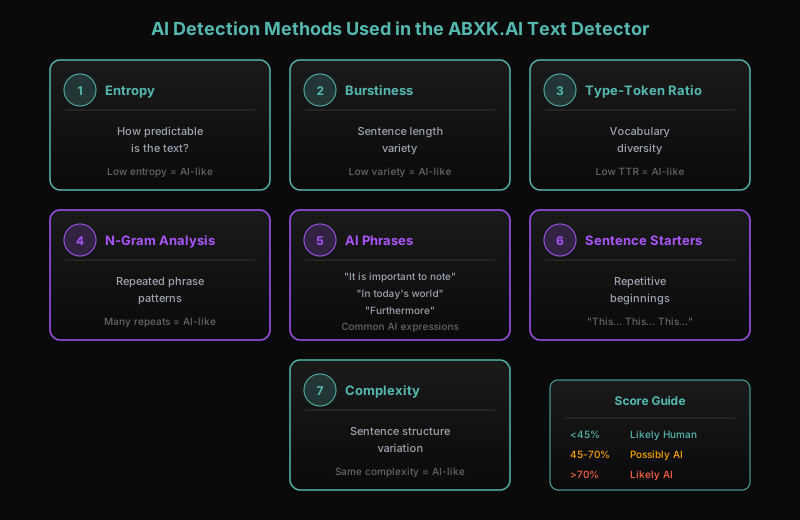
The Basic Idea
AI writing tools like ChatGPT are very good at creating text that looks human. But they have patterns that give them away. Our detector looks for these patterns using several different methods.
Think of it like recognizing someone’s handwriting. Even if two people write the same words, you can often tell them apart by how they write. AI has its own “writing style” that we can detect.
Method 1: Entropy (Measuring Surprise)
Entropy is a way to measure how surprising or predictable text is. Imagine reading a story. Sometimes the next word is easy to guess, and sometimes it surprises you.
How it works:
- We count how often each letter and word appears in the text
- We calculate how predictable the patterns are
- Lower entropy means the text is more predictable
Why AI scores lower: AI text tends to be very smooth and predictable. It uses common words and phrases. Human writers are more creative and surprising. They use unusual words and unexpected combinations.
Our detector calculates two types of entropy:
- Character entropy - How predictable are the letters?
- Word entropy - How predictable are the words?
If the entropy is too low, the text might be AI-generated.
Method 2: Burstiness (Sentence Variety)
Burstiness measures how much sentence lengths vary. Look at these two examples:
Low burstiness (AI-like):
The weather is nice today. I went for a walk outside. The park was very beautiful. Many people were enjoying themselves.
All sentences have similar lengths. This is typical of AI.
High burstiness (Human-like):
Beautiful day! I decided to walk to the park near my house because the sun was shining and I needed fresh air. Lots of people there. Kids playing, dogs running around, couples sitting on benches enjoying ice cream together.
Human writers mix short and long sentences. They use different structures. This creates natural rhythm.
How we measure it:
- We count the words in each sentence
- We calculate how much the lengths vary
- Low variation suggests AI writing
Method 3: Type-Token Ratio (Vocabulary Richness)
The Type-Token Ratio (TTR) measures vocabulary diversity. It compares unique words to total words.
Example:
“The cat sat on the mat. The cat was happy.”
- Total words: 11
- Unique words: 7 (the, cat, sat, on, mat, was, happy)
- TTR = 7 ÷ 11 = 0.64
Why this matters:
- AI often repeats the same words
- Humans use more synonyms and variety
- Low TTR can indicate AI writing
We also look at “hapax legomena” - words that appear only once. Human writing usually has more of these unique words.
Method 4: N-Gram Analysis (Phrase Patterns)
N-grams are groups of words that appear together. We look for repeated phrases.
Bigrams (2 words): “in the”, “of the”, “it is” Trigrams (3 words): “in order to”, “as a result”, “it is important”
AI tools often use the same phrases over and over. Our detector counts how many times phrases repeat. If there are too many repetitions, the text might be AI-generated.
Method 5: AI-Typical Phrases
Some phrases are very common in AI writing but rare in human writing. Our detector has a list of these phrases:
- “It is important to note”
- “In today’s world”
- “Plays a crucial role”
- “Furthermore” and “Moreover”
- “In conclusion”
- “It is essential”
- “Delve into”
When we find these phrases, it increases the AI probability score. Finding several of them together is a strong signal.
Method 6: Sentence Starters
AI often starts sentences in similar ways. Look at this example:
This technology is amazing. This makes work easier. This helps many people. This will change everything.
Human writers use more variety:
Technology keeps surprising us. Working from home became possible. Millions of people benefit every day. The future looks different now.
Our detector checks how often sentences start with the same words. Too much repetition suggests AI.
Method 7: Complexity Analysis
We also measure sentence complexity by counting clauses. A clause is a part of a sentence with a subject and verb.
Simple sentence (1 clause):
The dog barked.
Complex sentence (3 clauses):
The dog barked loudly, which scared the cat, so it ran away.
AI tends to write sentences with similar complexity levels. Humans naturally vary between simple and complex sentences.
How We Calculate the Final Score
After running all these tests, we combine the results:
- Each method gives a partial score
- We add up all the partial scores
- We normalize the result to 0-100%
- Higher scores mean higher AI probability
Score interpretation:
- Below 45% - Likely human-written
- 45% to 70% - Possibly AI-generated
- Above 70% - Likely AI-generated
What the Detector Can’t Do
It’s important to understand the limits of AI detection:
False positives can happen:
- Non-native English speakers sometimes write in ways that seem AI-like
- Technical or academic writing can score high
- Very polished, edited text may trigger false alarms
AI can be hard to detect when:
- Humans edit the AI output
- The text is very short
- The AI was prompted to write in an unusual style
Our advice: Use the results as a guide, not as proof. If you need to be certain, consider other methods too.
Try It Yourself
Want to test some text? Visit our free AI Text Detector. It works on any device, including iPhone and iPad. No sign-up needed.
Paste your text, click “Analyze Text,” and see the results instantly. You’ll get:
- An overall AI probability score
- A breakdown of each analysis factor
- Statistics about the text
Summary
Our AI Text Detector uses seven main methods:
| Method | What It Measures |
|---|---|
| Entropy | How predictable the text is |
| Burstiness | Variety in sentence lengths |
| Type-Token Ratio | Vocabulary diversity |
| N-Gram Analysis | Repeated phrases |
| AI Phrases | Common AI expressions |
| Sentence Starters | Repetitive beginnings |
| Complexity | Variation in sentence structure |
Together, these methods give a reliable estimate of whether text was written by AI or a human.
The technology keeps improving as AI writing tools become more advanced. We regularly update our detection algorithms to stay accurate.
Have questions about AI detection? Feel free to try our free tool and see how it works with your own text. Interested in how we build AI systems? Read about reducing AI development costs or our VibeCoding approach.