
AI Trading Platform: Observing Model Behavior During Strategy Optimization
Initial Observations
In our last post, we built an evaluation framework for measuring system behavior. With that in place, we could observe how the model performed under test conditions.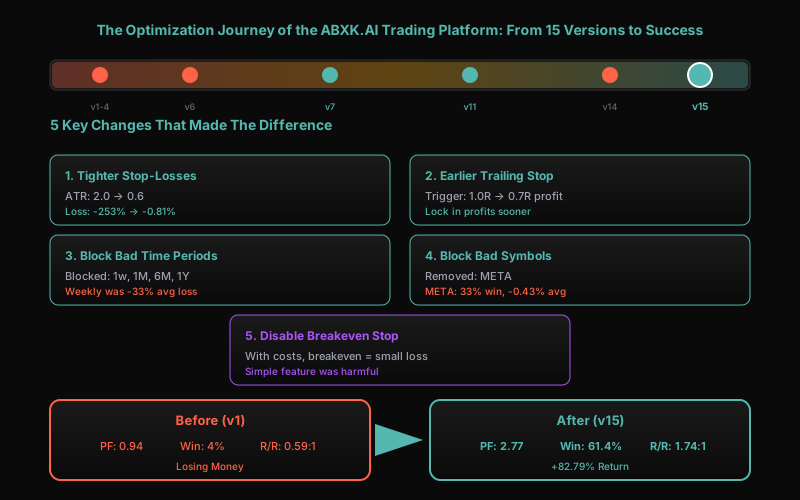
Initial metrics showed:
| Metric | Value | Note |
|---|---|---|
| Profit Factor | 0.94 | Below 1.0 |
| Win Rate | 4% | Low frequency |
| Average Loss | -253% | High magnitude |
| Risk/Reward | 0.59:1 | Unfavorable ratio |
A Profit Factor below 1.0 indicates negative expected value under the current configuration.
Research Objectives
We defined observation targets for iterative testing:
- Profit Factor > 1.0 — Positive expected value
- Win Rate stability — Consistent outcome distribution
- Loss magnitude reduction — Smaller drawdowns per trade
- Risk/Reward ratio — Favorable return distribution
Iteration Log: 15 Versions
The following table documents observed behavior changes across iterations:
| Version | Parameter Change | Trades | Profit Factor | Observation |
|---|---|---|---|---|
| v1-v4 | Strict filters | 0 | - | No signal generation |
| v5 | Relaxed filters | 332 | - | All breakeven exits |
| v6 | 1.0 ATR stops | 200+ | 0.69 | Increased loss frequency |
| v7 | Breakeven disabled | 150+ | 1.03 | First positive PF |
| v11 | 0.75 ATR stops | 180+ | 1.09 | Marginal improvement |
| v13 | Strict filters | 2 | - | Insufficient sample |
| v14 | Earlier trailing | 160+ | 0.94 | Regression observed |
| v15 | 0.6 ATR stops | 171 | 2.77 | Significant shift |
Non-monotonic behavior was observed. Parameter changes did not consistently improve metrics.
Observed Constraints
Observation 1: Stop-Loss Distance
The initial stop-loss was set at 2.0 ATR (Average True Range). This allowed significant adverse movement before exit. Average loss per stopped trade was -253%.
This represented the largest contributor to negative expected value.
Observation 2: Time Period Sensitivity
Performance varied significantly by time period:
| Time Period | Average Loss | Note |
|---|---|---|
| 1 week | -33% | High loss magnitude |
| 6 months | -99% | Severe underperformance |
| 1 year | -78% | Significant loss |
| 1 month | -45% | Elevated loss |
Certain time horizons showed consistent negative outcomes. This pattern was not anticipated.
Observation 3: Symbol-Specific Behavior
Certain symbols showed divergent behavior:
| Symbol | Win Rate | Average Return |
|---|---|---|
| META | 33% | -0.43% |
Model performance was not uniform across all instruments.
Observation 4: Breakeven Stop Behavior
A feature moved the stop loss to breakeven after small gains. In theory this reduces risk. In practice, trading costs (fees, spread, slippage) meant breakeven exits produced net negative returns.
This feature contributed to loss accumulation rather than risk reduction.
Parameter Adjustments
The following changes were tested:
Adjustment 1: Stop-Loss Distance
ATR multiplier reduced from 2.0 to 0.6:
| Condition | Previous | Tested |
|---|---|---|
| Normal | 2.0 | 0.6 |
| High volatility | 2.0 | 0.85 |
| Low volatility | 2.0 | 0.5 |
Observed effect: Average stopped loss changed from -253% to -0.81%. This represented the largest shift in loss magnitude.
Adjustment 2: Trailing Stop Timing
Trailing stop activation was adjusted:
| Setting | Previous | Tested |
|---|---|---|
| Trigger at profit | 1.0R | 0.7R |
| Trail distance | 0.5R | 0.4R |
This configuration triggered profit protection earlier in the trade lifecycle.
Adjustment 3: Time Period Exclusion
Time periods with observed negative performance were excluded:
Excluded: 1 week, 1 month, 2 months, 3 months, 6 months, 1 year
The system no longer generated signals for these time horizons.
Adjustment 4: Symbol Exclusion
Symbols with divergent behavior were excluded:
Excluded: META
Adjustment 5: Breakeven Stop Disabled
The breakeven stop feature was disabled. Its contribution to loss accumulation outweighed its intended risk reduction.
Observed Metric Changes
The following table shows metric distribution before and after parameter adjustments:
| Metric | Initial | After Adjustments | Change |
|---|---|---|---|
| Profit Factor | 0.94 | 2.77 | +194% |
| Win Rate | 4% | 61.4% | Significant shift |
| Total Return | Negative | +82.79% | Direction change |
| Average Loss | -253% | -0.71% | 99.7% reduction |
| Risk/Reward | 0.59:1 | 1.74:1 | +195% |
These observations reflect one configuration state. Generalizability has not been established.
Sample Distribution
The test sample included 171 trades:
| Exit Type | Trades | Percentage | Average |
|---|---|---|---|
| Trailing stop | 114 | 66.7% | +1.13% |
| Stop-loss | 57 | 33.3% | -0.81% |
| Category | Count | Average |
|---|---|---|
| Positive | 105 | +1.23% |
| Negative | 66 | -0.71% |
Research Notes
Observations from this iteration cycle:
1. Stop-loss distance affects loss magnitude
Wider stops allowed larger adverse movements before exit. Tighter stops reduced average loss per trade.
2. Time period sensitivity exists
Certain time horizons showed consistent negative outcomes. Segmenting analysis by time period revealed patterns not visible in aggregate data.
3. Earlier trailing affects return capture
Delayed trailing allowed gains to reverse. Earlier activation reduced this effect.
4. Feature interaction with costs
The breakeven stop appeared beneficial in isolation. When trading costs were included, it contributed to losses. Features should be tested with realistic cost models.
5. Non-monotonic optimization
15 iterations were required to observe significant metric shifts. Intermediate versions showed regression. Sequential iteration was necessary.
Configuration Snapshot
The following configuration reflects one observed state of the system during testing. It is not presented as an optimal or transferable setup.
| Parameter | Value |
|---|---|
| ATR Multiplier (normal) | 0.6 |
| ATR Multiplier (high volatility) | 0.85 |
| ATR Multiplier (low volatility) | 0.5 |
| Trailing trigger | 0.7R profit |
| Trail distance | 0.4R |
| Breakeven stop | Disabled |
| Min confidence | 50 |
| Excluded time periods | 1w, 1M, 2M, 3M, 6M, 1Y |
| Excluded symbols | META |
Next Research Phases
The initial observation target (Profit Factor > 1.0) was met in this configuration.
Further stages will focus on:
- Out-of-sample testing — Observing behavior on unseen data
- Live data observation — Monitoring system responses to real-time data streams
- Stability analysis — Measuring metric variance over extended periods
No conclusions about deployability are drawn from these observations.
The largest observed effect came from a single parameter change: reducing the ATR multiplier from 2.0 to 0.6 shifted average loss from -253% to -0.81%. This suggests stop-loss distance may be a high-leverage variable in similar configurations.
Learn more about the platform: AI Trading Platform
Previous: Building a Bulletproof Evaluation Framework
This document records observations from iterative testing. Results are specific to the tested configuration and data set.
AI Trading Platform Blog
 AI Trading Platform Blog
Read our development journey and latest updates:
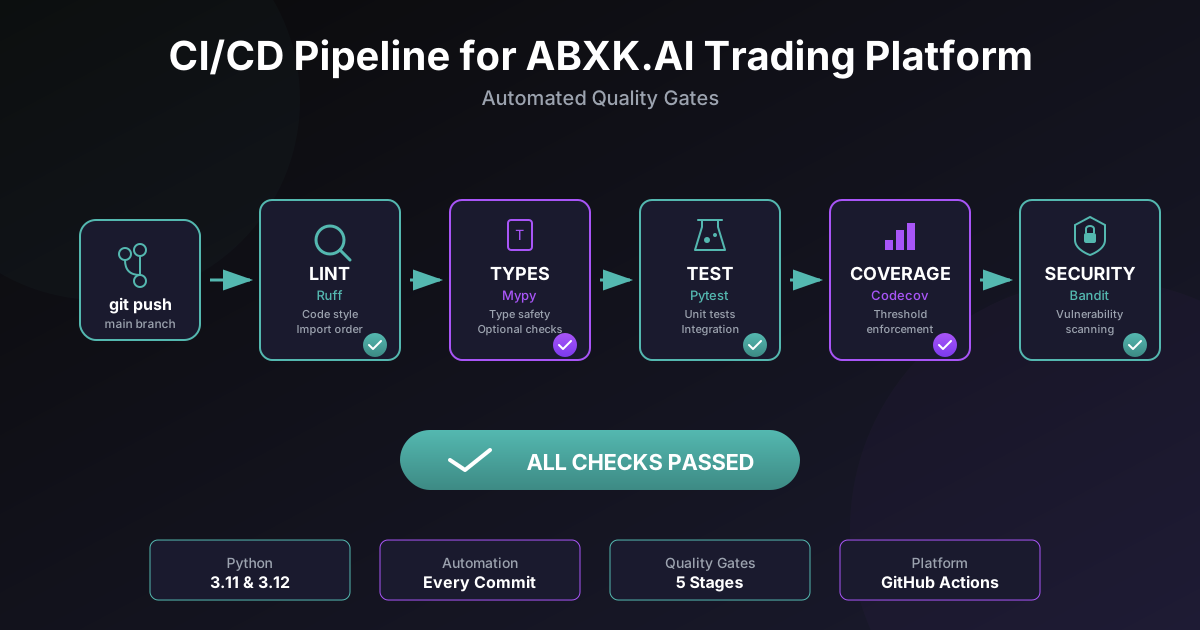
AI Trading Platform: Adding CI/CD to Our Development Workflow
We implemented a CI/CD pipeline for the AI Trading Platform. This post documents the approach, the types of bugs it catches, and why automated testing matters …

AI Adoption in Trading: Why Acting Now Matters
AI adoption in trading is accelerating. Learn why firms that act now gain an advantage, and how our AI trading platform validates this approach through real …
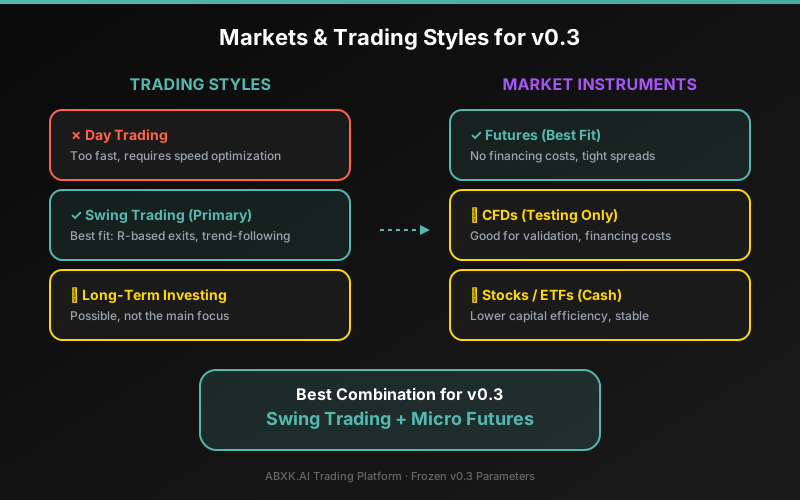
AI Trading Platform: Choosing the Right Markets and Trading Style
We tested our frozen v0.3 exit strategy across different markets and trading styles. Here is what we learned about CFDs, futures, stocks, and why swing trading …

AI Trading Platform: Exit Strategy Breakthrough & Paper Trading System
Our AI trading platform improved expectancy from near-zero to statistically meaningful levels through a two-stage exit strategy. We also built a causal paper …
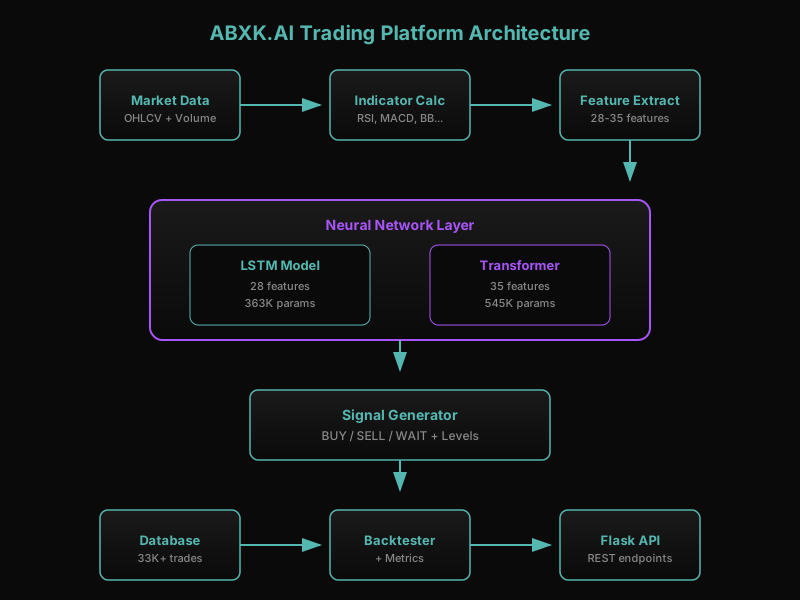
AI Trading Platform: Security Audit & Major System Updates
A comprehensive audit of our AI trading platform reveals a critical security fix, frontend accessibility improvements, and live stats from 33,000+ analyzed …
AI Trading Platform Update: Building a Bulletproof Evaluation Framework
Two days of intensive work on preventing overfitting and data leakage. Here's what we built and what we learned.
Building an AI Trading Platform: Our Progress So Far
We are building an AI trading system that learns from its mistakes. Here is what we have done, what works, and what problems we still need to solve.
The AI Trading Platform is an internal research project operated exclusively by ABXK.AI. It is not publicly accessible and cannot be used by visitors.
Any results, insights, or examples shared on this website or on social media are provided for informational and educational purposes only and do not constitute financial advice.